
TWIN
Digital twins are virtual replicas of physical objects or processes that are synchronized with the real thing and kept up-to-date to reflect reality. In the TWIN project we investigated the state and integration of digital twins for the construction and building industry. It is commonly assumed that digital twins have huge potential within the building lifecycle, notably contributing towards the "European Green Deal" objectives, since the building sector has a huge impact there.
Similar to the automotive industry or other huge production industries, the building sector has an enormous inherent complexity by incorporating many stakeholders, like suppliers, builders, maintainers, facility management, technicians, operators, and users over very long timeframes spanning several decades and even hundreds of years for some historical buildings. There are already many standards and models for specific phases, tasks and use-cases during construction, operation, maintenance, and usage. However, they are often disconnected, not updated, or not used holistically amongst different parties throughout a buildings’ lifecycle. Hence, the application of digital twins in construction and real estate remains limited in practice. However, within research and demo projects, they showed promising results in the areas of energy management, site logistics optimization, model-based services, reduction of errors and simplification of collaboration amongst stakeholders. Still, practical challenges to their application include technology hurdles, stringent regulatory requirements and liability, trust and data protection issues within the construction and real estate sector. Also, the resource-intensive nature of initially creating and maintaining digital twins over time is a hindrance to their application.
The TWIN project serves as a precursor to a comprehensive lighthouse project, aiming to showcase the value of digital building twins. This intends to catalyze the application of digital twins in future building endeavors. This subsequent lighthouse project will address the holistic applications of digital twins throughout the building's lifespan, considering ecological impacts, stakeholder economic interests, and industry-specific regulatory challenges in Austria.
Goals
The main goal of the TWIN project is to prepare a roadmap for a comprehensive lighthouse project and research programme, aiming to demonstrate and apply digital building twins in real-world settings. It should stimulate the application of digital twins in future building ventures to help fulfill long-term sustainability goals. We strived for a holistic approach, spanning a building's entire life cycle, while accounting for ecological impacts, stakeholder economic interests, and industry-specific regulatory challenges in Austria. Another integral part of TWIN's agenda was to pinpoint current technological gaps, and consequently extract the R&D needs for the following project. This includes proprietary software and standards as well as open standards and technologies. For the general recommendations, however, the focus in the project was on using open standards like IFC wherever possible, to avoid vendor-specific dependencies on single companies. The standards, methods and technologies should be future-proof and freely available to maximize the availability, impact and usability thereof.
Approach
To achieve the goal of retrieving a realistic landscape of the state-ofthe-art in building industry and to give recommendations how to tackle them, we did several rounds of reconciliation and interviews with industry stakeholders. Initially, we performed a thorough assessment of potential digital twin applications, emphasizing their strengths and opportunities. This analysis already involved close collaboration with industry from different areas in the building domain, e.g., construction, manufacturing, operation, asset management, and digital facility management. Afterwards we combined, clustered, and selected five use-case-chains for deeper exploration in the subsequent interviews. Based on these interviews we did a gap and SWOT analysis which gave us insight on the problems, needs, fears as well as the potential benefits, gains and wishes from building industry regarding the wholistic application of digital twins and to give recommendations for a roadmap in the subsequent lighthouse project.
Expected and Achieved Results
The most important outcomes of the project are twofold:
1. A general roadmap as guidance for further development in future research projects and governmental direction.
2. Recommendations about specific aspects, technologies and required legal enhancements.
Furthermore, intermediate deliverables were created during the project, e.g., a collection of use-cases, stakeholder analysis, requirements analysis, dependencies, and a skill-and-responsibility-matrix amongst stakeholders in different phases of buildings, a gap- and SWOT-analysis, interview documentations and reports on state-of-the-art and technologies. The broad stakeholder interest in TWIN was evident by collecting 14 Letters of Interests from industry companies.
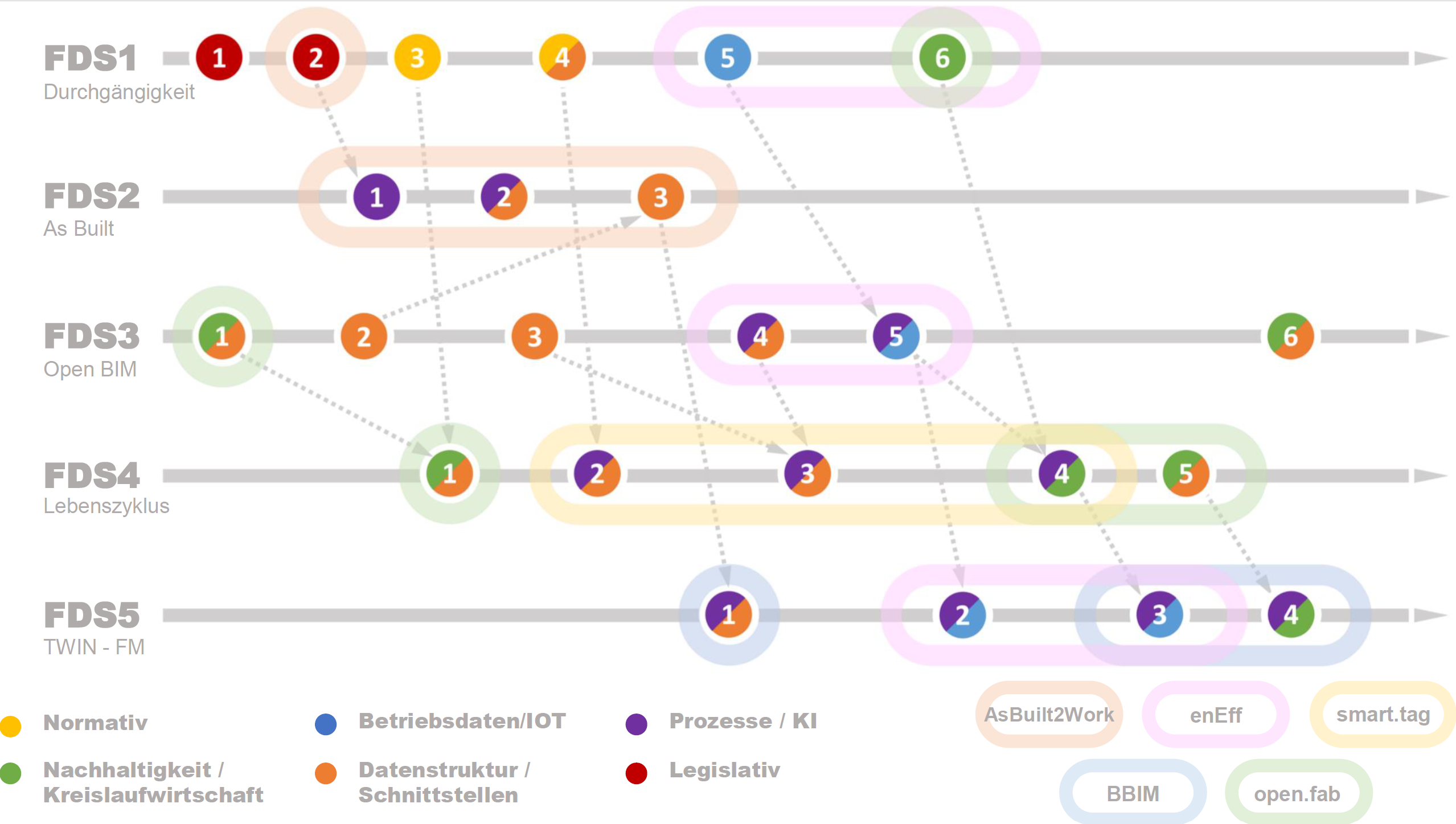
TWIN's outcomes, such as identified use cases, their ecological and economic evaluations, and spotted R&D gaps, were consolidated into a roadmap, laying the foundation for the lighthouse project. Here is the list of identified use-case-chains together with a short description of their purpose:
- enEff: Using digital twin to optimize energy-efficiency in heating, ventilation and air-conditioning for buildings.
- asBuilt2Work: Keeping digital twins, models and plans up-to-date to the current state of the building (“as it was built”).
- smart.tag: Identifying and tracing parts of buildings (maybe also including their usage history) and reuse them deconstruction or replacement.
- Open.Fab: Streamline the fabrication of building parts (batch construction, templates, modularization) and foster fabrication on-site.
- BBIM: Enable data continuity, reuse, and synchronization of digital twin models amongst all building phases and stakeholders.
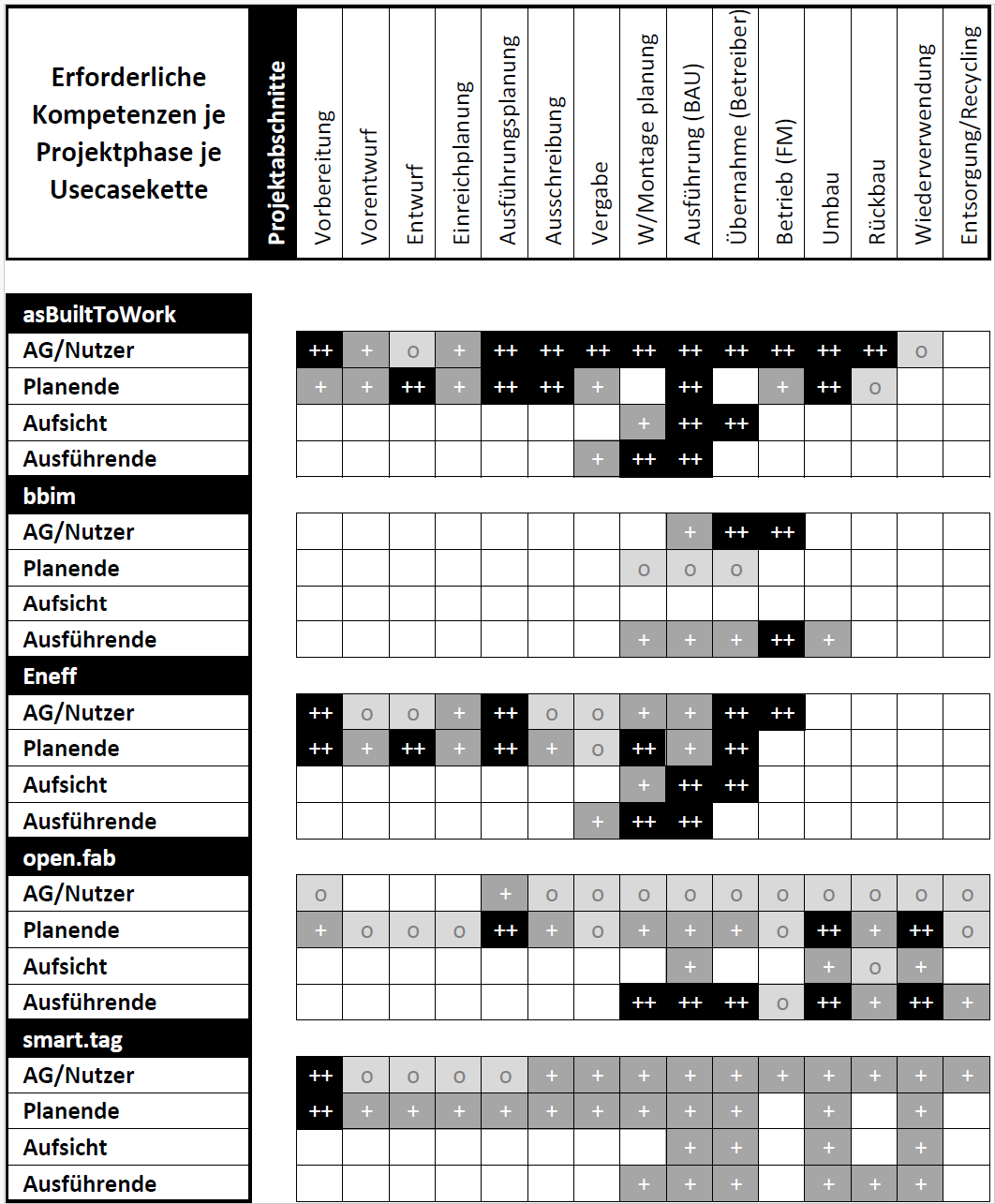
Figure 1 shows a simplified responsibility matrix that was created throughout the project. The table depicts which stakeholder-group (consisting of users, planers, supervisors, and builders) are involved in which building phase, and how high their required skills and competencies should be.