
AI2Human
The technological revolution is rapidly transforming the work environment, subjecting workers to new challenges, such as collaborating with highly efficient and partially autonomous machines. Currently, computer-assisted techniques and AI systems (human-centered artificial intelligence) are utilized in production research and machine development to enhance productivity and flexibility. However, occupational safety is often overlooked or given low priority in these advancements. This project aims to leverage the emerging generation of AI-based production systems to promote occupational safety and accident prevention. The project will focus on investigating the following areas: (i) hazard assessment and robustness analysis for safety-relevant AI systems, (ii) building trust and enabling transparent communication with safety- relevant AI systems, (iii) preemptive testing of safety-relevant AI systems, (iv) feedback and intervention measures, with a focus on Safety 2 approaches, and (v) analysis and implementation recommendations for EU regulations related to AI and machine safety, and safe AI in the workplace with or without machines.
The achievement of the project's objectives will be demonstrated through (i) sensor and algorithm-based hazard assessment, (ii) visualization of intrinsic (human-caused) and extrinsic (environmental) hazards, (iii) the development of an intervention and feedback system, and a (iv) final report on affiliated industrial projects, including an assessment of state-of-the-art practices, an evaluation of occupational safety and accident prevention, and a critical examination of how the elements of the EU AI Directive were implemented in to ensure safe AI. In summary, this project seeks to harness the potential of AI-based production systems to prioritize and enhance occupational safety and accident prevention. By addressing key aspects like hazard assessment, transparency, preemptive testing, and feedback systems, the project aims to contribute to the realization of a safer work environment and promote compliance with relevant EU regulations related to AI and machine safety. Through the integration of human-centered artificial intelligence, this endeavor holds the potential to create a transformative impact on workplace safety and worker well-being in the face of evolving technological advancements
Goals
The project aims to implement the following goals:
(i) developing a comprehensive survey of the current research landscape concerning aspects of AI systems, such as robustness, transparency, trust, risk assessment, and evaluation. The focus is on understanding the methods and tools used in previous studies and analyzing existing norms while proposing new ones to enhance safety in AI systems,
(ii) develop a risk assessment of AI systems in affiliated industrial projects, beginning with identifying potential hazards and their locations, followed by the evaluation of risks and the implementation of measures to mitigate them. The importance of trust and transparency should be emphasized, focusing on identifying monitoring interfaces and communication methods to build user trust,
(iii) implementation of a demonstration case within a controlled factory environment. The demonstrator should showcase successful implementations of robustness, transparency, trust, risk assessment, and evaluation principles in AI systems.
Approach
The project addresses its goals using a threefold approach. By joining and participating in meetings of (inter)national standardization committees, an understanding of issues and planned solutions for worker safety and AI systems is being created and decisions influenced. By cooperating with affiliated companies outside the project consortium, real world issues regarding AI systems and worker safety are identified and investigated. This process will involve performing risk analyses of potential application use cases for AI systems in the industrial domain. Finally, a prototype of a safe integration of an AI system into a production process will be developed and demonstrated within a safe industrial environment. To this end, a guideline of necessary steps for this integration process will be developed and published.
Expected and Achieved Results
The project identified national- and EU norms regarding AI systems and worker safety and determined the state-of-the-art in developing and using sensor technology and algorithms for hazard assessment. It focused on pinpointing weaknesses in existing norms and practices and proposing enhancements and test processes for safety-relevant AI systems. This effort resulted in a final report including use case descriptions, risk assessments, and recommendations for measures, while ensuring compliance with AI regulations. Ultimately, this project provided a resource for safely applying AI in production environments to be used by industries and related stakeholders. This resource took the form of a report on the safe integration of AI system into production processes.
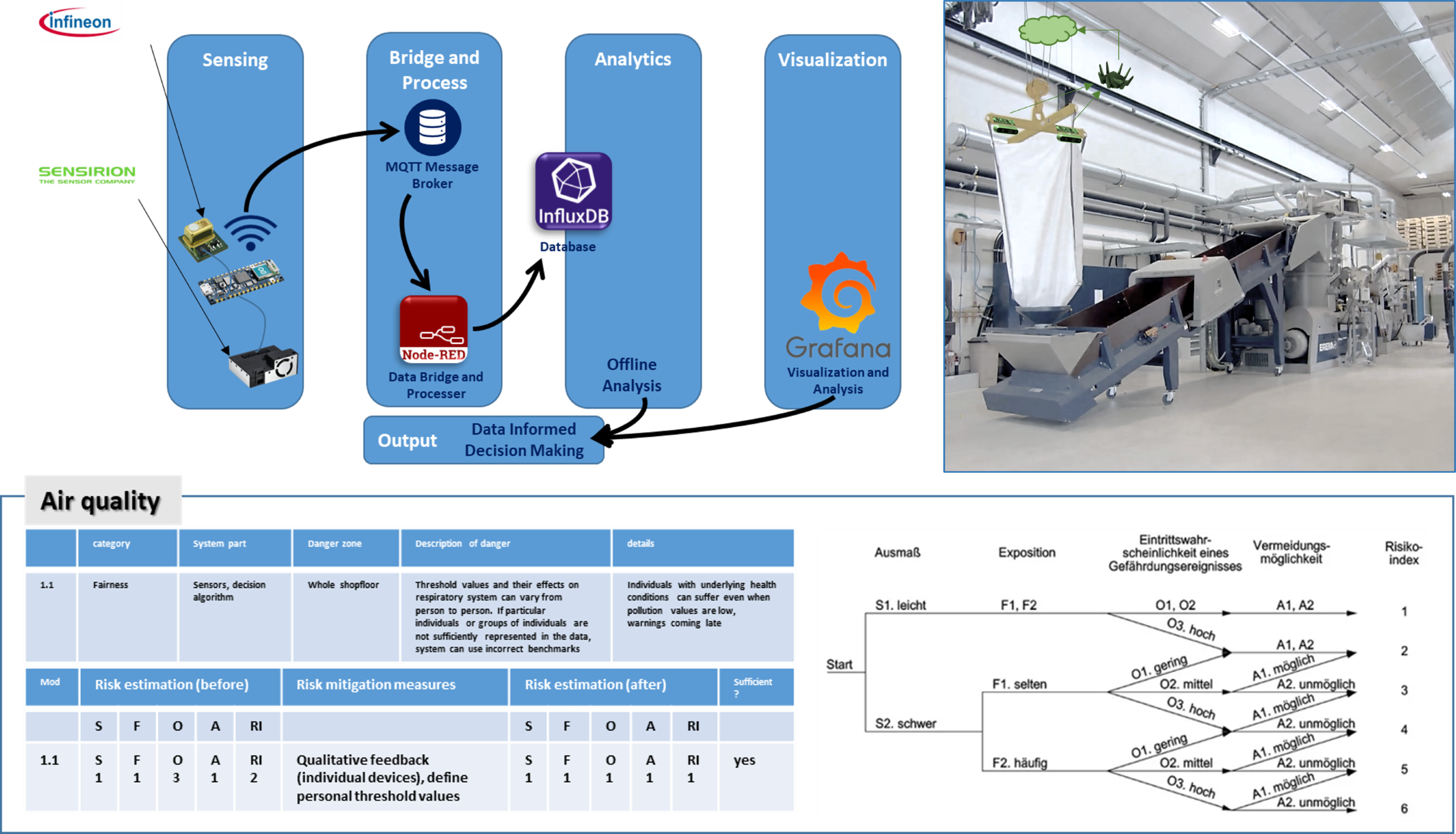
Further, the project yielded risk assessments of three affiliated industrial projects, that were used as input for the prototype development of demonstrative worker safety system within industrial environments. The system monitors safety relevant parameters within the environment, while fulfilling predetermined requirements for safety-critical applications. A risk assessment of an affiliated industrial project was developed and served as basis for the development of a prototype system that aims to demonstrate how safety-aware AI applications could be designed, deployed and function. The prototype was deployed for demonstration- and data collection purposes. The system consists of a selection of appropriate sensors and feedback mechanisms to enhance safety measures.