
VIVARIUM
Monitoring multivariate sensor data in automated welding can be critical for ensuring product quality. However, gaining actionable insights from data remains a major challenge due to the high volume, dimensionality, and variability of welding process sensor signals, such as current, voltage, and wire feeding speed. Purely automated approaches, i.e., for anomaly detection, often fall short, either because they lack interpretability or they generate excessive false positives, since there is no ground truth available. Therefore, visual analytics systems are needed to integrate unsupervised algorithms with interactive visualization, enabling domain experts to detect, interpret, and label interesting occurrences in a guided, iterative manner. In collaboration with our industry partner Fronius International GmbH, we develop a tool that allows domain expert users to explore and validate interesting occurrences, based on their domain knowledge, within their process data.
Challenges must be addressed to make our approach effective in an industrial setting: First, the system must handle large-scale, high-frequency time-series data while preserving temporal and multivariate patterns that indicate relevant anomalies. Second, anomalies in welding time series data are often ambiguous, requiring the incorporation of human domain knowledge into the analysis for insights to become actionable. Third, unsupervised approaches can produce results that are not immediately meaningful to end-users, so the system must support interpretability through linked views to offer contextual information. Finally, the system must be intuitive and compatible with industrial workflows, ensuring it can be adopted without extensive training. This project presents a scalable and human-centered approach that enhances visual anomaly detection for automated welding manufacturing processes.
Goals
This project aims to develop a streamlined, efficient visual analytics system for anomaly detection in multivariate data acquired by welding processes. Instead of relying on open-ended exploration, the system is designed to guide users directly to areas of interest, highlighting clusters and segments in the data where anomalies or other interesting patterns occur. This focused guidance ensures that experts spend their time evaluating only the most relevant patterns, significantly improving efficiency and decision quality. The system combines unsupervised approaches with intelligent guidance mechanisms. The project aims to deliver a highly targeted, human-in-the-loop tool that enhances anomaly detection through guided interaction and integration of machine learning via clustering and anomaly detection.
Approach
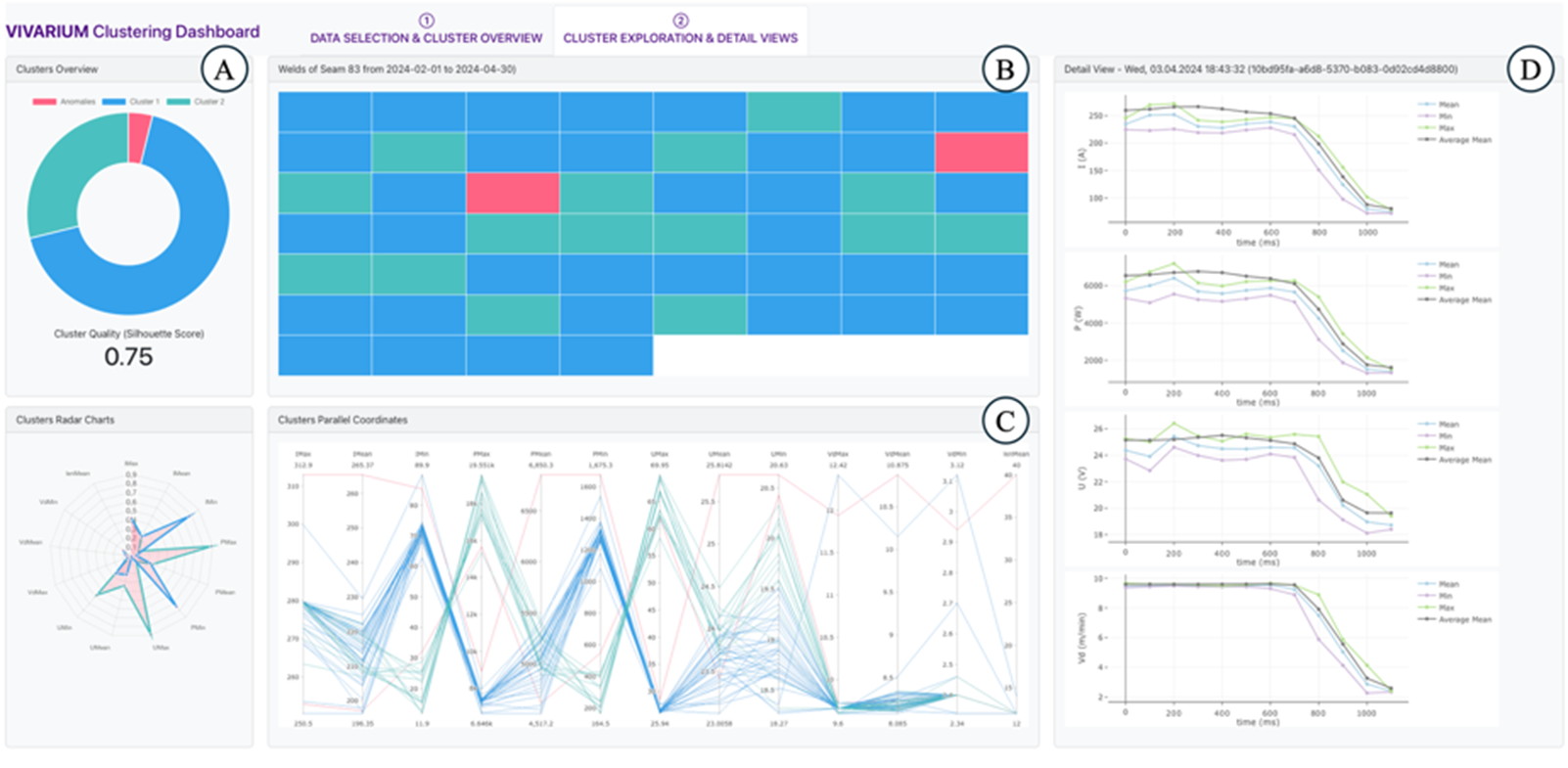
Our approach builds on a cluster-based method for anomaly detection and focuses on a streamlined guided approach rather than open exploration. Instead of exploring freely, users are directed to the most relevant insights through a ranked list of interesting occurrences. Data is visualized via linked views to analyze data on different levels of detail, such as pie charts, radar charts, parallel coordinates, and heat maps. On the deepest level, domain experts can visualize the raw data time series in line plots since this is the most relevant one for derived decisions from data-driven insights. Regarding automated data analysis, we integrate different clustering algorithms such as a distancebased approach (k-Means), a density-based approach (DBSCAN), and a hierarchical-based approach utilizing a Euclidean distance function.
Expected and Achieved Results
We implemented a fully functional prototype that demonstrates the core capabilities of our guided system. The main goal was to deliver a solution that can integrate with the existing infrastructure of our company partner, ensuring a low barrier to adoption and long-term usability in real industrial settings. By aligning closely with real-world workflows and technical environments, we aimed to create a technically effective and practical tool for immediate application.
A key part of the project is an evaluation with domain experts, where we validated the system’s usability, efficiency, and relevance in day-today analysis tasks. This evaluation demonstrated the effectiveness of our approach and helped identify future research directions, such as interactive labeling and a higher degree of guidance. The system can significantly reduce the effort required by experts to analyze complex welding process data, while at the same time lowering the technical barrier to making use of this data. Ultimately, our approach aims to empower experts with intelligent, focused analytics, enhancing productivity and process understanding.