CEPS
The automotive industry is developing complex, interdisciplinary systems, containing a multitude of software and hardware components that have to work together as a unified product. In order to achieve this, multiple teams with different specialty backgrounds need to develop each of these components separately, while also collaborating tightly to assure the flawless and safe integration of these pieces into a whole. To ensure this collaboration and the thoroughness and safety of the development, each team must follow a process, which specifies the steps to be performed.
However, in the context of engineering processes and interdisciplinary products, the process contains innumerable use cases and decision points. All these use cases have to be captured by the process model, which is then to be followed by the engineers. As a result, the level of complexity of this process model can easily become overwhelming, leading to process deviations, or frustration for the engineers.
To address this complexity, we are proposing an approach and tool support that supports the specification of such complex process models. Also, we are assisting the engineers in following this process, through customized guidance and suggestions that help simplify the task of following the correct use case of the process. Additionally, we are developing the basis for a new type of process constraints, called temporal process constraints. These are rules applied on a process step, which capture and check that the order of the operations performed on the system is correct. These rules allow the process modelers to more accurately describe the process to be followed and the relationships between the operations, while also improving the guidance given to the engineers.
At the current state of the project, we have developed some prototypical implementations of the approach suggested and the temporal constraints, as well as a tool connector linking the approach to the production environment. We have also conducted a user study and a series of interviews to capture the main open challenges and feedback for our approach. In the next steps, we are improving the prototypes, as well as planning additional user studies and tool integrations.
Goals
As previously stated, the main goal of this project is to support the engineering process through tool integration and guidance. In this regard, the approach targets the two most important components of the engineering process.
On the one hand, we are aiming at supporting the modelling of engineering processes through tool integration and constraint specification. In this regard, we are researching the modelling and use of temporally-aware constraints, which react to each engineer’s progress through the process at runtime. As such, our goal is to enable process modelers in defining complex and collaborative processes.
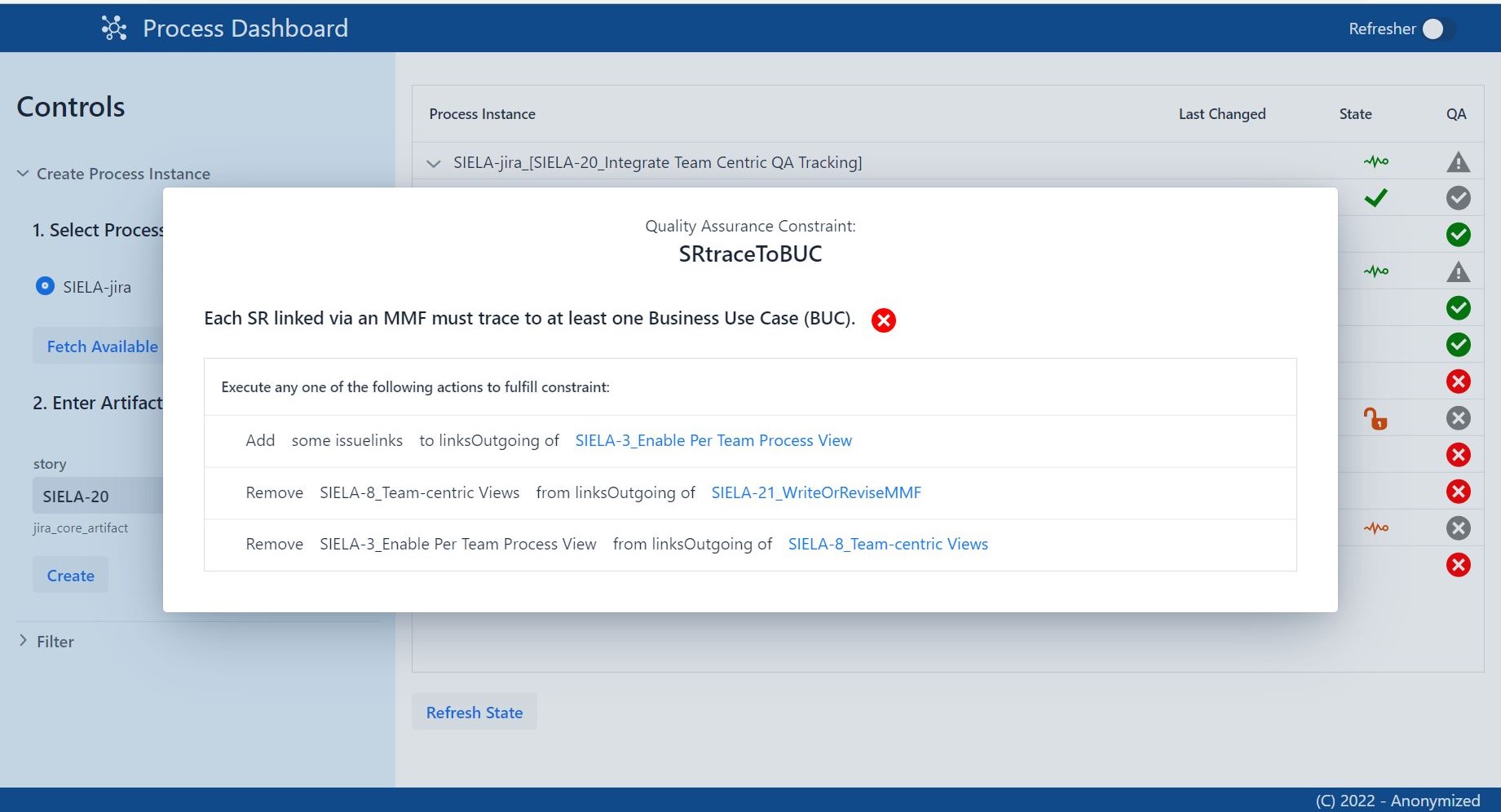
On the other hand, our approach also targets the engineers working through these complex processes. With the ever-increasing number of use cases and corner situations, the tool support and approach designed assist the engineers in navigating the process and finding which tasks are pending at each step. Additionally, in contrast with other existing approaches, we are allowing process deviations where they occur, and assist the engineers with repair suggestions to get back on track.
Therefore, the aim of our constraints is to balance the need for ordered tasks, resulted from safety constraints and standards, with the flexibility and creativity that is intrinsic to engineering processes.
Approach
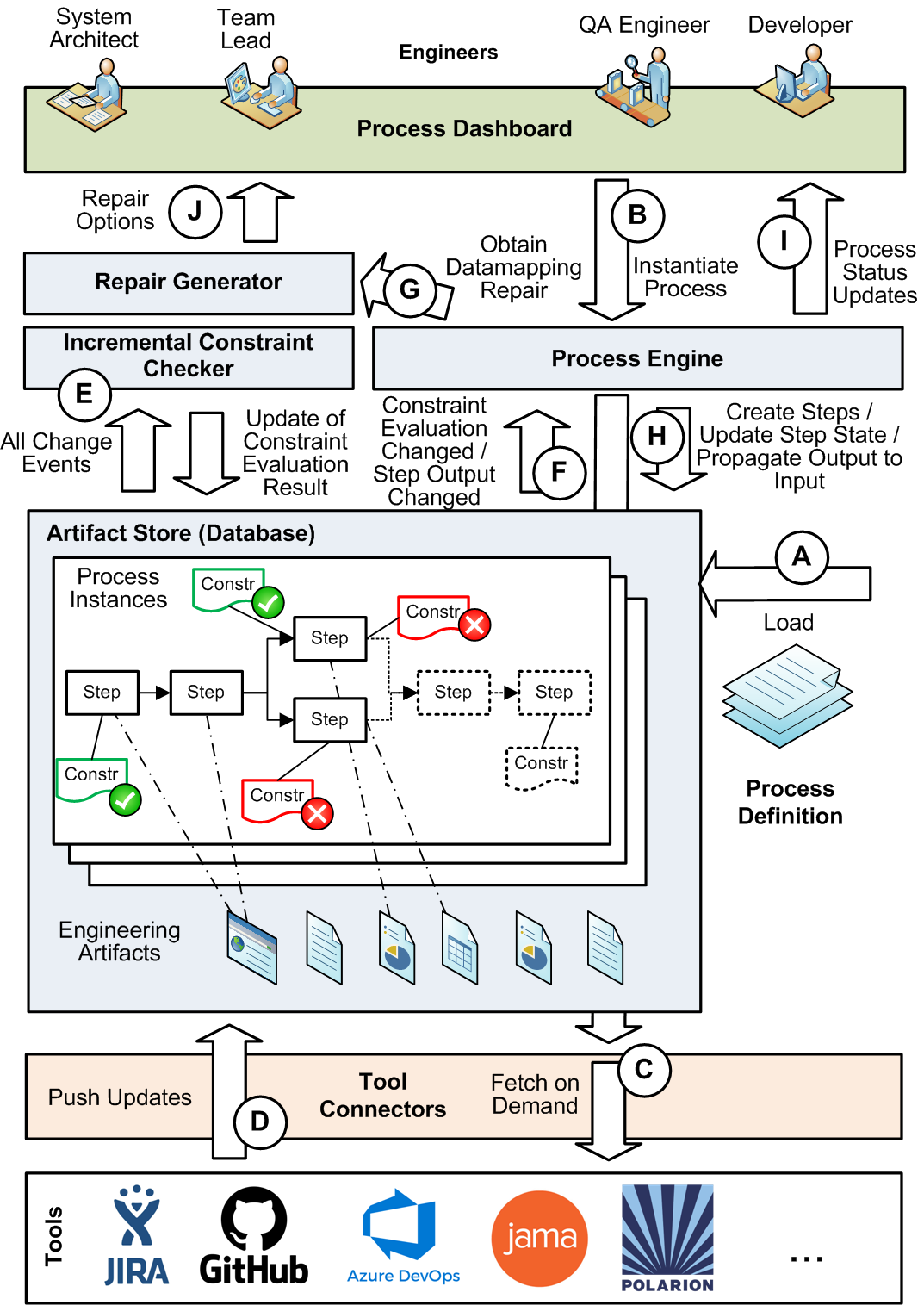
In order to achieve this goal, we are developing a process engine which can observe at runtime the artifacts created and manipulated through the process. Firstly, tool support solutions will enable the process engine to view these artifacts and the changes that occur. Then, the constraint checker integrated into the process engine evaluates whether the artifacts and their links fulfill the specified process constraints for the current process step. Finally, based on this evaluation, the process engine determines the required repairs, when a process deviation is detected, or the next step to be performed in the process. The result of this determination is then transmitted back to the engineers in the form of guidance.
Expected and Achieved Results
With the aim of the project being the support of engineers and process modelers in working with and through the processes and their constraints, our first concern is the integration of tool support into their current working environment. Thus, they will not have to change the toolset they already have experience using. Instead, our approach will enhance their use of these tools with in-tool guidance and suggestions. Also, the process modeling task was extended to capture the traceability links between related artifacts in different components, and a more accurate and fine-grained view of the status of development for each such artifact and component.
Additionally, we are aiming to provide a proof-of-concept that will cover the approach proposed, as well as a proof-of-concept solution to the problem of integration. Through these, we can evaluate our chosen approach in user studies and experiments, and iteratively improve the process modelling, as well as the guidance and repair suggestions visible to the engineers.
Finally, in terms of temporal constraints, we are developing a novel solution that addresses the unique features of such constraints in the context of engineering processes. Namely, these constraints need to support a balance of fulfilling the required standards, as well as allowing and supporting the engineers in case of process deviations. Additionally, in order to provide adequate and relevant guidance, we are investigating how violations of these constraints can be repaired.