

CoExCo
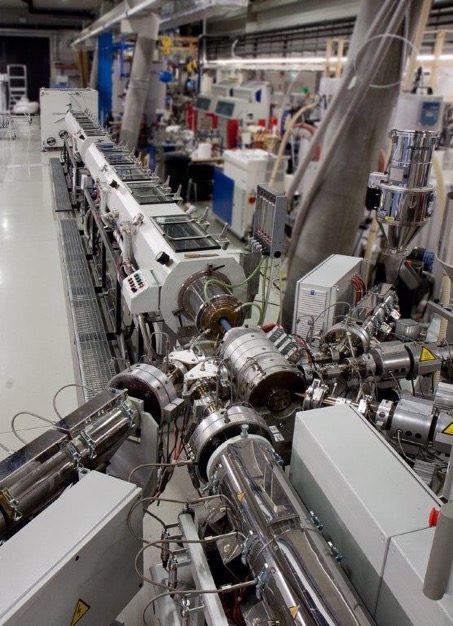
Polymer processing plants show a nonlinear relation between extruders and downstream equipment, so this MFP will investigate and develop novel strategies for self-optimization in the field of film and sheet processing, pipe coextrusion, corrugated pipe processing, gravimetric dosing, as well as coextrusion blow molding. Up to now concepts of self-optimization for polymer processing lines are unknown in applicable complexity but the production systems would need almost real-time reactions based on process data. Therefore productivity and quality remains highly dependent on the operator in production runs as well as in ramp up after material change.
Goals
As processes for polymer production show a high variety the goals of this MFP do either. The thermal management of extruders will be investigated, as extruder mostly have several but uncoupled heating zones. New control algorithms will be developed showing improved temperature management in heating as well as in operating change. Gravimetric dosing will also be investigated, as dosing units change to volumetric mode when shaked. Volumetric mode will become independent from screw characteristic lines by applying data based modeling and improvements to gravimetric mode sensitivity will be investigated. Online layer thickness measurement techniques will be developed to be applicable to corrugated pipe processing and the separation point inside the corrugator will be investigated for improvements of the cooling process. Furthermore, many simulations are intended to create a mathematical model that describes the process in a new way. As many polymeric products are processed by coextrusion, this process will be investigated by developing a novel coextrusion demonstrator to study the occurrence for layer rearrangements and flow instabilities in more detail under clear conditions. By means of data modeling and big data analysis new models for process design will be developed.
Approach
By combining approaches and data of physical/mathematical modeling (first principle), numerical calculation (e.g. network theory), CFD-simulations, experimental and production data, model-based control engineering, smart data mining etc. control concepts will be developed especially designed for polymer processing. Additionally, new sensor concepts will be applied or developed when needed for online process or quality control.
Expected and Achieved Results
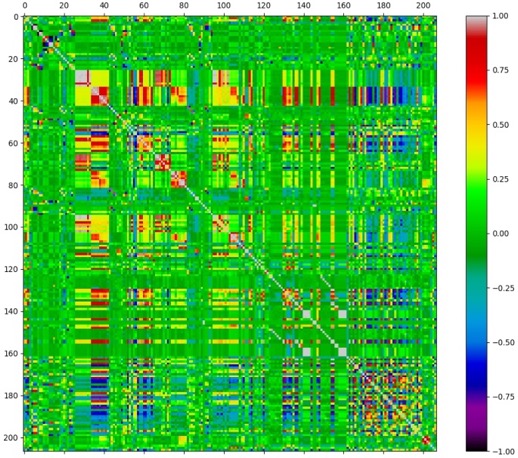
In modeling of corotating twin-screw extrusion a parametric study based on a dimensional analysis was performed, leading to novel parameters for the dimensionless conveying parameters of kneading blocks (like A1;see below). Consecuting research work will perfom a) an regression analysis leading to analytic expressions to enable fast and accurate screw design calculations and b) an experimental validation.
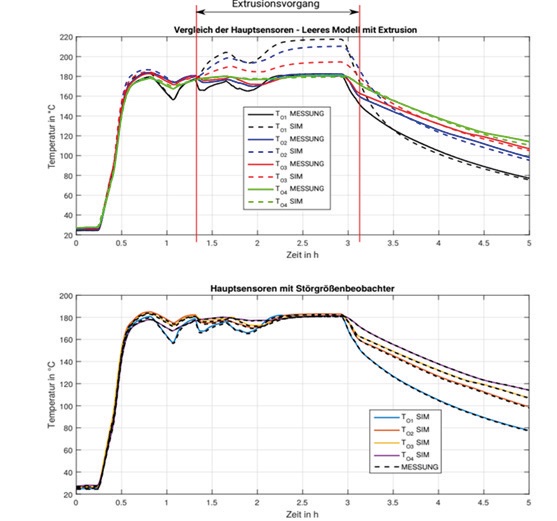
Additionally, to estimate the temperature distributions within the extruder and the heat flow between melt and barrel a model predictive control for start up, as well as set point and material change was developed. Experimental validation was performed showing good accordance when applying disturbance observer based on precise process model (see below).