

CSG
Due to the ongoing integration of distributed energy resources such as domestic photovoltaics into the existing distribution grid, conventional – mostly passive – monitoring and control schemes of power systems are no longer applicable. This has led to increased research into smart grid technologies, in particular how novel control schemes can be applied on a distribution-system level with the aim of implementing new services to mitigate the problems associated with distributed energy resources. Dependable communication plays a central role in smart grid operation.
The advent of the Internet of Things (IoT) paradigm has precipitated an ever-growing number of wireless communication technologies and protocols which could be utilized in the context of smart grid operation, among many other industrial IoT applications. The available protocols differ in their operation characteristics, including communication range, bandwidth, supported nodes, and network topologies. When designing a new smart grid control or monitoring scheme, the question arises which communication protocol is best-suited for the task. In addition, protocols must exhibit different levels of dependability in order to satisfy the given use-case requirements.
This MFP investigates potential wireless communication protocols for smart grid operation, and the results can be abstracted to their application in the context of industrial IoT applications in general. Dependable communication is a cornerstone for future cognitive products, as it allows them to gain information from the outside world beyond their own sensors, and to act in a distributed fashion. As cognitive services are often highly information dependent, using the right means of communication is crucial for their success The MFP thus aims to systematically investigate potential wireless protocols and their properties (such as bandwidth or dependability attributes) in order to derive a detailed analysis of available protocols. The analysis will be mapped into a knowledge base (ontology), which will be used to establish a recommender system to allow the specification of dedicated smart grid communication use-cases and support decisions about underlying communication protocols. This will be done by outlining the potential technical and economical performance of the available protocols in the context of the particular use case. In addition to building a recommender system, the project will research strategies which allow the online adaptation of protocols in case of any changes in their operation environment or requirements, as well as fail-over functionality to further improve dependability of smart grid operation.

Goals
Within this project, detailed characteristics of candidate wireless communication protocols for smart grid operation will be established based on typical smart grid monitoring and control application requirements. Once established, these characteristics will be used to (i) develop an ontology-based recommender system which allows a user to specify a dedicated smart-grid communication use-case, and to receive recommendations for suitable protocols for the implementation of that use-case. These recommendations are based on technical and economical feasibility. Additionally, the ontology will be used to (ii) enable a use-case dependent parameterization of the target protocol (i.e., recommending not only the protocol but also a suitable parameterization). The protocol characteristics will also be used for (iii) adaptation and reparametrization of protocol parameters during runtime as well as fail-over mechanisms (such as switching between communication protocols in case of a communication fault) in order to further strengthen and leverage the dependability of the protocols to the level required within a specific smart-grid operation use-case.
Approach
First, a detailed screening of smart-grid communication use-cases is performed. Based on this screening, required key performance indicators (KPIs) are established which allow the assessment of wireless protocols regarding their application in a smart-grid communication scenario. Second, an in-depth analysis of existing wireless protocols is performed. The protocols are investigated regarding their technical specification, their potential parameterization, parameter influence on protocol performance, protocol requirements and limitations, as well as available mechanisms to increase dependability. This information is used to establish an ontology of wireless protocols, which is used to implement a recommender system. Finally, the information is used to perform online adaptation of protocols.
Expected and Achieved Results
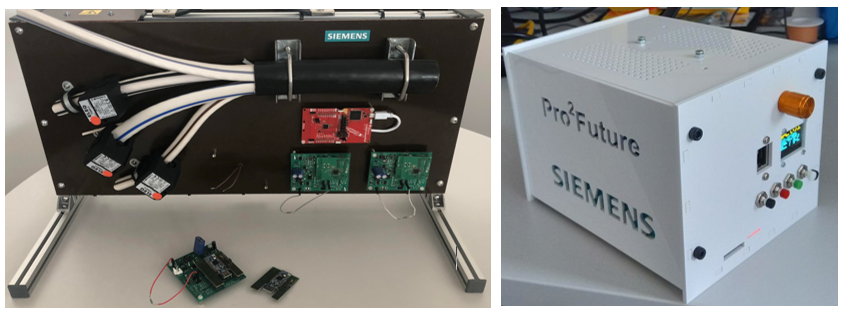
In the first phase of the project, smart grid monitoring and control use-cases were investigated to establish communication requirements. Use cases where wireless communication is used to control system-critical infrastructures impose very strict requirements on communication in terms of underlying availability, maintainability, reliability, and security. In the context of this analysis the need for retrofitting brown-field electric substations was identified, leading to the development of a Bluetooth low energy (BLE) based mechanism, which allows time-synchronized collection of data within secondary substations and an on-site configuration of sensors by authorized maintenance personnel.
In a second step, an in-depth analysis of available wireless communication protocols was performed. The technical parameters of various relevant protocols, both short and long range, were established. The focus of this analysis was the protocols’ dependability as well as external factors which impact their performance. The analysis was used to establish an ontology which represents the detailed protocol information. Ongoing research investigates how the ontology can be integrated into a semantic framework to implement a recommender system. The aim of this system is to allow a user to establish suitable protocols or protocol combinations for a defined communication use-case. Finally, the project focuses on establishing mechanisms which allow automatic parameterization of protocols for their application in the target use-case. In addition, the project aims to develop online methods to adapt a communication protocol in response to environmental changes to enable fail-over mechanisms for maintenance of connectivity and communication requirements.
As they will be generalizable beyond smart grid applications, the project results are a first step towards establishing dependable wireless communication for cognitive products and their production processes.