

DERELE
Machine learning-based detection of geometric shapes has emerged as a rapidly expanding research field, with significant attention currently directed towards external, outside geometries. This project investigated methods to achieve this for large-scale interior geometries while leveraging RGB-based data - a novel and intriguing challenge. At the heart of this project lies the development of a prototype machine learning algorithm, specifically designed for the recognition of longitudinal edges and cross-sections. The primary objective was to provide valuable support to surveyors involved in the complex task of geometry creation for 3D tunnel models. By automating the detection of longitudinal edges and cross-sections, this machine learning approach aimed to streamline and expedite the process, ultimately enhancing the efficiency and accuracy of 3D tunnel model processing and analysis.
This project extended the boundaries of the existing state-of-the-art methodologies in the domain of transforming 3D models into comprehensive 3D tunnel geometries. By building upon the foundations laid by prior research, this project advanced handling of large interior geometries within the context of tunnel models. The inclusion of RGB-based data further added a novel dimension, as it opened new possibilities for richer and more detailed geometric analyses and texturing. Throughout the project, rigorous experimentation and prototyping was conducted to refine the machine learning model continuously. The focus was on optimizing the accuracy and reliability of the longitudinal edge and cross-section recognition. Additionally, the research team collaborated closely with surveying experts, gathering valuable feedback to ensure the practical applicability and effectiveness of the developed algorithm.
This project represented a step forward in the field of machine learning-based geometric shape detection. By expanding its applications to encompass large-scale interior geometries and incorporating RGB-based data, it opened doors to novel opportunities in the realm of 3D tunnel model processing and analysis. The successful implementation of this prototype provided a valuable tool to surveyors when creating indoor geometry and the project contributed to advancements in the transformation of 3D models into comprehensive 3D tunnel geometries.
Goals
The primary objective of this project was to facilitate the data transformation process of 3D point clouds into an actual 3D geometry, here instantiated at the example of a road tunnel. The point cloud was collected in advance and outside of the project by a vehicle dedicated for the task. Previously, achieving the task of transforming point clouds into geometries relied on manually defining the underlying reference geometry to fit to the point cloud. The project aimed at leveraging machine learning techniques to automate this process at least partially, thereby streamlining the workflow. The project targeted the following key areas of investigation: (i) machine learning-based recognition of fracture edges or longitudinal edges (potentially extending to include the identification of vertical and plan view axes), and (ii) machine learning-based cross-section computation and recognition.
Approach
To implement the recognition of longitudinal edges, cross-sections, and section planes for point clouds and meshes using parametric, open curves, the following approach was adopted:
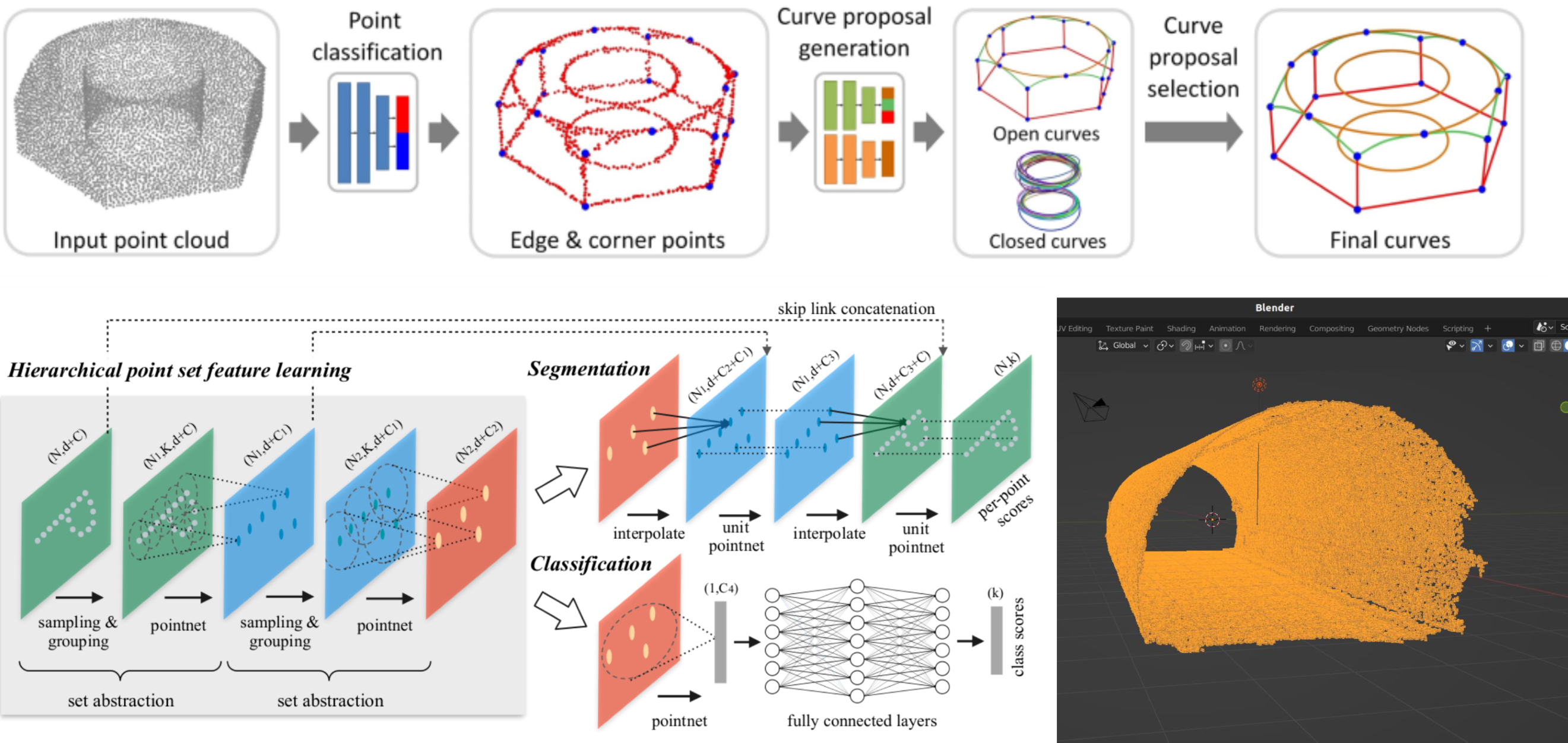
(i) PointNet++ was used to perform point cloud segmentation. PointNet++ is a deep learning architecture that can effectively handle unordered point clouds. By dividing the point cloud into segments, it was possible to isolate distinct regions that are relevant to specific edge and cross-section detection tasks.
(ii) For precise identification of corners and edges in the segmented point cloud, PIE-Net was used. PIE-Net is designed to detect features like corners and edges with high accuracy.
(iii) Prior to applying the deep learning methods, the point cloud and mesh data was processed using open-source tools such as Blender.
(iv) Section planes in the 3D models were identified using standard geometric algorithms, and parametric curves that represent longitudinal edges and cross-sections were constructed using mathematical techniques like B-spline interpolation or fitting polynomial curves to capture the intricate details of the detected features.
Expected and Achieved Results
The project is now concluded. To inform the project’s approach, a comprehensive analysis of the state-of-the-art in transforming 3D models into descriptive 3D geometries was conducted and a corresponding report generated. Additionally, the team developed prototypes to showcase the effectiveness of machine learning-based fracture edge- or longitudinal edge recognition (with potential extensions) and machine learning-based cross-section recognition. These prototypes featured a complex processing pipeline, made up partially of established deep learning networks for processing and segmentation of point clouds (PointNET++, PIE-NET), as well as purpose-built aspects of generating section planes and parametric curves. This pipeline was initially devised and prototyped using open-source data sets of object point clouds, and subsequently adapted and optimized to be used with a pre-existing point cloud data set provided by consortium partners. The final system was demonstrated successfully within the frame of the project. The achieved advancements enhanced the efficiency and accuracy of the 3D tunnel creation process from raw point cloud data, using an approach based on lineation and longitudinal edge course detection, as well as section plane recognition, thereby contributing to the field of 3D modeling and beyond.