

Enhance UWB
The rapid digitalization across all industrial sectors has fostered an increased need for connectivity in heterogenous application environments. As a consequence, research and development of radio-based technologies for long- and short-range communication has intensified over the last decade, with a multitude of technologies and protocols currently available. Ultra-WideBand ("UWB") is a radio-based communication technology that offers reliable data transmission for indoor and outdoor application scenarios. Latest UWB transceivers are relatively energy-efficient and thus support battery-powered mobile applications. UWB has applications in automotive, data transfer, radar, mobile phones, real-time localization, and related industrial applications, and has the potential to catalyze the seamless digitalization of shop floors, warehouses, and process chains.
Several challenges remain for UWB, including the mitigation of non-line-of-sight (NLOS) conditions in the context of localization applications. Another challenge concerns the use of UWB systems in the presence of co-located wireless devices sharing the same frequencies (e.g., Wi-Fi 6E devices), which can result in detrimental collisions that may degrade the communication and localization performance.
To further advance NXP’s existing UWB solutions, the project ENHANCE-UWB aims to develop a testbed allowing for the reproducible study of UWB in complex application environments. Overall, the envisioned testbed will allow the project to pursue the following research directions:
- UWB real-time NLOS detection and ranging error mitigation
- Performance study of UWB in co-existence scenarios, which can cause issues with co-located wireless devices (e.g., Wi-Fi 6E devices)
Goals
- G1: Design and realization of a UWB testbed for the reproducible study of NLOS and co-existence scenarios.
- G2: Development of NLOS detection and ranging error mitigation strategies and their demonstration and evaluation in the ENHANCE-UWB testbed.
- G3: Incorporation of Master/Bachelor projects and thesis.
Approach
We focus on the investigation of NLOS conditions in the context of UWB ranging and localization scenarios, as well as on the development of NLOS detection and mitigation strategies. A particular focus of this work lies on the study of ‘strong NLOS’ conditions, i.e., situations where the line-of-sight (LOS) component is blocked entirely and no longer detectable by the receiver.
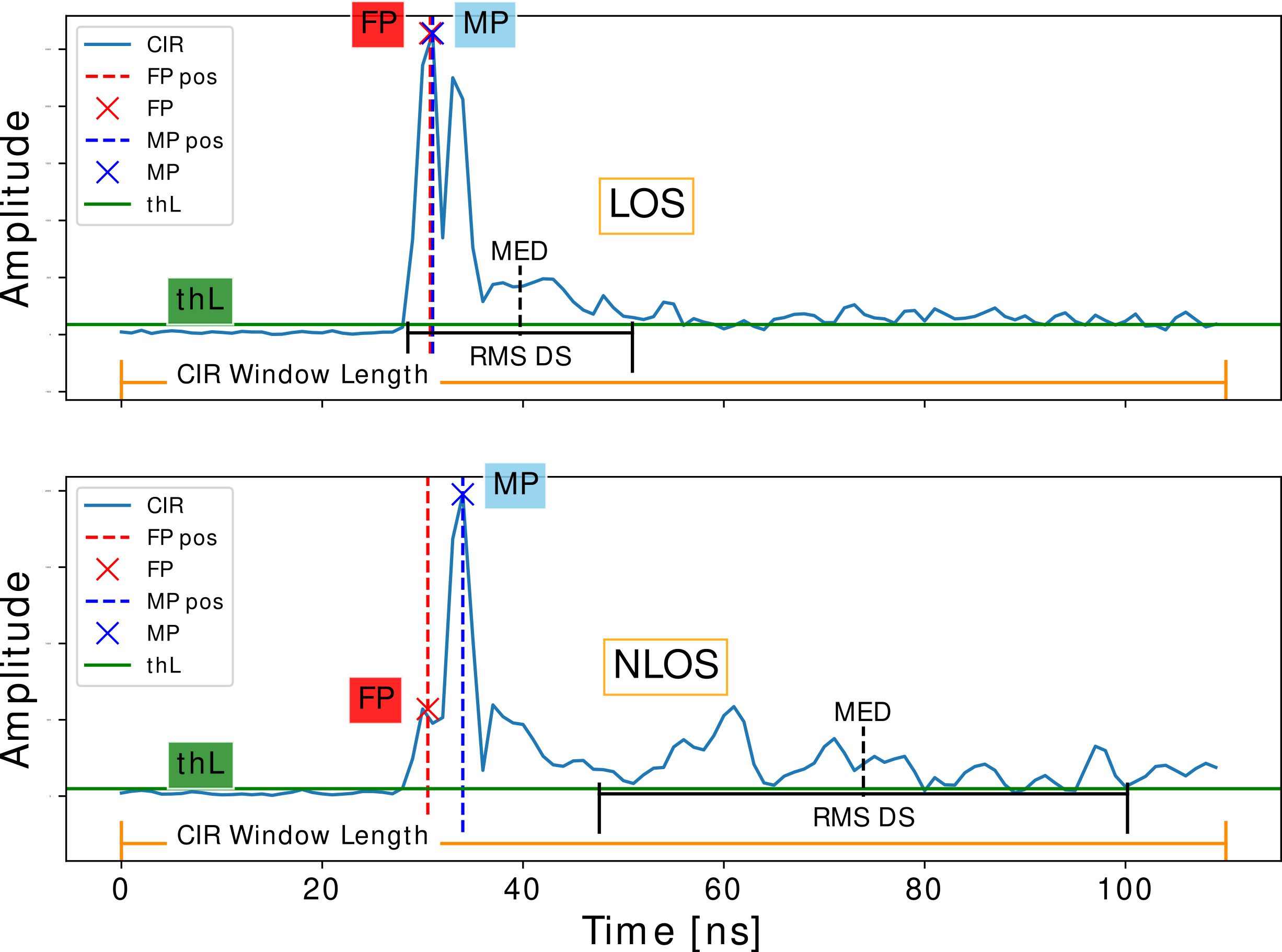
In a first task, suitable and challenging testing scenarios will be designed for implementation and execution within the ENHANCE-UWB testbed. The different CIR signals in NLoS/LoS will be analyzed. In a second task, existing approaches for NLOS detection and mitigation will be adapted for application on NXP UWB hardware. These approaches will serve as a baseline for further investigation. In a third step, the testing scenarios defined in the previous step will be implemented in the testbed and the baseline methods will be tested and benchmarked. The results serve as a starting point for the development of novel and refined NLOS detection and mitigation concepts. The last task of the work concerns a final benchmarking of the developed methods.
Expected and Achieved Results
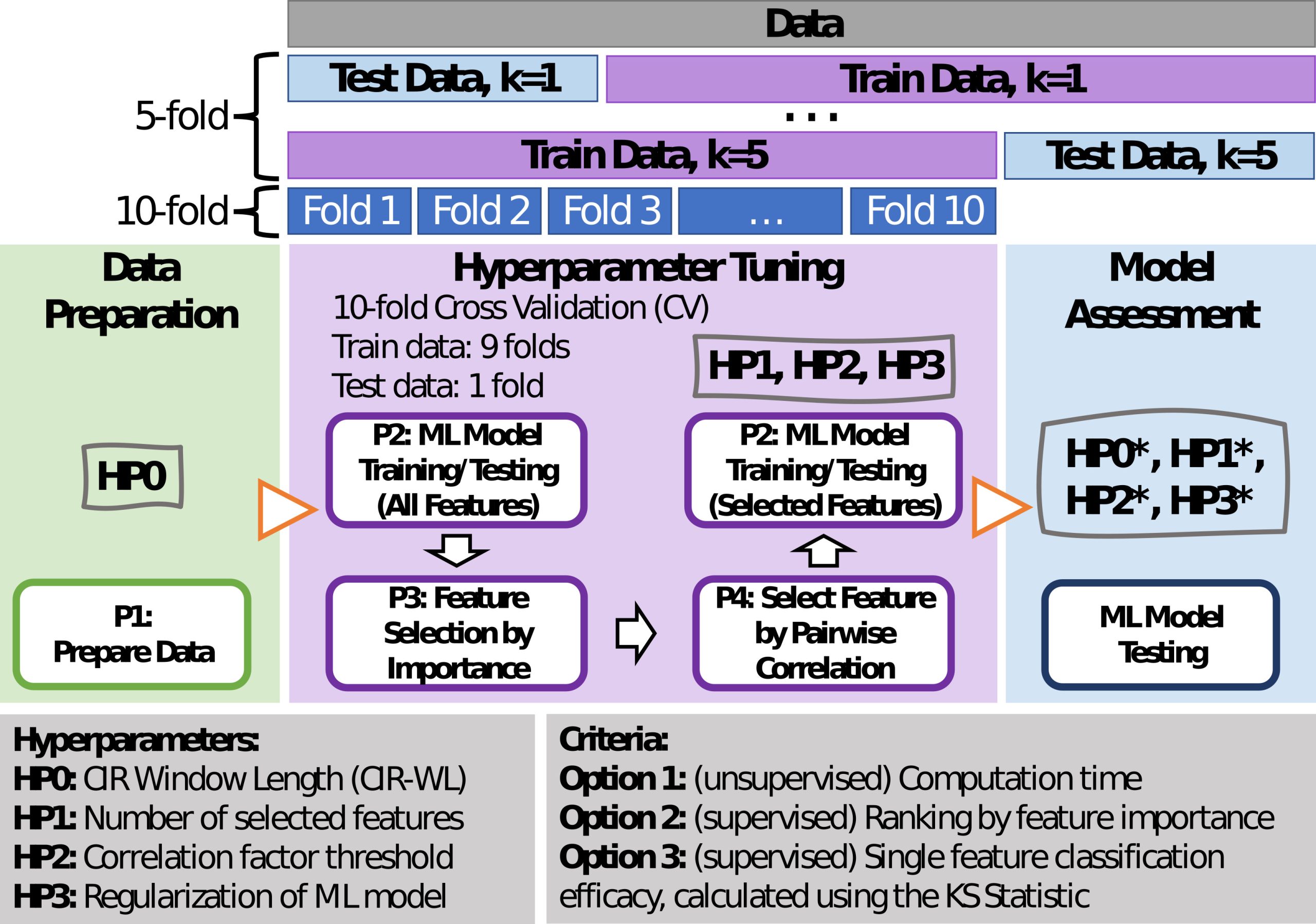
We have developed an automated machine learning workflow for developing ML models for categorizing UWB NLoS/LoS situations. In order to decrease the computational complexity, our solution employs two key strategies:
(1) feature selection, we choose the most effective features for classification in a data-driven manner.
(2) by reducing the CIR Window Length (CIR-WL) for feature extraction, the feature extraction time is drastically reduced.
To get results that are generalizable, we specifically took into account 29 features and investigated the impact of feature selection across five different datasets using various ML classifiers. Nested Cross-Validation (Nested CV) is used in our suggested ML pipeline in order to perform hyperparameter (HP) tuning and provide unbiased performance estimates for our ML models.
We demonstrated that we can extract two sets of just 3 and 8 features, resulting in tiny machine learning models (less than 1 kB) and quick computation speeds (3.6 ms and 27.7 ms, respectively, using an 80 MHz ESP8266 microcontroller). Compared to the State of the Art (SoA), this enables a runtime reduction of more than 90% while retaining an comparable classification accuracy to the SoA of 85% across all five datasets.
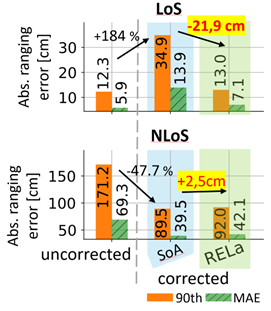
In additional work, this time involving UWB ranging error mitigation, we have explored methods to re-label the UWB datasets. Interestingly, our detailed analysis on SoA methods showed that there is a significant impact of the NLOS error mitigation on LOS samples. Our analysis indicated that there is strong potential on re-labeling the NLOS and LOS samples, as the human operator assigning the labels cannot assess properly these labels. Instead, the operator acquiring the training date uses a simple heuristic, a sample is NLOS, if there is an obstacle blocking the direct path between both UWB transceivers. In our scientific work, which received a best-paper award at the IFIP WMNC 2024 conference, we proposed “RELa”, a method for re-labeling the data based on the ground-truth ranging error of the samples, which is generally applicable to any machine-learning model based 2-stage approach for UWB ranging error mitigation. Our proposed “RELa” method, maintains NLOS ranging error correction performance, without, in average, introducing any over-correction on LOS cases.
Other works performed during the project in collaboration with our partner at TU Graz, which have been published in the scientific literature, include: (1) improving the localization of UWB devices by considering the estimated NLOS/LOS status of the localization anchors, (2) the training of fast XGBoost models with reduced computational complexity, and (3) the detailed study and modeling of UWB co-existence with Wi-Fi 6E networks.