

LineTACT II
To participate in a highly competitive market, manufacturing companies today offer a wide range of product variants accommodating the increasing customer demand for customization. To this end, manufacturing companies pursue producing highly customizable products, in small lot sizes, at the costs of mass production. Different uncertainties, such as the volatility of the market demand, abrupt disruptions of supply chains, production errors, etc. may arise threatening various stages of production. This gives an advantage to flexible manufacturing systems for their ability to cope with these unforeseen situations.
To ensure assembly planning flexibility towards internal and external disturbances, prompt planning and configuration of the assembly process are necessary. This includes the balancing of the assembly line. The Assembly Line Balancing Problem (ALBP) is the partitioning of assembly work among stations with respect to prioritized objectives. These objectives are cost or profit-oriented and aim to minimize the number of stations and/or maximize the line efficiency. The ALBP has drawn considerable attention from the academic and industrial communities for decades. The formerly presented solutions, however, are not always feasible in real-world assembly systems where we notice a gap between the effort invested in solving the ALBP within the research community and its applications in industrial settings. This is often due to the lack of input data, namely the assembly precedence graph. Experts in different industries rely on their tacit knowledge of precedence relations and other constraints to deliver a feasible assembly line balancing. The process of manual assembly balancing is tedious, error-prone, and time-consuming. It limits the rapid responsiveness of the assembly system, making it more vulnerable to disturbances.
Goals
This Project aims to support the prompt balancing of new products while addressing the lack of vital data in real-world assembly systems, namely the assembly precedence graph. Additionally, we plan to support the re-balancing of already existing products allowing efficient responses to market changes and supply chain disruptions. To this end, we attempt to learn the missing precedence graph allowing the application of several prominent automated assembly balancing solutions in real-world assembly systems.
Approach
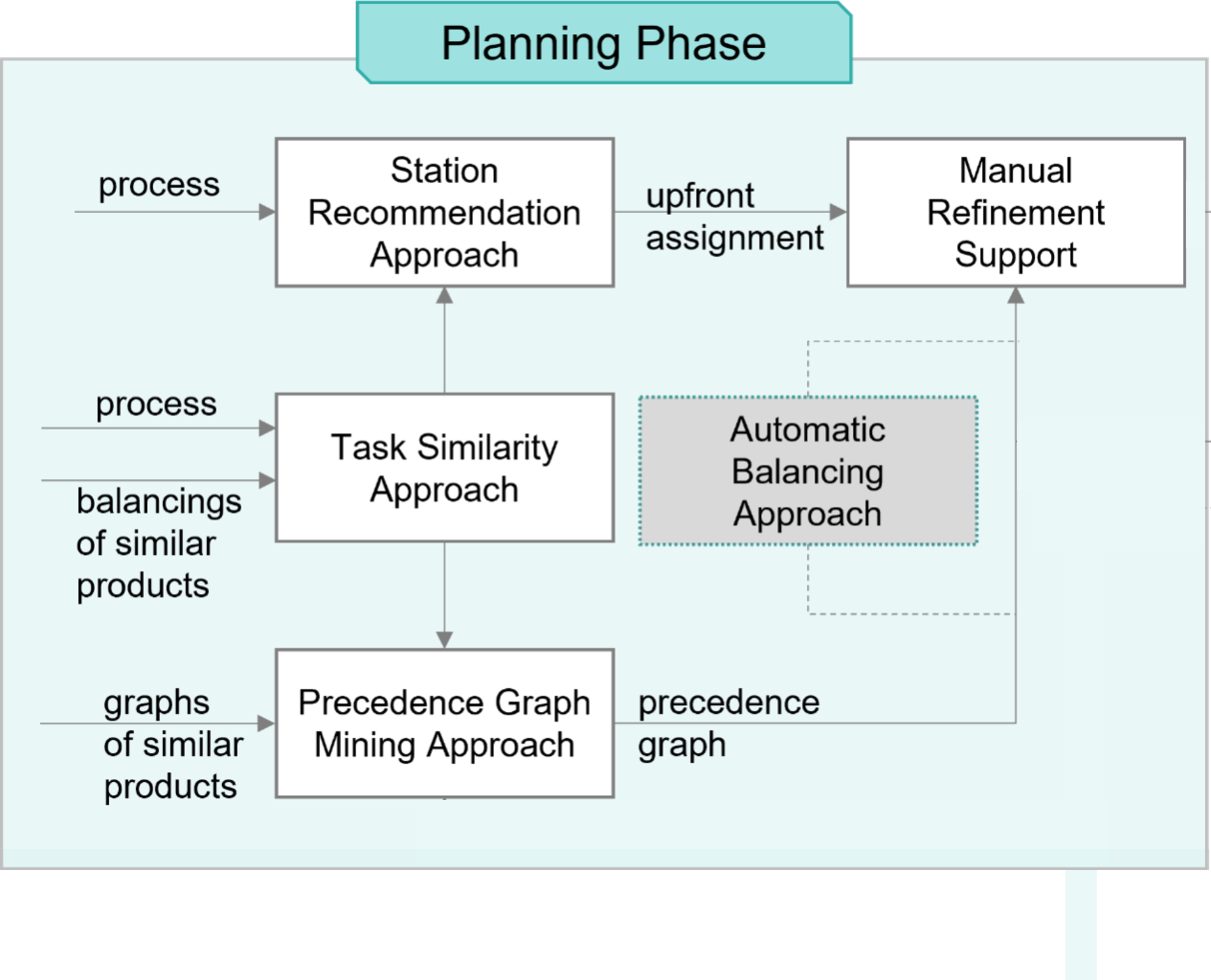
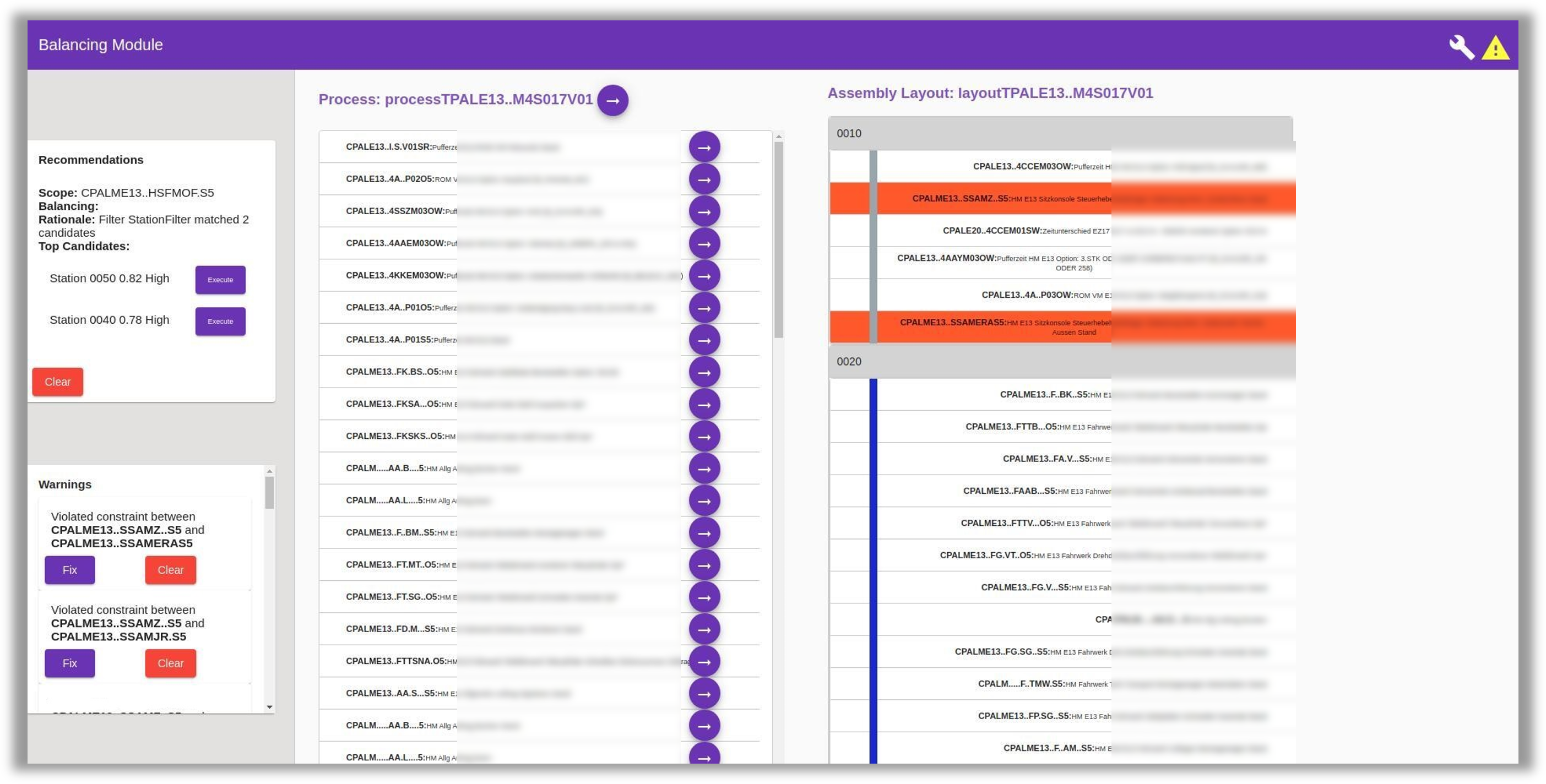
We proposed a novel approach for the support of the flexibility of assembly systems during the planning phase. For the first case, entailing the planning of new products, we propose an approach providing station assignment recommendations for each task of the process. These recommendations are based on similarities calculated to tasks of previous balancings of similar products. The output of this step is an upfront task to station assignment. At this stage, not all tasks have been assigned (for some tasks, no recommendations are provided) and the assignment is not properly balanced. A planning expert then manually refines the assignments. We also provide support for the manual refinement step through (i) recommendations for alternative stations where a task can be shifted and (ii) warnings for violations of precedence constraints based on the learned precedence graph. In the case of new products, where no past feasible sequences are available, the learning is based on graphs of similar products. The precedence graphs of similar products can be already available at the manufacturing company or generated using our approach. Using the learned precedence graph, an automatic balancing approach can also be used. There are several solutions available that can be applied depending on the assembly conditions and balancing objectives. Manual refinement is still required after using automatic balancing solutions as well.
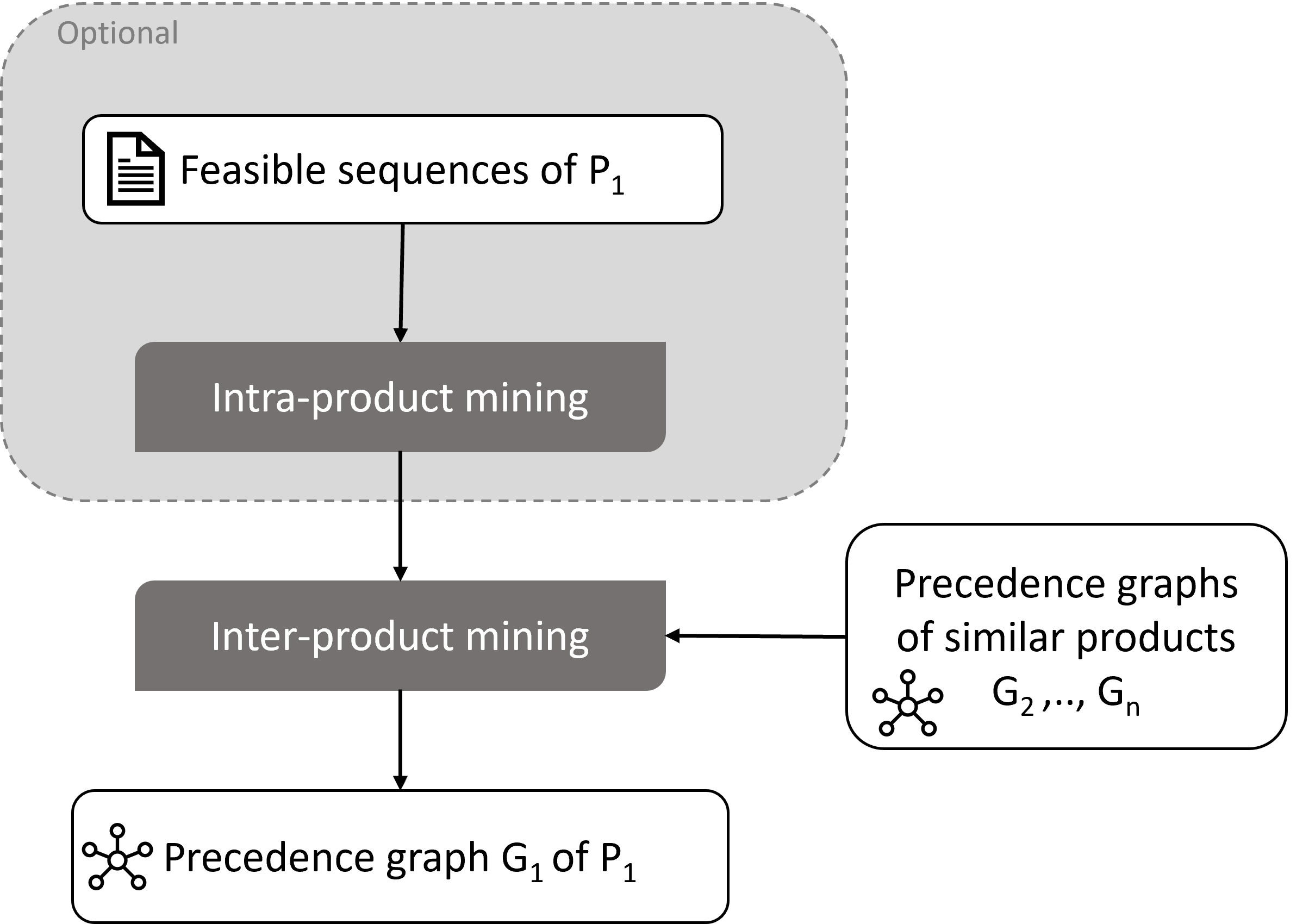
The second case entails the re-balancing of already existing products in order to adjust the line throughput or to modify the line tact for example. We proposed a two-step graph mining approach. The first step is the intra-product graph mining approach using past feasible sequences if available. The second step is the inter-product graph mining approach, in which the initial learned graph from the previous step can be improved by learning additional independencies from the graphs of similar products. Using the learned precedence graph, automatic assembly balancing approaches can be used before a manual refinement step is performed.
Expected and Achieved Results
We evaluated the recommendation approach using real assembly data of excavator assembly and by calculating 2 metrics, namely the coverage and precision.
Our approach is able to provide station assignment recommendations for 91% of the total of tasks with a precision of 82%. We also presented a dynamic threshold approach that improves the approach coverage as compared to a standard static threshold. We conclude that task similarities can indeed be used to derive task assignment information from other products. It is critical, however, to select a sensible reference product, which is typically a straightforward task for a user familiar with the product portfolio.
We also investigated to what extent can task similarities to other products be used to derive precedence constraints. To this extent, we evaluate our precedence graph mining approach based on real industry data of construction machine assembly. We conclude that graphs of similar products can be used to derive task independencies. Our approach specifically addresses the lack of feasible sequences in the case of new products. We have also evaluated the results of a user study conducted with balancing experts, who corroborated the usability and usefulness of a prototype implementing our approach for manual balancing support, including warnings based on the mined graphs.