
RTEAS
RTEAS will provide support in rail track error analysis based on the data from rail track machines. Along with company partner System7 which builds this kind of machines, the analysis support will be used by System7 customers in the form of reporting and suggestion the maintenance of the rail tracks. E.g. in Europe alone over 200000 kilometers of rail road need to be maintained, whereas a repair job for 500 meters takes several hours. Especially with providing a green alternative to flying, the maintenance of rail tracks is crucial when driving with very high speed, e.g. over 200KM/h. Deterioration of the tracks is not only governed by use but also by bad weather conditions, e.g.strong rain or very low or high temperatures.
Typical rail track maintenance is costly and done with automated inspection of the rail tracks which records errors in several regards, such as longitudinal, directional, or superelevation errors, which can if not mitigated are sources for derailment. These errors occur typically when the underlying ballast bed cannot absorb the force by driving. The errors are fixed using semi-automatic tamping machines, which press together ballast. This process can be repeated on several occasions till a point where the gravel is destroyed by the tamping process and the ballast bed needs to be replaced. In order not to over-tamping areas which don’t need tamping as well as finding out when to replace the ballast, RTEAS aims to leverage data coming from the hydraulic units of these machines.
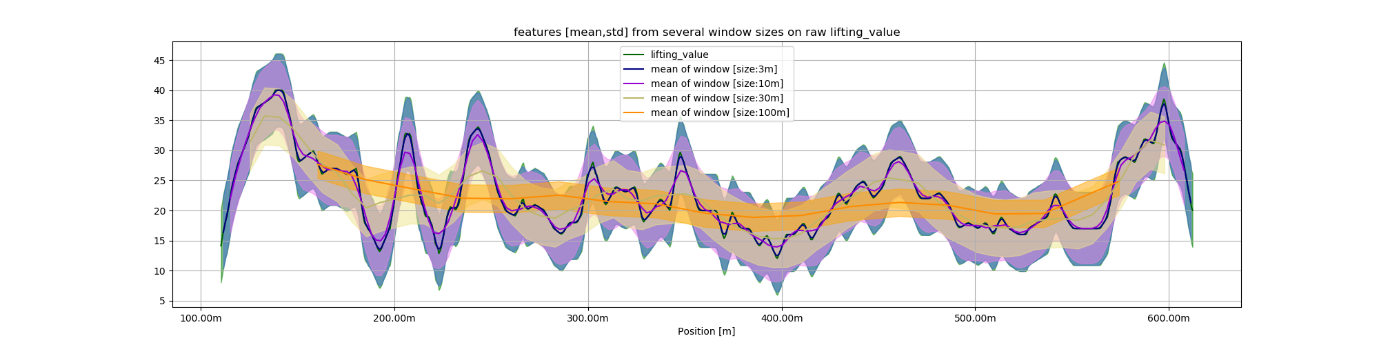
Therefore with both historical measurements and maintenance data along with the (i) Rail Road Geometry (Hight shift, direction, Height Variance), (ii) Ballast Measurement (compaction force, Adjustment travel, Regulating time) and the (iii) Position (odometer, GPS, IMU), rail road tracker managers as well as tamping machine operators should get insights into data and also derive action suggestion. Based on a unsupervised machine learning pipeline built in Guide and WorkIT, along with further descriptive data analysis measures, the project team aims to improve the quality of track maintenance and reduce the cost of unnecessary track maintenance.
Additionally, based on the data analysis and the insights gathered from it, RTEAS also will build a reporting engine, which prepares this data into persuasive reports for both tamping machine operators as well as rail road track maintenance managers.
Goals
RTEAS has the goal to to provide decision support for manager and tamping machine operators, suggesting the scheduling of maintenance operations and replacement of ballast bed by monitoring and analyzing the (i) Rail Road Geometry (Hight shift, direction, Height Variance), (ii) Ballast Measurement (compaction force, Adjustment travel, Regulating time) and the (iii) Position (odometer, GPS, IMU). Based on machine learning, e.g. outlier detection, and descriptive statistics, e.g. variance analysis, correlations should be found between errors and data, which guide decisions whether or not to make the correction to the railroads in order prevent failures. RTEAS aims to use the specifically coming from system7 tamping machines sensors, i.e. the hydraulic unit, and will develop the anomaly detection mechanisms able to predict and generate suggestions for further correction in a railroad.
Approach
RTEAS will (i) build on over state-of-art methods for data analysis and correlation in the data for anomaly detections, (ii) Conventional machine learning and recognition architectures tailored to the railroad and temping session data processes, (iii) and powered by an existing data collecting architectures from the system 7 tamping machines. RTEAS will find the correlations, plot, and calculate the wear and tear of the rail track. Subsequently, different anomaly classes are matched to the models derived from domain-specific expert knowledge, thereby supporting prediction, and suggesting the maintenance of the track and guiding decision makers by providing appropriate persuasive reports to either take action in various direction, e.g. not scheduling maintenance for several months or immediate replacement of ballast bed.
Expected and Achieved Results
RTEAS aims at two developments within the project frame: (i) a data analysis pipeline which will be powered by data coming from rail track tamping machines; (ii) a report engine which delivers high quality reports and charts to guide decision makers into appropriate actions. Of course, the main deliverable of this project is the Data analysis pipeline and prediction of the rail track maintenance status. As for this data analysis, we already implemented various expected outputs such as an (i) In-Depth Report on Distribution of Data and Correlation between Problems and Data (ii) Interactive Visualization, which is not yet embedded in System7 Inframe Platform. As for the data analysis company partner System7 expects to find correlation between several relevant data classes, namely geometry data (longitudinal error, directional error and superelevation), ballast bed measurements provided by the hydraulic units (compaction force, compaction path length and time) and position (odometer and GPS data) and to be provided with scientific visualization results clearly indicating underlying problems.
Further in the Recommendation part of the project, the main outputs are (i) the implementation of deriving appropriate actions in reporting Engine (ii) and the preparation of reports on Decision Making by providing necessary visualization and outlining circumstances for actions. Additionally persuasion techniques typically found in HCI sustainability projects should be applied to these reports.