

Simatic Failsafe 4.0
The proliferation of industrial monitoring and control systems has led to the generation of a huge amount of data. It is predicted that 50 billion devices will be connected to the Internet by 2020, with the majority generating data in industrial settings that can be used to optimize industrial processes and to increase flexibility and integration along the product life-cycle. As the Internet of Things paradigm spreads into the industrial realm, we need to take into consideration additional aspects of industrial processes, such as their safety. The desire for better and faster production has created an industrial environment where people and cognitive machines collaborate in the same physical space. Consequently, the safety of people and of equipment has emerged as one of the greatest concerns for engineers in human-robot collaborative work settings. Manufacturers of Programmable Logic Controllers (PLCs) have invested a lot of resources in upgrading their PLCs, so that they are capable of detecting anomalies and of ensuring safety for the system and workers in the case of failures. Complex systems with multiple control units still represent a significant challenge, since the optimal safe state of the entire system needs to be determined and reached in time and space.
This MFP investigates how functional safety, availability, and maintainability can be improved in industrial environments. Analysis tools and methods stemming from the domain of predictive analytics will be applied to data sources already available in industrial fail-safe modules. Integrating data analytics (the main focus of Area 3’s research) into industrial fail-safe processes denotes a prerequisite for future cognitive products and production processes, as it should fulfill the level of dependability which is required in industrial cognitive applications. In addition, the project investigates the required transition of traditional, static approaches to fail-safe operation into more challenging dynamic environments. This is necessary as smart factories which employ cognitive production processes are expected to exhibit non-static behavior, including rapid changes of tooling, physical movement of robots, and even the reconfiguration of entire manufacturing processes when required. Consequently, future fail-safe mechanisms must also be cognitive in order to adapt to or, ideally, anticipate these dynamics to guarantee fail-safe properties at all times. To do this, the project will investigate how to achieve an integration of predictive maintenance and fail-safe operation. This will result in novel cognitive Predictive Failsafe (PdF) mechanisms, which enable a system to adapt its fail-safe measures to new configurations and situations, as well as to forecast and mitigate errors.
Goals
The overall goal of this project is to enhance fail-safe strategies for their application in cognitive production environments. This will be done by extending fail-safe strategies to include prediction of the mostly likely future states, thus leading to the new paradigm of Predictive Failsafe (PdF). PdF will give a system the ability to adapt its fail-safe measures to new configurations and situations that dynamically arise in smart factory environments, with the goal of protecting itself and its working environment, including human workers. In order to achieve the PdF paradigm two key elements are required: data sources for obtaining data that is relevant to fail-safe predictions, and prediction algorithms for analyzing this data. Identifying safety-relevant data sources and obtaining access to their data is not straightforward, since fail-safe components are usually deliberately shielded from the rest of an automation system. Obtaining this data is however crucial to PdF, especially since insufficient data quality can lead to incorrect conclusions and decisions, which is especially critical when dealing with safety-relevant data. Accordingly, one research goal of the project is to establish new mechanisms which provide a simple way of tapping into existing data sources in order to achieve the overall research goal of investigating how this data can be used in combination with machine learning and statistical methods to establish new, cognitive predictive failsafe mechanisms.
Approach
Being able to connect to and therefore utilize data sources is a key requirement for PdF. The project thus initially focused on the development of methods which allow access to and communication of fail-safe data produced by PLCs of the Simatic family. In a next step, existing fail-safe approaches and their underlying methods as well as application scenarios were studied in detail, providing a starting point towards the creation of new predictive fail-safe approaches for cognitive products and processes and establishment of their requirements. In order to demonstrate the applicability of these new approaches they will be implemented as demonstrators in a virtual environment that simulates real-life hardware and the services established in the earlier steps of the project.
Expected and Achieved Results
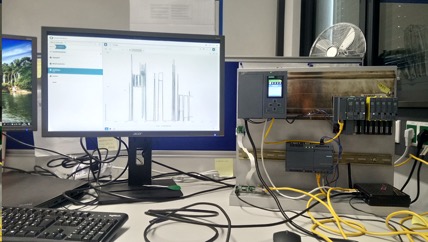
The first results of the project were the research, evaluation, and generation of the practice-relevant, future fail-safe scenarios for the Simatic automation device family. Based on our research, a first use case was established which concerns the application of the Simatic system in prospective collaborative industrial environments. As a result, a demonstrator for a dynamic fail-safe system was developed. The demonstrator is fully integrated into the Siemens production environment and demonstrates how selective, dynamic safety mechanisms can potentially be achieved based on Simatic automation in future collaborative workspaces. During the implementation of the use case, interfaces to access a Simatic’s safety data as well as interfaces which allow connections with higher level services and systems (i.e., Siemens’ TIA-portal and Mindsphere cloud environment) were established. These interfaces constitute a starting point for all further implementations in the project. The fail-safe mechanisms which are already implemented in the Simatic system are currently being investigated in detail. Our current research focuses on the application of machine-learning and statistical methods to improve fail-safe mechanisms as well as to establish a first iteration of predictive fail-safe mechanisms. Based on PdF mechanisms, the project aims to develop mechanisms for adaptive availability, which inform a user in advance about the likelihood of a given system entering a fail-safe state and offer concrete guidance on how to optimize the system to increase its reliability and availability. Predictive fail-safe will be used to establish services which allow Siemens to achieve improved context for any occurring fail-safe events within the Simatic product line, thus helping to further improve and optimize the performance of automation systems.