

SmartCoEx
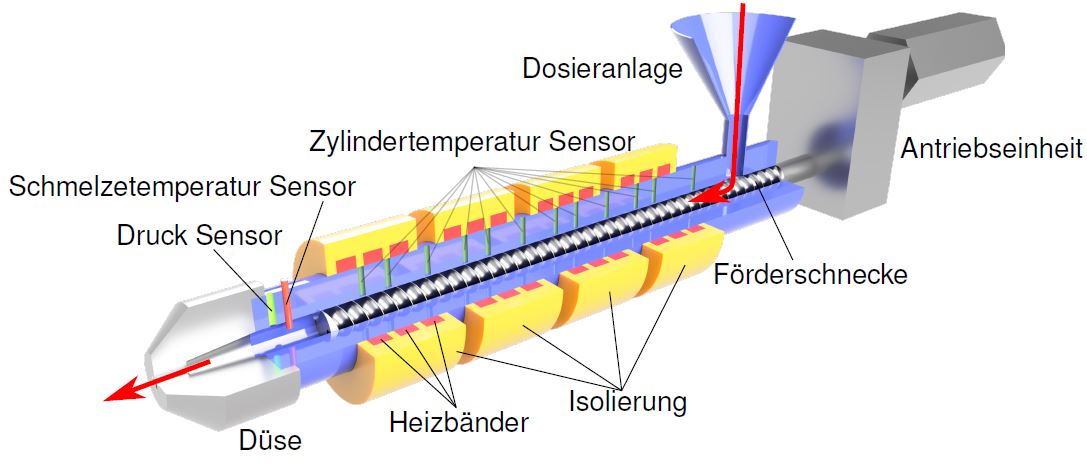
An important process for the production of plastic products such as packaging, pipes, etc. is the extrusion process. In this process, plastic granules are fed into a machine, the extruder, conveyed through the extruder cylinder with a complex screw and melted with the help of pressure and heat. The heat required for melting is generated by friction and heating elements, and the pressure is generated by the screw. The pressure, mass flow and temperature of the melt should assume values that can be specified at the outlet. With the newly developed control, the extrusion process can run faster, more efficiently and in a more environmentally friendly manner, while at the same time ensuring optimal product quality. This process should be as energy-efficient and environmentally friendly as possible, but it should also be able to extrude a large number of polymers in such a way that the end products are of high quality. Today's challenges are the lack of active cooling and the processing of granules with varying properties, e.g., in recycling. The standard is that experienced employees set the extruder with the help of recipes in such a way that the best possible behavior is achieved under the same conditions. Changes over time due to defects or changes in the composition of the granules cannot be specifically taken into account. The recipes also have to be elaborately created. Modern extrusion is an extremely complex process that changes a lot over time and the best possible settings have to be found.
Goals
In order to ensure adequate quality of the extruded products, the material melt temperature must be close to an appropriate desired melt temperature. The temperature controllers commonly used in extruders do not regulate the melt temperature, but rather the temperatures in the barrel. The control concept developed should be able to regulate the temperature of the melt. The advantage of a control concept that controls the temperature is that it can react to small changes in the melt temperature. A concept that only controls the barrel temperatures cannot react to small changes in the melt temperature. Another goal is to achieve a quick start of extrusion and a quick heat-up phase of the extruder. The commonly used PID controllers are slow and do not take into account the coupling effect between the heating zones. Therefore, the concept must be model-based. Waste should be minimized, and energy-efficient operation should be guaranteed. The concept must be applicable to different extruder types that differ in size and number of sensors and actuators. Production-related restrictions must be observed to ensure high product quality. The concept must make it possible to extrude different materials without knowing their physical properties.
Approach
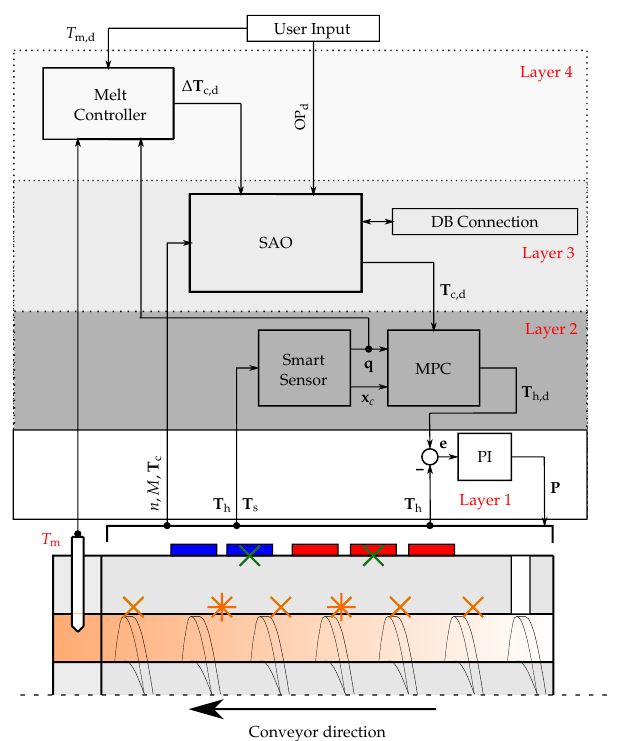
The control concept developed consists of several superimposed layers. The first layer includes the heater band temperature control implemented as a PI controller. The next layer consists of an observer (smart sensor) and a model predictive controller. A model predictive controller calculates appropriate temperature targets for the heater band temperatures to achieve the desired temperature profiles in the extruder while meeting any defined process or vendor-specific constraints. Another superimposed concept enables fast operating point changes by determining optimal cylinder temperature profiles. A material-independent melt temperature controller forms the top layer of the developed concept.
Expected and Achieved Results
To underpin the applicability and effectiveness of the newly developed control concept for different types of extruders, extensive test series were carried out on two different extruders. These test series enabled a thorough analysis of the performance of the control concept in various operating phases, including heating processes, extrusion starts, operating point changes and fault scenarios. The capabilities of the concept were comprehensively evaluated both through detailed simulations and through practical tests on industrial extruders. An outstanding advantage of the control concept became apparent when the operating point changed. The quick and accurate adjustment of the process parameters enabled a seamless transition between different production requirements. This flexibility plays a crucial role in modern production environments where rapid changeovers are required to meet dynamic market demands. The control system also proved to be extremely robust and reliable in disruption scenarios. It responded quickly and effectively to various disruptive factors such as material variations or temperature variations to maintain process stability. This counteracted possible negative effects on product quality and ensured continuous production.
Overall, the results of the test series clearly demonstrate the high performance and applicability of the control concept developed on various types of extruders. The precise control and the ability to flexibly adapt to changing production conditions make the concept a promising solution for optimizing the extrusion process. It makes a significant contribution to improving efficiency, product quality and sustainability in plastics processing and opens up new opportunities for innovative plastic products in various branches of industry.