

SUPRA-2
The project “SUPRA-2” is motivated by company partner AVL. Sustainable production and assembly (SUPRA) are critical aspects in the development and implementation of fuel cell technology. Fuel cells are promising technologies for clean and efficient energy conversion, and they have the potential to play a significant role in reducing greenhouse gas emissions, addressing energy security concerns, and most importantly addressing SDGs and EU Green deal. Among the various types of fuel cells, the polymer electrolyte membrane fuel cell (PEMFC) and the solid oxide fuel cell (SOFC) are two of the most widely researched and developed technologies. PEMFCs are known for their high energy efficiency, quick start-up time, and compact design, making them well suited for transportation and portable power applications. SOFCs, on the other hand, are capable of operating at high temperatures, providing high fuel utilization and thermal efficiency, making them suitable for large-scale stationary power generation and cogeneration applications. In order to achieve sustainable production and assembly of fuel cells, it is essential to consider various aspects of the fuel cell life cycle, such as the materials used in their production, the manufacturing processes employed, and the end-of-life scenarios for the fuel cells. With a focus on PEMFCs and SOFCs, this research aims to identify sustainable production and assembly practices, as well as to explore the potential for further improvements in terms of reducing the environmental impact and increasing the economic viability of these technologies.
Goals
The focus towards the Sustainable Development Goals and Circular Production is addressed by the SUPRA-2 Project. Four topics or goals will be addressed in this SUPRA-2 project. They are:
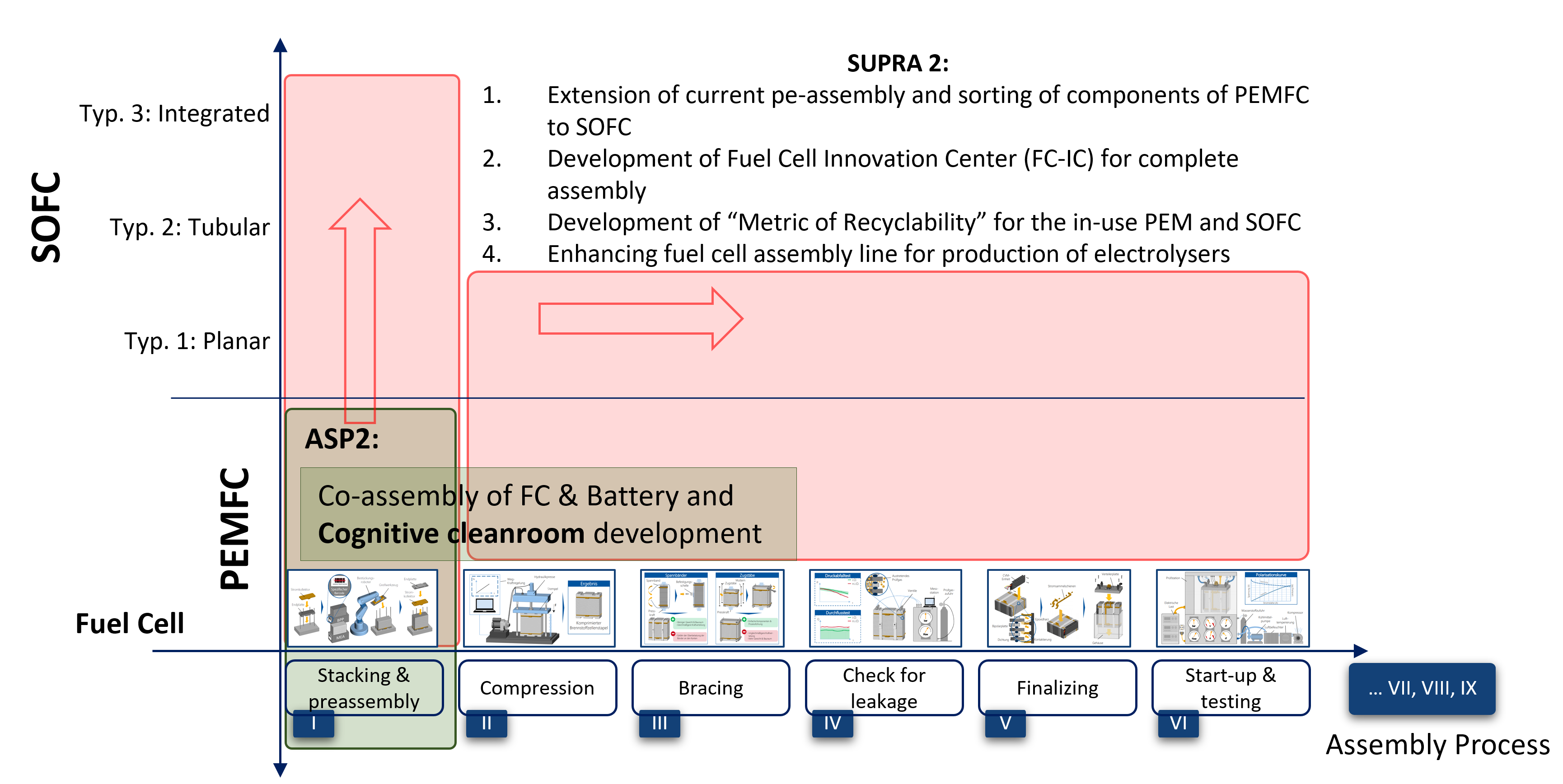
- UC1: Extension of current pe-assembly and cleanroom cabin of PEMFC to SOFC
- UC2: Development of Fuel Cell Innovation Center (FC-IC)
- UC3: Development of “Metric of Recyclability” for the in-use PEM and SOFC
- UC4: Enhancing fuel cell assembly line for production of electrolysers
The goals among the four use-cases are summarized below:
- Extension of ASP2 results, i.e., pre-assembly and sorting of individual components along with the cleanroom demonstrator, to a new type of fuel cell.
- In ASP2, the focus was on Gen0 and Gen1 PEMFC. However, this will be extended to include SOFC in SUPRA 2.
- Design and development of complete assembly process line at IFT for: PEMFC – Extension to include all assembly steps until start-up and testing; and SOFC – Development from pre-assembly to start-up and testing.
- Acquisition, construction, and testing of the assembly line to simultaneously perform assembly operations of both, PEM and Solid-oxide fuel cells.
- A beyond state-of-the-art demonstrator for combined assembly of both fuel cells -> Fuel cell innovation center (FC-IC).
- Real-time sensory data acquisition of the in-use products.
- Data processing and visualization along with anomalies detection to ensure predictive maintenance.
- Finally, an evaluation metric, i.e., metric of recyclability, will be developed to indicate the level of recyclability of the fuel cell.
- This metric will indicate a score and based on this score; the right feasible direction will be chosen.
- The production of electrolysers that are used for electrolysis.
- Methods and design of these electrolyser units
- Development of initial demonstrators via additive manufacturing technologies
- Three different electrolyser units will be developed -> alkaline electrolyser, PEM electrolyser, and solid-oxide electrolyser.
Approach
The use-cases are intertwined with one another as depicted in the image. Use-case 1 extends the developments from ASP2 project to include other assembly steps in the PEMFC and SOFC. Additionally, the project will also address the production of electrolysers, with which hydrogen production can be achieved much cheaper than supplied by high-pressure cylinders.
Expected and Achieved Results
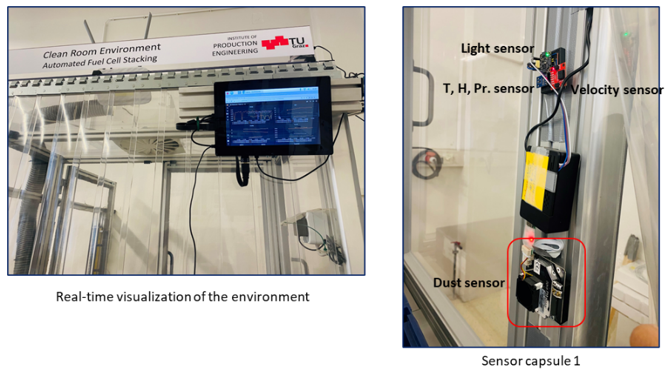
The four sensory capsules are well integrated into the cleanroom cabin and are continuously monitoring the parameters. They are further displayed on the control monitor which also has an integrated control of the filter-fan-unit. This extension has been followed by the results of ASP2 project. The control mechanism developed in this project extends the reliability of the system. Thus, the system now operates in a closed loop without no or minimum interference. As depicted in the images, one of the sensory capsules are shown among the four capsules.