

P2D2
The P2D2 project is dedicated to advancing sustainable manufacturing by revolutionizing quality checks. Traditional end-of-line testing, where only a few parts are examined, has its drawbacks, including the risk of defects going undetected until the final stage, i.e., after the final product assembly. P2D2 introduces a groundbreaking approach, protected by our pending patent application, that enables real-time non-destructive quality testing for all manufactured parts. Remarkably, it achieves this without the need for additional hardware, such as sensors. P2D2's innovation has already been demonstrated in experimental production batches of steel and aluminium parts, and the project's goal is to develop it into a Minimum Viable Product (MVP) suitable for commercialization and scale-up.
The project's main objectives encompass achieving high-performance defect detection, targeting a per year maintenance of P2D2 software through an affordable software license price. Other objectives in this Fellowship will include the implementation of the beta-version of our software at IFT (TU Graz), potential customer engagement, business strategy refinement, and securing follow-up funding. Sub-targets involve creating stakeholder and customer networks, establishing a corporate presence, and enhancing our expertise in startup management.
P2D2's competition analysis reveals almost a lack of solutions capable of identifying material defects in real-time during manufacturing without additional sensors. We have benchmarked a prototype version of P2D2 against an existing edge device manufacturer solution, which has showcased the superiority of our approach. P2D2’s unmatched accuracy and access to IIoT platforms sets us apart from other competitors.
In this project, we will focus on (1) the detection of common defects during machining, such as porosity, cracks, voids, welding imperfections, and material agglomerations and (2) tool-life estimation. P2D2 employs a mathematical approach that involves analysing machining data to achieve real-time non-destructive quality testing.
P2D2 has already achieved remarkable results, detecting defects as small as 0.2mm in diameter. Experimentations with different materials aim to expand its capabilities. In summary, the P2D2 project promises to reshape manufacturing quality control, offering real-time defect detection during machining and significant sustainability and economic benefits.
Goals
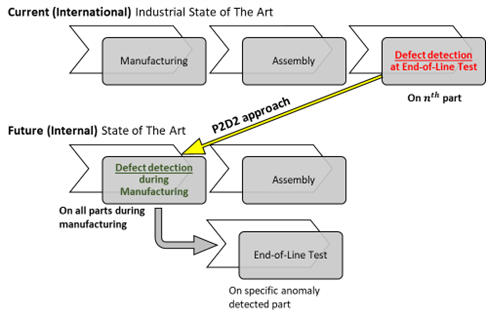
The main goal of the P2D2 project is to develop a Minimum Viable Product (MVP) to achieve real-time defect detection for batch manufacturing based on the high-frequency CNC machining-data (HF-data), with no additional sensors required. The quality inspection envisaged by P2D2 allows to inspect every workpiece of the batch – through its HF-data – and aims at reducing the costs of end-of-line testing (Figure 1) and supporting quality assurance and related efforts. Additional objectives of the P2D2 project are to reduce the dependence on high-quality reference parts compared to competing solutions – that is, real-time HF-data-based defect detection, such as Analyze MyWorkpiece / Monitor from Siemens, other process monitoring tools present on the market –, and to develop algorithms following responsible AI practices with a highlight on algorithmic explainability.
Approach
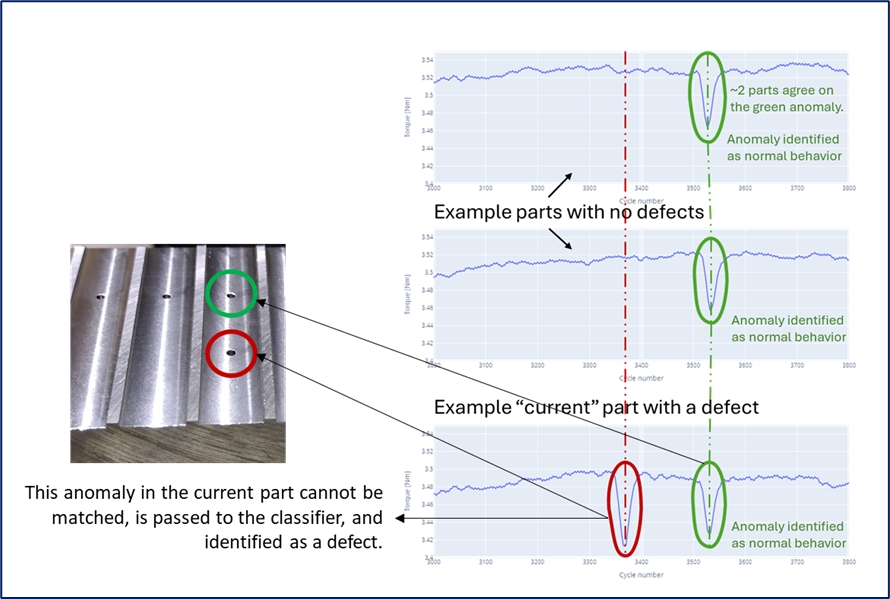
The approach developed during the fellowship also led to the filing of another patent (invention disclosure submitted). Therefore, 2 patents secure the developed IP of this project and future startup. The detection of anomalies or defects is now possible with no reference parts required, with the adaptation to state of tool wear, and classification of normal-behavior anomalies, i.e., usual behavior of the material structure/properties. The approach to test the developed algorithms is experimental with over 1000 machining experiments performed at smartfactory, TU Graz. The process is being continuously improved to identify defects with higher precision and to estimate the remaining life of the tool, i.e., tool-life estimation.
Expected and Achieved Results
Highlights (to-date):
1. Founding of the start-up planned on 1st week of August 2025 (CW 32)
2. Personal interviews with more than 300 interested customers
3. 7 signed NDAs with potential customers, 3 signed LoS and 4 LoS planned
4. Inventure disclosure for 2nd patent
5. Incubation secured in Science Park Graz
6. Submitting FFG Basisprogramm proposal for further development of SoF MVP
7. Ongoing talks with 14 investors for additional financing of the start-up