
TUNSPEKT
In the D.A.CH Transport Infrastructure Call 2024, topic 2 “Automated condition recording and damage detection in road tunnels” will be answered. The multinational consortium brings together four partners with extensive references in tunnel scanning, transport infrastructure planning, and maintenance, and three R&D partners with extensive experience in the industrial implementation of their solutions in sensor technology, robotics, data evaluation and interpretation, and AI.
The project focuses on areas that are difficult to access and AI-based methods for damage detection and analysis, as well as supporting BIM with related aspects of maintenance planning and economic considerations.
The project includes a use case analysis, an overview of known methods of the individual components of damage detection (sensors & robotics, data preparation / fusion / mapping, AI mechanisms, BIM) as well as multi-sensor and multi-temporal demonstrations, the new sensor technology and implement evaluation and data representation on specific tunnels.
Existing R&D approaches are used as a starting point. Concrete innovations include the opto-acoustic “LaserBeat” for the remote detection of cavities, a multispectral laser scanning for the automated detection of moisture (a process using thermal inertia is being tested in addition) and the adapted Dibit-Altira system for the insertion of sensor technology in areas that are difficult to access.
On top of these sensors, data fusion methods address 3D and 2D alignment issues of different but co-registered sensor data and supports the spatial association of physically separated tunnel areas to detect artefacts on both sides. This enables new AI approaches use combined data sources (including areas with difficult access) - together with data from optical and infrared (also thermal) sensors, as well as environmental data such as temperature and humidity - for multi-modal damage detection / categorization.
Goals
TUNSPEKT adapts methods for the automated BIM creation including tunnel areas that are difficult to access. AI-based object recognition and segmentation approaches precisely localize tunnel equipment and IoT devices as the basis for digital twins. The goals aims to deliver three technological demonstrations. ‘Demo-1’ focuses on tunnel areas with known damage, but which are difficult or impossible to recognize using RGB photogrammetry methods. It combines several ground-breaking innovations from sensor technology to AI-based damage categorization of different tunnel sections, especially those that are difficult to access.
A multi-temporal ‘Demo-2‘ will provide a worldwide unique data set, containing condition developments of a road tunnel for extensive analysis, over a period of several years (2018, 2024, 2025, 2026) and with different sensor technology. For this purpose, the AI mechanisms are expanded to include a multi-temporal component. Demo results are validated based on independent reference measurements as well as existing ground truth and reference statements from a tunnel expert about relevant damage and objects.
In addition to the demo data, demos, reports on the requirements, existing solutions as well as the proposed and used solutions in sensor technology, robotics, modelling, datafusion, AI and BIM, an analysis of the medium and long-term R&D roadmap will be made available for the clients ASFINAG, BAST and ASTRA at the end.
Approach
In TUNSPEKT Pro2Future focuses on the AI-Mechanisms, therefore is specifically dedicated to the question of how AI applications can be used and trained to interpret the condition data or damage patterns and causes of damage to the tunnel. The core objective is to empower these AI systems to proficiently interpret complex condition data, recognize intricate damage patterns, and accurately identify the root causes of damage within the challenging environment of a tunnel infrastructure.
For this purpose, single-modal AI models are trained, extended to multi-modal AI models and investigated how alternative learning methods and an extension by a temporal component could have a positive influence on the problem.
Expected and Achieved Results
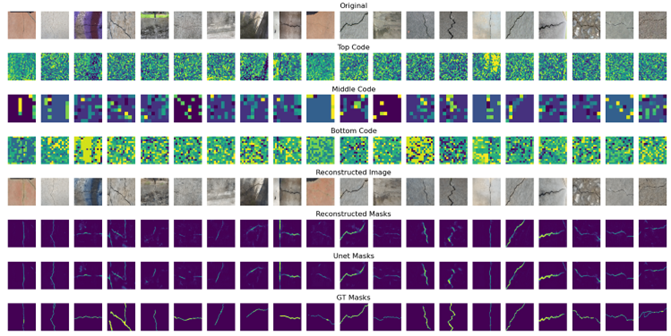
The aim of this task is to train single modal AIs on the basis of existing public data sets (e.g. DeepCrack, BOCHUM Crack Dataset), existing data sets of the consortium and newly generated data sets in the course of the project (especially with regard to cavity detection) to perform classification, segmentation and localization tasks, such as the condition assessment of concrete (new, old), the “semantic segmentation” of cracks, the detection of “objects”, such as lighting devices, in the tunnel. In a second step this single modalities AI are extended, to do state detection and assessment of sections/blocks of the tunnel based but using multi-modal data. Based on the single and multi-modal supervised approaches, finally a potential analysis is to be carried out (i) to what extent non/supervised learning can be applied to the problems, (ii) whether the simultaneous learning of several tasks provides a benefit, (iii) whether generative or adversarial approaches can be used and, if so, under what conditions and (iv) how the multi-modal AI can be extended by a temporal component in order to realize improved state recognition.