
CORVETTE
The CORVETTE project aims to establish a robust software infrastructure for cognitive vehicle fleet monitoring, enabling comprehensive datadriven services. The project encompasses diverse CORVETTE services, from data-driven development support to predictive maintenance and identifying emerging mobility trends through fleet data analysis. AVL is the esteemed company partner.
In the initial phase, rapid prototyping of onboard measurement hardware will ensure seamless data acquisition in real vehicles for method development. Concurrently, existing AVL solutions, such as AVL SMS, will facilitate swift data-driven method development.
CORVETTE's core focus is on developing methods for onboard measurement hardware and the CORVETTE backend, addressing multiple use cases involving monitoring vehicle movement, displayed information, and various driving parameters. One key challenge is achieving highresolution monitoring of driving parameters, with a sampling rate of at least 10 Hz frequency, crucial for realizing the project's objectives.
The main objectives of the project are:
- Efficient data collection through rapid prototyping of onboard measurements
- Designing modular devices for tailored data capture and future expansions which can be deployed in different vehicle types
- Backend infrastructure for data storage, data analysis, and live retraining of machine learning models
- Performing onboard data capture, interpretation, and preprocessing for intelligent analysis with a high resolution (>10 Hz).
Goals
Onboard Data Acquisition: Data is collected and pre-processed onboard the vehicle, prioritizing data collection and transmission to minimize communication overhead. This approach focuses on capturing valuable information for higher-level CORVETTE services and novelty. Contextualized data for advanced CORVETTE services is generated using Statistical Machine Learning (ML) techniques, such as Autoencoders and Gaussian Mixture Models, along with preprocessing methods. The primary goal is to ensure robust and stable ML methods, enabling reliable detection even with variations in input data. Privacy preservation is achieved through ML-based data preprocessing.
Backend Data Processing: The central CORVETTE backend efficiently manages the Onboard Devices, handling device management and aggregating all collected data for higher-level services. The project aims to achieve a flexible and scalable backend, implementing routing mechanisms for automatic provision of specific services for incoming Onboard events and context-sensitive data processing. Multimodal ML methods will be designed to automatically assign incoming Onboard data to situation classes. The backend will support individual Onboard ML model training, where existing Automated Machine Learning Frameworks will be extended for automated model generation, with a focus on adapting models for embedded ML on Onboard Devices (e.g., Pruning). We will provide suitable visualizations and Northbound interfaces for easy data access and seamless integration with higher-level systems.
Demonstration and Testing: The developed methods in CORVETTE will undergo thorough testing and demonstration through various implemented use cases, showcasing their adaptability across different scenarios. Agile and iterative method development, based on real vehicle data, will ensure continuous evaluation. The project will culminate in a long-term test, where the methods and the CORVETTE Framework will be showcased.
Approach
The project adopts a scientific approach, with a primary focus on developing systematic methods for integrating and utilizing real-time vehicle data in higher-level services, both at the vehicle level and fleet level.
The following topics are investigated:
- ML-based anomaly detection and novelty detection in multimodal measurement time series
- Automatic ML-based contextualization and preprocessing of measurement time series
- Privacy-aware ML
- Methods for improved ML Robustness & Reliability
- SOA / Microservice Service Architectures
- Automated generation of ML models
- Methods for automated model transformation (Embedded ML)
Expected and Achieved Results
The research contributes to the field of industrial applications of machine learning, specifically addressing domain-specific challenges posed by multimodal sensor data. This includes tackling issues related to robustness, privacy, and changepoint/novelty detection, tailored to the unique requirements of the industry.
The achievement of the goals becomes visible by:
- Robust and adaptive ML models for anomaly or novelty detection in vehicle sensor data.
- Situation-specific generation of ML classification models
- Prototype CORVETTE onboard measurement hardware
- Prototype CORVETTE Backend
- Demonstration of the CORVETTE concept in the context of two defined use cases (Automated model generation, OnDevice data acquisition / recognition, Automated classification of incoming OnDevice measurement time series on fleet level, Higher-level service integration)
In the project's initial phase, the software infrastructure was successfully established, enabling effortless integration of new applications within Docker containers. This modular approach ensures easy addition of functionalities. Applications can be conveniently downloaded and updated directly on onboard devices in the Docker environment.
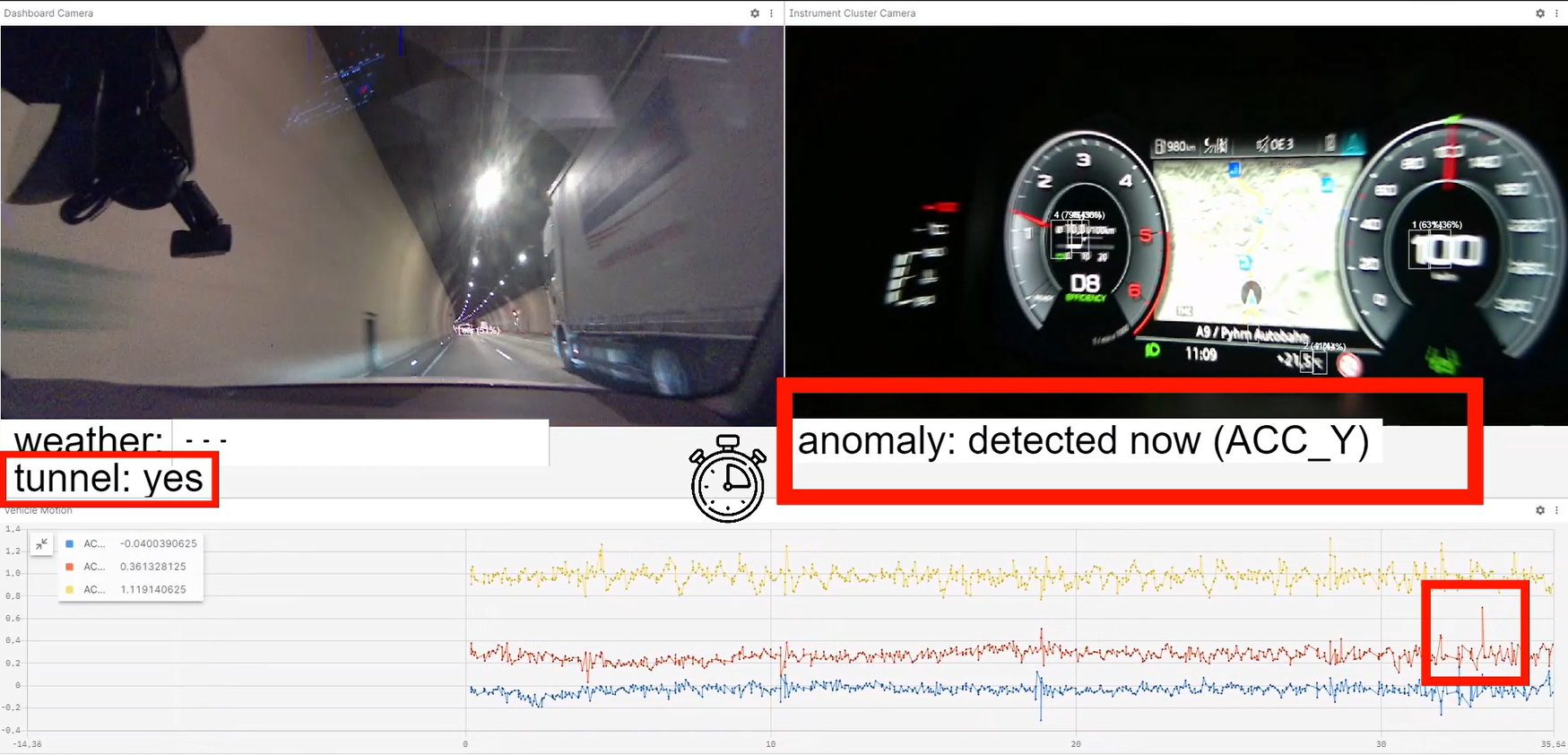
A unified software system remains consistently available, accessible at system startup regardless of the number of vehicles or onboard devices. Several implemented use case applications are currently operational on the devices. These applications include:
- Digit Dashboard Detection – QR code approach to identify regions of interest (ROIs)
- Weather and Tunnel Detection
- Anomaly Detection – Monitoring acceleration data
- Up/Download of recorded data to a backend where data analysis algorithms are applied
- Retraining of ML models in the backend which can be updated on the edge device in runtime