
DPA_inklusive
The project "DPAinklusive" focused on the development, implementation, and evaluation of Digital Personal Assistants (DPAs) in selected workplaces at Team Styria Werkstätten GmbH. The overarching goal was to empower disabled employees—especially those with support needs—by integrating digital assistance systems into their daily work environments. This initiative built upon the outcomes of the earlier "4.0inklusive" project, aiming to transform theoretical findings into practical applications.
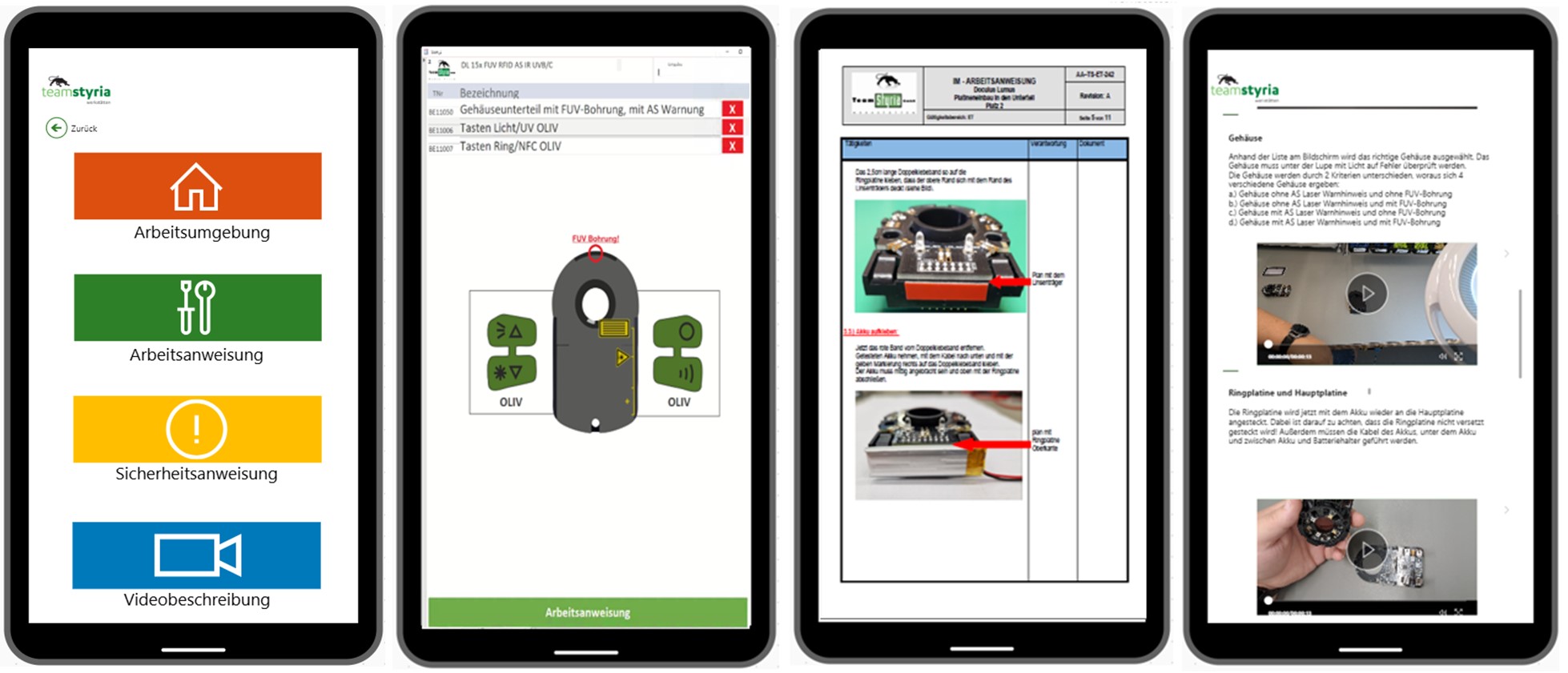
A Digital Personal Assistant (DPA) is a compact, portable computing device designed to assist users in carrying out various work-related tasks. Within the project, DPAs were introduced in the business areas of Wood Technology Graz, Metal Technology Graz, and Electrical Engineering Graz. These systems were tailored to the specific tasks and needs of each workplace, supporting employees with instructional content, real-time guidance, and adaptive learning tools.
The project followed a structured approach, divided into eight work packages (WPs). WP1 focused on preparing and involving employees from the start. WP2 dealt with the acquisition and adaptation of suitable technologies. In WP3, the DPAs were implemented and tested in real work settings. WP4 centered around employee training and feedback collection. WP5 aimed to optimize the technology based on user experience and prepare it for broader application. WP6 evaluated the impact and effectiveness of the system, while WP7 is currently focused on dissemination, publication, and exploitation of the project’s findings. WP8 managed the overall coordination and communication among project partners.
The results of the project are both technological and human-centered. On the employee level, the DPA led to noticeable empowerment by increasing digital competencies and enabling peer-to-peer learning. Employees actively contributed to shaping the systems and discovered new ways of applying their skills. Additionally, the project produced a spill-over effect, as improved digital literacy transferred to private life—benefiting daily tasks and civic participation, such as using digital government services. The project also contributed to enhanced life quality and intergenerational knowledge exchange. From an organizational perspective, the project demonstrated how digital assistance can be sustainably integrated into inclusive workplace strategies. The image of digital tools improved among employees and managers alike, fostering a culture of competenceoriented work.
In conclusion, "DPA_inklusive" successfully demonstrated how inclusive, adaptive technologies can be implemented in real-world settings. The results are now being disseminated to inform future initiatives in industry and policy, supporting broader adoption of DPAs in both business and social contexts.
Goals
The main goal of the project "DPAinklusive" is to implement and apply the findings and recommendations from the previously completed preliminary project "4.0inklusive". That project focused on the support of employees with disabilities in production through the use of digital technologies. In this continuation, the focus is on the practical application of a Digital Personal Assistant (DPA) at selected workplaces. A DPA is a compact and portable computer system designed to assist users in various work-related tasks.
In collaboration with the employees of production at Team Styria, Pro2Future is working to introduce the DPA as an informative assistance system directly into the work environment. These digital assistants provide several types of support: Help systems that convert existing analog knowledge into digital formats—such as digital manuals, training videos, and instructions for assembly or maintenance; adaptive assistance systems that use sensors to capture the working process and context—such as interactive workplace instructions and pick-bylight solutions; and tutorial assistance systems that offer personalized guidance by delivering relevant knowledge and training directly in a situational context.
This integration is expected to enhance accessibility, efficiency, and autonomy at the workplace, especially for individuals who require additional support. The project’s overarching aim is to foster a more inclusive working environment through smart, context-aware digital tools.
Approach
The project is structured into eight work packages (WPs) to ensure a systematic and effective implementation of the Digital Personal Assistant (DPA) at selected workplaces. In WP1, employees are prepared and actively involved in the process to ensure acceptance and relevance. WP2 focuses on acquiring and adapting the necessary technologies to suit the specific work environment. In WP3, these technologies are implemented on-site. WP4 includes training sessions for employees as well as the collection of feedback to refine the approach. WP5 aims to optimize the system based on insights from earlier phases and prepare for a broader rollout. WP6 is dedicated to evaluating the impact and effectiveness of the project. WP7 involves dissemination of results, publication, and exploitation of findings, ensuring long-term benefits beyond the initial scope. WP8 ensures smooth project coordination and management throughout all phases.
Expected and Achieved Results
The implementation of the Digital Personal Assistant (DPA) in the business areas of Wood Technology Graz, Metal Technology Graz, and Electrical Engineering Graz has led to several expected and already observed outcomes, particularly for employees.
One of the most significant impacts is empowerment. This includes (i) an expansion of individual competencies, as employees are able to upskill through the use of suitable assistance systems. By engaging with the DPA, they experience and become more aware of their own abilities. Additionally, (ii) peer-to-peer learning is fostered, as colleagues participate in shared learning processes and actively contribute to shaping how the assistance systems are used.
A notable spill-over effect into employees’ private lives has also been identified. (i) The increased digital competence acquired at the workplace proves transferable to civic and social engagement, such as using online government services. (ii) Furthermore, the project contributes to quality of life by promoting competence-based approaches in private contexts, encouraging intergenerational communication and knowledge transfer within families.
In terms of sustainability, the project helps improve the image of digital assistance—both in professional and personal spheres. It also promotes a strength- and competence-based approach to workforce management, offering companies a progressive leadership model centered around employee potential rather than limitations.
Overall, the DPA deployment not only supports task execution but also strengthens individual confidence, fosters inclusive learning cultures, and contributes to broader social and organizational development.