
LineTACT
This MFP investigates models, architectures, techniques, and algorithms for reducing the time to rebalance a manual assembly line.
A primary concern in assembly production systems is increasing the flexibility and adaptability as companies move towards producing highly customizable products in small lot sizes at the costs of mass production. Manual assembly processes exhibit tight dependencies between work steps, their duration, input, required machines/tools/skills, product variants, product mix, and production cells/stations.
Optimally balancing the assembly steps across the available assembly stations requires a multi-objective optimization: ensuring that all workers have equally much to do, don’t sit idle within a assembly tact, but also are not constantly stressed to meet the tact time, have all parts nearby to avoid non-productive activities such as fetching parts from their (temporary) storage location, achieving this for every station (so that all station consist of roughly equally long work steps, a necessity for a fixed tact), and achieve this over all products on a line as well as all product variants. The result of balancing is a set of assembly processes, one for each product that describes exactly which step is done at which station by which worker using which parts.
One aspect in generating such a distribution of tasks is the dependencies amongst task (some task might need another task done earlier such as mounting the tracks requires the prior mounting of the wheels). Hence obtaining a usable assembly process upon introducing a new product or new variant requires several rounds of design and feedback from the line before all errors (e.g., impossible task sequences, suboptimal task sequences) are removed. Most often the knowledge to do this is available only as tacit knowledge among the assembly workers, station leaders, and line leaders. Explicitly modelling all dependencies is not only a very costly (because time consuming) task but also quickly outdated as smaller and larger adjustments are made in the product design or line layout. Constantly checking and improving the dependencies quickly becomes infeasible.
Instead, this project aims at reusing data from past processes, line layout, and parts to find similar situations, extract dependencies from this and produce a baseline line balance. This reduces the effort required for engineers to come up with a first balance while having the advantage that the approach and algorithm learns over time from an increasing data set and also encourages thus the exchange of tacit knowledge across production sites. The challenge is to derive at suitable similarity algorithms that can distinguish between generally valid dependencies and variant or product specific peculiarities that might not be found in past data. The approach thus has to provide accurate results even in the presence of incomplete and inconsistent data (e.g., dependencies in one product are not found in another, and vice versa).
Goals
The overall project goal is - in the sense of applied research – the investigation of a new approach to support the planning of the timing of an assembly line. The primary approach to reduce the effort for deriving a configuration is to automate it as much as possible, to generate it at least partially automatically, and thus to have provided a usable basis for manual refinement and expansion.
The specific goal is to continuously improve the priority graph (the graph that defines assembly dependencies) without aiming for a perfect graph. Creating a perfect graph is too lengthy and time-consuming and potentially changes again and again. Instead, it should be possible to continuously improve it and to model how precise / inaccurate certain dependencies are, hence introducing the concept of the partial fuzzy priority graph.
Approach
The approach is based on “Design Thinking”. Stage1 Empathize: Interviews and workshops with company partners showed the current complexity of modeling the assembly process and the balancing procedure. Stage 2 Definition: Based on this, specific objectives of reducing the time for balancing were defined and use cases were developed in which target attainment was to be measured (e.g., amount of automatically, correctly allocated steps to stations). Stage 3 Ideate: Based on a study of the state of the art and research, several architectural solutions and allocation strategies have been identified. Stage 4 Prototype: Simple / advanced prototypes focused on the basics and iterative enhanced prototypes allow fast implementation of ideas. A first step similarity measurement algorithm was implemented. Stage 5 test: Scientists and engineers at the industrial partner will evaluate the prototype and thereby generate feedback for the previous 4 stages. The whole process is highly iterative and non-linear, feedback from each stage to previous ones is not only possible but explicitly desired.
Expected and Achieved Results
This project has two main expected results: (i) a set of similarity metrics and step-to-station allocation algorithms building on top as well as (ii) a prototype integrating these metrics and algorithms to evaluate the performance of the algorithms and, more importantly, enable the reduction of the time needed for line balancing.
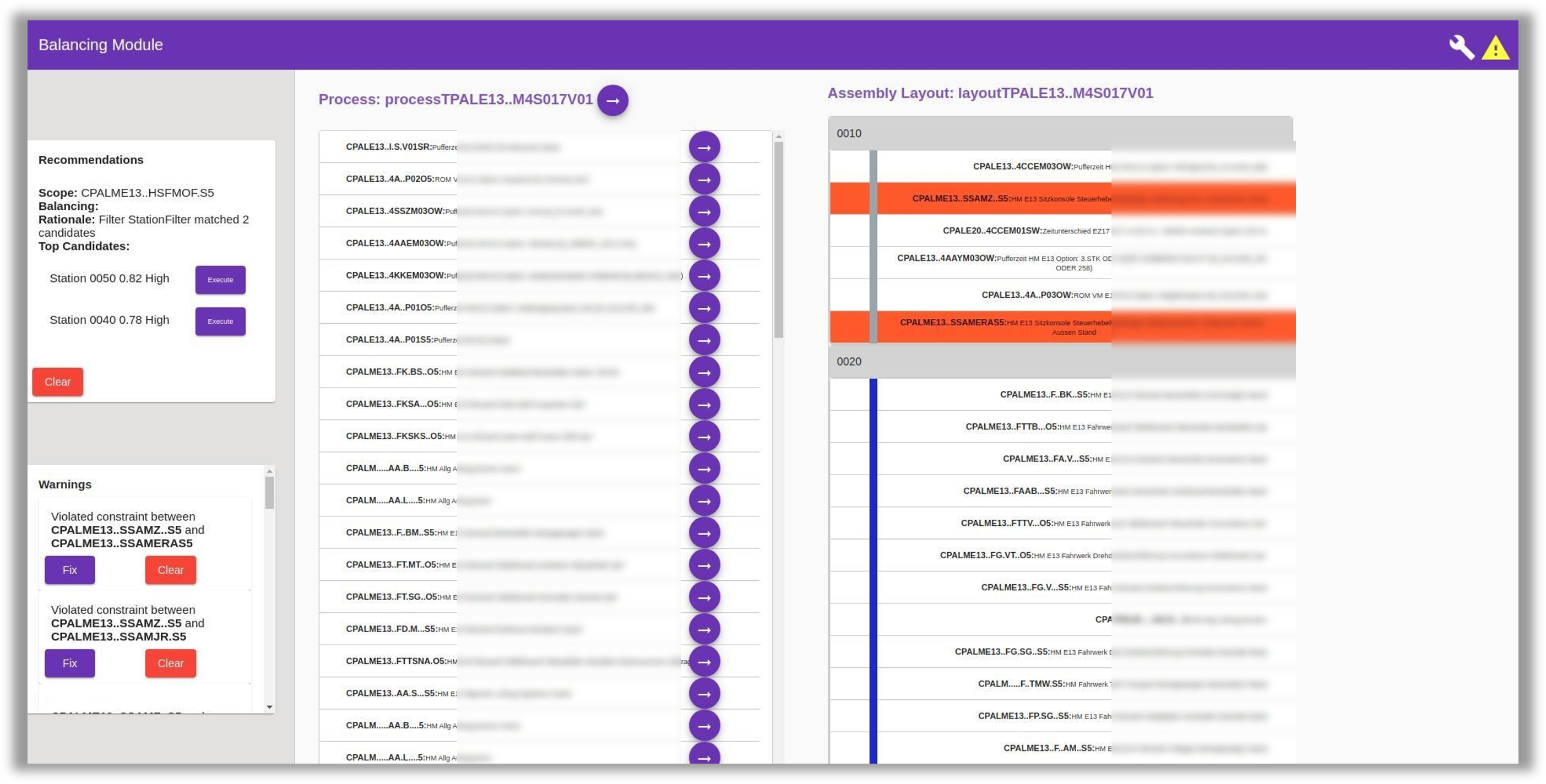
The prototype will be fed with previous line balancing configurations, line layout, list of current steps to be balanced (i.e., allocated across the stations), and each step’s involved part (where applicable). The line balancing engineer then has the option to request step to station allocations at various levels of accuracy, obtain rationale why a particular allocation has occurred, may refine the allocation, and while doing so, will receive warnings if the new allocation appears to violate some implicitly learned step dependency. The engineer can always choose to ignore the warnings.
The step similarity metrics help to identify where previously unseen steps (e.g., new steps of a new product) may best be allocated to and what other steps need to come before and may follow thereafter.