
HOP-ON
Production Systems are systems-of-systems and very specific and unique systems. Here Production Systems address machines composed of mechatronic systems and also shop floors that are composed out of machines. In order to control, adapt, and achieve interoperability among machines, a common communication infrastructure is envisioned that targets the peculiarities of shop-floors and robotics. Dynamics in the production environments require the system elements (machines, sensors, etc) to be adapted to changing needs. However, this flexibility of adapting a system based on changing behaviour and / or structure of systems that form the system under consideration comes not for free, but needs to be designed in order to be available and hence needs a middleware that support such adaptivity.
The basis of any such adaptativity is awareness what is going on the shopfloor and how interactions among shopfloor participants can be traced back to particular orders, respectively, products.
Goals
The overall project goal is - in the sense of applied strategic research - to enable a new approach to support the monitoring of work processes, orders, implementation on the shop floor / assembly floor between machines, robots, and humans. Approaches from applied software engineering to systems of systems monitoring are to be researched. These approaches are primarily evaluated in laboratory environments, but it is also possible / planned to prototype them with industrial partners (up to Technology Readiness Level 4). This exploration is carried out using software prototypes.
Approach
The project’s approach is based on "Design Thinking".
- Stage1 Empathize: Insights into the problems of existing Pro2Future partners and other industrial companies in the context of existing collaboration describe the current challenges and processes in monitoring system-of-systems in the industrial sector. These insights help to make realistic assumptions in the algorithms and prototypes.
- Stage 2 Definition: Building on this, the goals of system-of-system monitoring are adjusted based on new knowledge (stage 1) and use cases are refined, which allow the achievement of the goals of the project to be measured more precisely. Feedback from stage 5 (test) enables iterative adjustments and objectives of the ideal phase (e.g., which model / information sources, i.e. algorithms, were promising, which were not and in which direction the next idea (state 3) and prototype phase (stage 4) should go.
- Stage 3 Ideate: Based on the study of the state of the art and research, existing fuzzy information description models and information merging algorithms are identified for their applicability, expandability, modifiability or their shortcomings.
- Stage 4 Prototype: Simple / iterative improved prototypes focused on the basic concepts allow quick implementation of the ideas. The prototype implementation is based on the prevailing conditions on the shop floors of the industrial partners. Prototypes range from demonstration of individual algorithms, to scenario walkthroughs on paper, to manual simulation of production situations, and use in laboratory environments.
- Stage 5 Test: Scientists (and indirectly reviewers as part of submission reviews) evaluate the respective prototype and thereby generate feedback for the previous 4 stages.
The chosen technical approach basically consists of the following components:
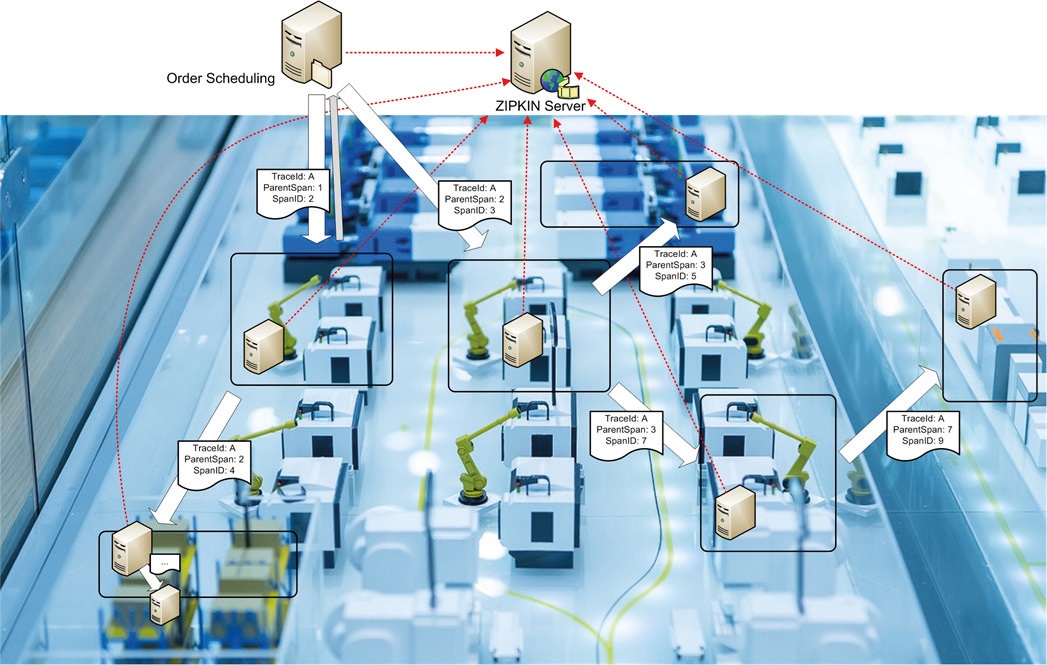
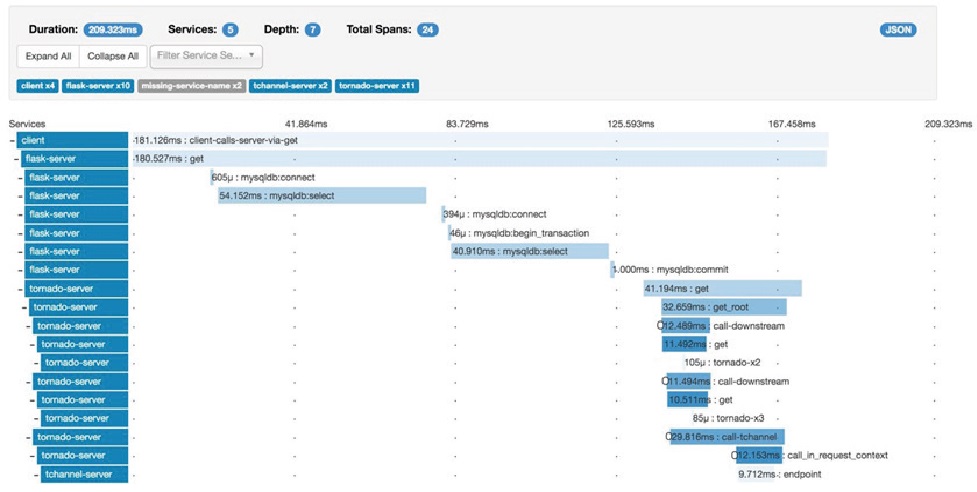
- Enrich communication channels / messages / events / calls with context information: this is planned to be based on X-B3 http headers and Zipkin tracing infrastructure, whereby the header formats are adapted to the respective transport / communication technologies: ie OPC UA header, MQTT message meta information, Akka Actor Message meta information, etc.
- Pass through context information such as order id, iteration ids, batch ids, process step ids, etc. through the individual systems: this means that any reaction to signals (messages, calls, parameter read / writes) can be assigned to a very specific order and can be precisely tracked in what condition and, consequently, why the individual shop floor participants reacted to this order.
Expected and Achieved Results
This project is of high strategic relevance: Accurate monitoring what goes on on the shopfloor and enabling all shopfloor participant to better perceive their usage context is fundamental to adaptation at across all levels. Hence this project investigated following key aspects:
- Tracking processes / orders / activities through a complex production environment (system-of-system) requires the observation of control / data flow, correlation of events / messages across system boundaries and the merging of model information about the individual systems. Due to the different processing speeds (near-realtime machine control, slower human workers) and participants (machine, robot, humans, logistics), this is a significant problem that has not yet been adequately solved.
- A new approach is control / data flow, the correlation of events / messages is not tracked top-down (e.g. in MES) but bottom-up, directly via the effective individual communications, control and data connections.
- As a side effect, the participants were able to experience their work context directly instead of being provided incompletely and with a delay from “above” (i.e., the MES).
Concretely, the expected output of this project are prototypes and accompanying methodology how to incorporate cross shop floor tracing information in communication channels and how to set correlation and sub interactions appropriately.