
GuFeSc
Nowadays, customers require more and more specialised products adapted to their specific needs and circumstances. This results in a large number of product variants and options, creating a considerable challenge in the maintenance and support of all these products. Since customers also expect a high quality of support for all products, personnel working in testing, maintenance, repair or customer support require considerable time to familiarise themselves with all variants and available options so that they can satisfy these expectations.
This is as cost intensive for the manufacturer as it is cumbersome for the worker. Hence, there is a large potential for assistance systems that provide help to the maintenance and testing personnel and reduce their required training effort. This project researches support systems for maintenance and testing personnel, which are based on data collected during the testing and operation of the devices.
One major aspect is to split up the devices into their components. This spilt-up is then the basis to identify relationships between the collected data and the affected components. Since there are many product variants and options, it cannot be expected to have a sufficiently large data basis for all products. Hence, the approaches researched here should be capable of transferring insights discovered in one particular setup to other setups if the circumstances deem this reasonable.
This is an important aspect to support maintenance and repair personnel in handling rare problems and setups just as profound as the most common once. The prediction of wearout in some parts is another important aspect of the project. By modelling and estimating the expected wearout of parts, their lifetime can be estimated allowing to schedule required maintenance actions well in advance.
Goals
A large number of product variants and options make maintenance and support tasks a complex undertaking where the unique characteristics of the product at hand need to considered. It also implies that there are only a small number of commonalities between different product variants and options. The objective of this project is to research new support systems for workers in fault identification and maintenance. The support system should draw its knowledge from different data sources capturing aspects like successful or failed product tests, product usage data or maintenance action reports. All available data sources currently collecting knowledge for other primary uses should be investigated about their potential applicability for the envisioned maintenance and repair support systems.
Due to the large number of product variants and options it is unlikely that for each and every product configuration enough data are available to create a dedicated model. Instead, it is an objective to research the possibility of applying a model and its insights also to other, similar products. In this process commonalities between the different products should be identified allowing conclusions by analogy between the products and use them to derive support for maintenance workers dealing with unseen product variants. This is a requirement to adapt to new products or variants with small lot sizes. Hence, maintenance workers can be assisted with the required information about expected causes for equipment failure, provided with information about what spare parts are most likely required and when maintenance actions should be scheduled in advance.
Approach
This project follows a fully data-driven approach where at the beginning of the project the available data sources of the industrial partner are evaluated according to their potential use in this project. In an explorative data analysis phase, the data sources are matched to the information needed to solve the posed questions. This matching shows the potentials and shortcomings in the available data sources highlighting where additional work or knowledge bases are required.
In the next step, the data are used to generate models by using machine learning approaches. These models are crucial for the approach, since they will be used to derive the support actions suggested to the workers from the data describing the case at hand. The models cannot be derived from a single data source but additionally require an interaction with workers to incorporate their knowledge.
Expected and Achieved Results
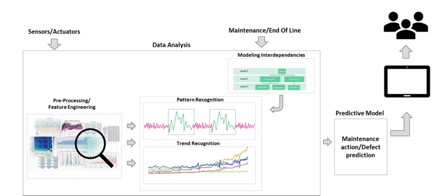
The project aims at the creation of predictive models to support maintenance workers by suggesting (1) components potentially responsible for failures, and (2) scheduling and type of maintenance actions. These models are derived in a data driven manner from currently available data sources and also knowledge captured by employees on a daily basis. To do this, the data and knowledge are analysed and transformed to train models by means of machine learning. In this process, potential missing information is identified leading to a plan on how to improve and adapt the data collection in the future.
Based on the collected data and the already existing product structure, the devices are split into components. Different error pattern observed in the past are then matched to the components, therefore creating the basis to suggest error causes and affected components for maintenance work. This is accompanied by a wearout prediction to estimate the life time of selected parts. Hence, the wearout prediction is essential to schedule necessary maintenance actions in advance.