

DRIWE
In order to establish new services and applications in the context of cognitive products and production processes, it is necessary to have information on the current and historical behavior of the target system. To monitor and gather such information, a dependable communication infrastructure and sensors with adequate sampling rate are needed. A good example for products which are currently undergoing rapid cognification are cars. Real-time monitoring of temperature, pressure, acceleration, voltage, chemical composition, or force, measured at a high sampling rate (100 Hz) within defined areas of the vehicle, constitute vital information which can be used for autonomous driving, online optimization of vehicle performance, or to guide future development of car components.
Vehicles are a challenging environment for sensor integration, partly because vehicles and their components (such as motors) are becoming increasingly compact, leaving little room for a sensor system. Given these spatial constraints, hardwiring the sensors within a motor block is not an option, although this would provide sensors with a continuous power supply and means of wired communication. For this reason, autonomous sensor solutions are required in the context of in-car communication, as they can provide flexibility in terms of sensor placement and energy supply. Current in-car communication is based on the Bluetooth Low Energy (BLE) standard, a radio frequency (RF) technology. BLE provides considerable flexibility regarding sensor placement and exhibits good power consumption characteristics. Unfortunately, the in-car environment contains many metallic surfaces which can result in unwanted reflections of RF wireless signals and a corresponding reduction in signal quality, thereby negatively impacting communication dependability.
This MFP investigates how the intelligent design of antennas and wireless RF communication systems can be optimized for in-car communication. Antennas, among other system components, play a crucial role in RF communication and can therefore be adapted to improve communication within a specific environment. Given the vast amount of different car designs and sensors, it is simply not possible to establish a one-design-fits-all antenna design and communication infrastructure for optimal in-car communication. To provide dependable communication, the underlying solutions must be individually adapted for their application environment to achieve optimal performance. The goal of the MFP is therefore to develop a framework which allows optimization of the antennas used by the sensors and the underlying communication network topology in an RF communication system, given a target in-car environment.
Goals
Dependable communication plays a key role in the implementation of cognitive services and applications. Given the increasing diversity of products and their designs, bespoke communication frameworks are necessary to achieve dependable performance. The automotive industry is a very good example for the continuing individualization of products. Given the vast differences of in-car environments, the development of in-car communication requires novel solutions in order to optimally adapt the communication system to its operational environment. In this project, RF wireless communication systems will be investigated in terms of their application in this domain.
The project will establish key performance indicators (KPIs) which allow the assessment of wireless communication systems in in-car environments. Based on these KPIs, the project will research means of improving communication quality. As real-world experiments for in-car communication are very costly, the overall goal of the project is to establish a simulation framework for the automated design of in-car wireless communication systems. The envisioned framework will allow a specific in-car environment to be modelled, which can then be used to design the optimal RF wireless communication system for that environment. Optimization will be achieved by adapting antenna designs, antenna types, sensor positions, and communication network topologies for the target environment, resulting in bespoke, dependable communication solutions.
Approach
In order to establish a framework for the design of wireless communication systems for in-car environments, the following approach is taken. First, existing RF communication solutions for in-car environments are analyzed and KPIs are established to assess the quality and dependability of communication solutions. Second, a simulation framework is established, based on existing simulation software and parameterized using real-world sensor measurements. This simulation framework will be used to calculate the KPIs of a communication system in a specific in-car environment. It will then be used to iteratively generate, evaluate and optimize an antenna and communication system design until an optimum has been reached for a specific in-car environment.
Expected and Achieved Results
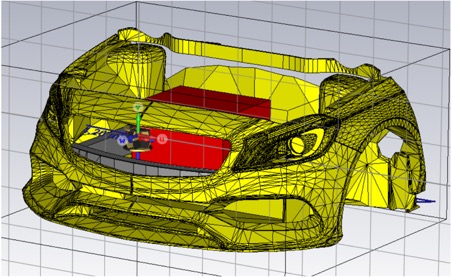
This project involves the systematic exploration and development of dependable RF communication systems for in-car environments. The project will result in an in-depth analysis of RF constraints in cars. So far, an initial electromagnetic simulation model of a motor block and a typical RF antenna has been established in order to investigate the behavior of reactive near-field and radiative near-field of antennas and the corresponding propagation effects within the in-car environment. Using standard RF sensor hardware, various tests and measurements were designed and are currently being performed in order to specify the characteristics of the sensor hardware. These experiments involve establishing the directional characteristics of the wireless sensor node and its antenna in environments with differing amounts of metallic elements. The results of the experiments will be used to tune the simulation. Once the simulation is aligned with this ground truth, the project will focus on the optimization of wireless sensor nodes in in-car environments. The optimization approach will investigate to what extent multiple-input and multiple-output (MIMO) antenna systems, different antenna types such as directed antennas and broadband antennas, as well as environment-specific antenna designs can improve the dependability of wireless in-car communication. The most promising concepts and technologies will be evaluated in the context of a demonstrator. The methodology resulting from this MFP is a first step towards establishing individualized, dependable wireless communication which is specifically adapted to the communication environment of a product and its production processes. The approach taken and results gained can be abstracted and used to facilitate future cognitive services in other branches.