

Graz/Linz, September 2026. Manufacturing industry needs to cut its CO₂ emissions, yet a product’s energy demand is usually assessed late in the design process, or only afterwards. This is where the REDUCE project comes in: together with Know Center, Haratech, Syrion, Tripan and TU Graz, Pro²Future is developing a decision support tool that gives product designers and production planners predictions of energy and material consumption. The first results are now available.
DEXPRO: Exploring the energy consumption of design and CNC machining
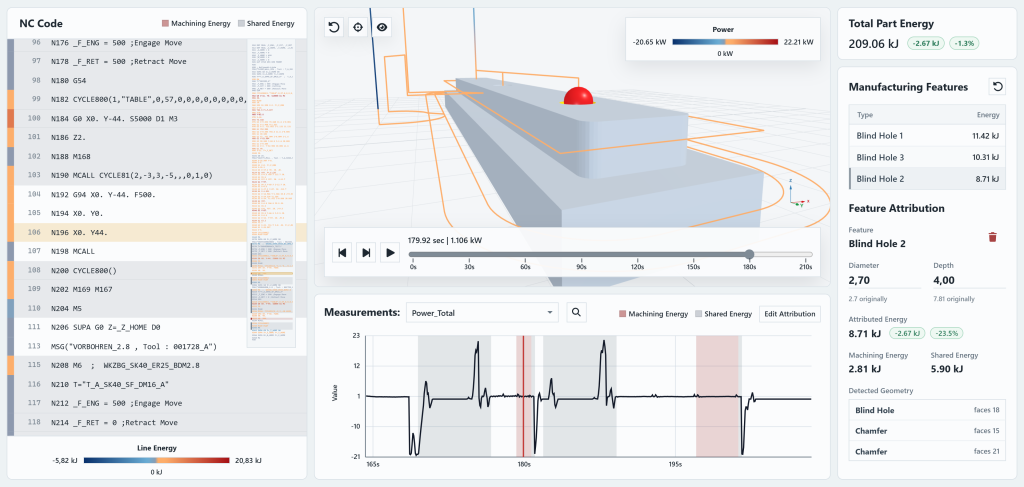
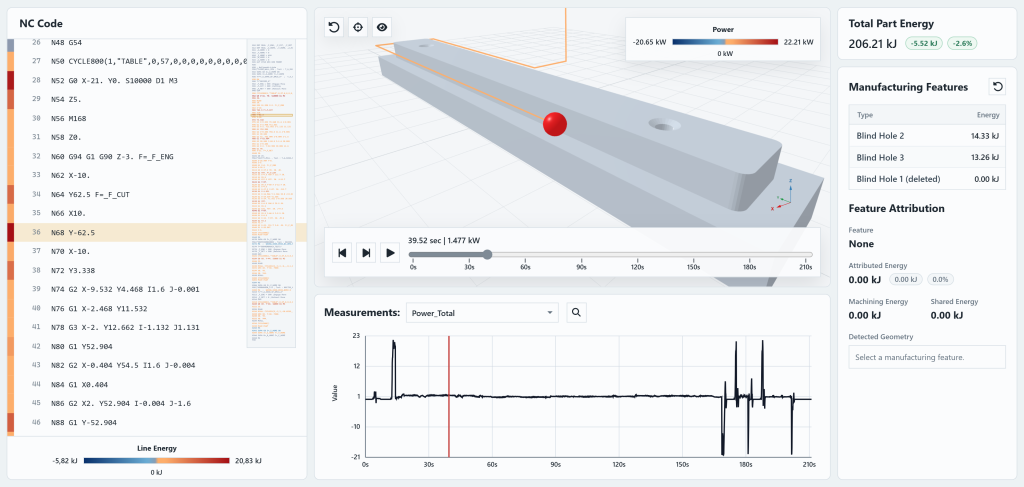
DEXPRO, developed by TU Graz, links 3D geometry, NC program, toolpaths and machine measurement data in one interactive interface. The NC program is displayed line by line alongside the energy consumed by each instruction, so energy-intensive operations are quick to find. DEXPRO also automatically recognizes manufacturing features in the CAD model. When selected features are modified, the tool shows the estimated effect on energy consumption in a direct comparison. Design becomes resource-aware, and faster than the traditional cycle of designing, programming and producing.
A shared data foundation for all partners
Know Center has developed a unified dashboard for visualizing and analyzing energy measurements that is available to all project partners. It accesses the measurement data on the central server directly and was built with Python, Streamlit and Plotly. Standardized scripts for importing Tripan’s operational data are also provided.
Experiments and models for a wide range of manufacturing processes
Together with Tripan and Haratech, baseline experiments were defined that cover many common production steps. At Tripan, for example, holes are milled and drilled in different ways, using various materials and settings. At Haratech, the same object is 3D-printed with different settings; in a second experiment, different geometries are printed with a uniform setting. The data will be used to train machine learning models that deliver predictions for a wide variety of processes. For the Haratech use case, the time and material required for different geometries and settings are also modeled using linear regression based on slicer software, and then validated against operational and experimental data.
Publications
The CNC dataset, comprising geometry, NC code and high-frequency energy consumption data, has been published in Data in Brief (2025), and the tool concept was presented at EAI MMS 2025. Most recently, Know Center published an open-access paper in Waste Management & Research (2026) as part of the REDUCE project.
For more information, visit reduce.pro2future.at or contact Philipp Eisele directly.