
TWIN-SOLUTION
Due to the complexity of automation systems, extensive on-site engineering is required during installation, commissioning, and maintenance. Skilled engineers and technicians need to be close to the automation system to assemble and configure components, perform rigorous testing, and fine-tune control parameters, making this approach resource costly. Furthermore, working on a real physical system does not provide full flexibility, meaning that during the testing and configuration phase, the automation components can be damaged if a system is configured wrongly. This is especially a problem with safety-critical systems since testing in such systems often requires dangerous fault injection to test implemented safety functions and see if they can protect operators, machines, and the environment in the case of failure.
To reduce on-site engineering and allow more flexibility to the engineers and technicians, virtual commissioning and digital twins are emerging as promising concepts in automation systems, especially in safety-critical ones. Virtual commissioning is a process that involves simulating a physical manufacturing environment using software systems. The primary purpose of this simulation is to provide engineers with an opportunity to validate their configurations and test behavior before system debugging in the manufacturing production environment, enabling remote design, installation, and maintenance of automation systems that comply with defined standards and regulations without hardware equipment.
The core of the successful virtual commissioning process is a digital twin, which can represent a virtualized copy of various physical assets ranging from a production line to a single component. The digital twin integrates all data, models, and information of a physical asset, including its behavior and technical performance. The role of the digital twin is to predict and optimize performance. Digital Twins enable the virtual test of a system's behavior and have a high potential for the rapid execution of risk analyses and system tuning to verify the consistency, correctness, and completeness of an automation/autonomous system.
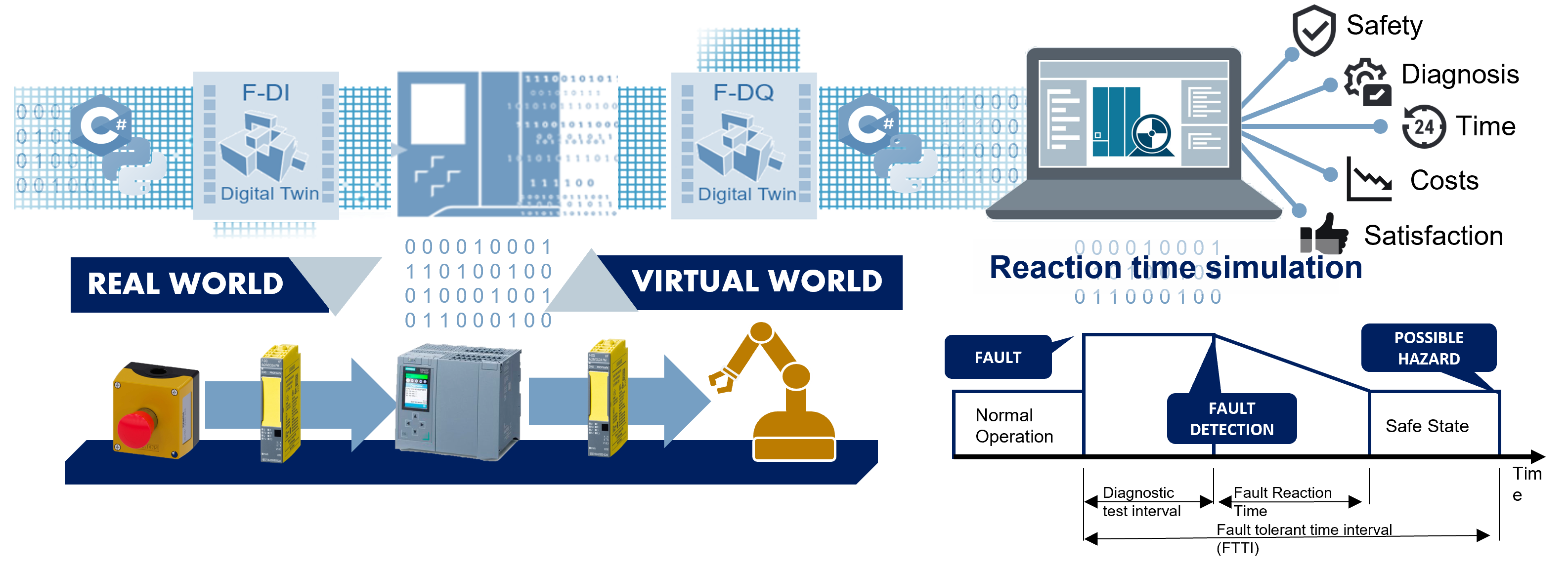
In the safety system, the configuration of safety functions and their testing is of very importance since, besides machines and the environment, human lives are also at stake, and the wrong configuration could lead to hazardous events. In this project, we wanted to develop a digital twin of the safety components and leverage the use of a virtual environment to do risk-free testing and parametrization (i.e., virtual commissioning) of the safety systems and their safety functions complying with the safety standards.
Goals
As virtualization and digital twin technologies hold great promise, the goal is to use these approaches to reduce commissioning and maintenance time in the automation industry while ensuring system consistency and features, such as safety. The research involves analyzing the behavior and performance of current safety-related physical components (e.g., safety controllers or safety input/output modules) to create their digital copies (i.e., digital twins) in the virtual environment. Since safety in these components is ensured with multiple safety functions, the goal is to successfully implement all safety functions and produce highly accurate digital replicas (i.e., digital twin) of the safety component that can aid in thorough testing and validation, ultimately contributing to enhanced safety and reliability in automation systems. The implementation of such digital twins will also lead to decreased resource requirements and offer a faster, safer, and easier way to meet the strict requirements set by safety standards. The long-term goal is to contribute to the identification and development of technologies that will play a crucial role in industrial and process automation, especially in safety-critical systems, in the years to come.
Approach
In the beginning phase, the behavior and performance of current physical safety-related components are analyzed. To ensure an organized approach, we categorized and prioritized the safety functions of these devices based on the valuable insights of on-field control engineers. In the next phase, Siemens' virtual portfolio and their virtual embracing tools, such as PLCSIM Advanced v3.0 and SIMIT tool are carefully analyzed. These tools together with a result of components analysis played a main role in our research and development process. The focus lies in comprehensively researching each safety function, creating a digital footprint of these functions, and understanding how they behave (i.e., their capabilities and limits) in the virtual industrial environment. Moreover, based on the relevant norms and regulations we design rigorous tests and conduct simulations, with a special emphasis on critical aspects like reaction time.
Expected and Achieved Results
The first outcome of the project was the detailed study and analysis of the safety functions implemented in real physical devices, which enabled the translation of their functionalities and performance to the virtual world. The safety components analyzed were the fail-safe input and output modules, indicating that in the first phase of the project, the goal was to have 2 digital twins so that the entire input-control-output automation loop could be simulated. Based on these results, the first version of the digital twins was developed using a simulation platform called SIMIT tool. Due to the complexity of the device itself and the complexity of the underlying software, the initial versions of the digital twins simulated some key safety functions that could be used for further evaluation of the overall system. One such simulated function is a logical behavior of the safety component that simulates the usage of safety architectures such as 1oo1 or 1oo2. This enables engineers to simulate and test the logical behavior of the entire system that uses safety-related components. In addition to the logical aspect, digital twins simulate additional functionalities. For both digital twins (i.e., input and output), a safety function is implemented that calculates the worst response time of the modules and informs the user about it. For the digital input, the behavior of the discrepancy analysis is simulated, which enables error detection in sensors connected to the fail-safe input module. In addition to the simulation itself, the developed digital twins impact industrial automation by enabling new and more efficient approaches such as safety-related relevant data collection, which becomes possible without additional hardware, simplifying processes and reducing costs. In addition, the new way of generating data supports research and development of novel approaches for preventive and predictive maintenance and revolutionizes the way systems are managed and maintained.