

SmartWell
Corrugated pipes provide both higher stiffness and higher flexibility while simultaneously requiring less material than rigid pipes. Due to rising commodity prices, pipe manufacturers have been driven to produce corrugated pipes of high quality with reduced material input. To the best of our knowledge, corrugated pipe geometry and wall thickness distribution significantly influence the mechanical properties of the final product. Essential factors in optimizing wall thickness distribution include adaptation of the mold block geometry and structure optimization. In addition, the energy flow in the corrugator, in particular the cooling process of the corrugated pipe, is also important for corrugator design. Modeling and simulation of the thermal energy flow during the corrugated pipe extrusion from the die exit to the finished pipe from the corrugator is the basis for solution strategies aiming at process optimization in terms of efficient cooling. Therefore, in this research work, a workflow, guidelines, and mathematical models are developed to predict the wall thickness distribution, the cycle time for the entire inflation process and the dissipated energy of the entire pipe manufacturing process. Subsequently, the models can be used for structural analysis, enabling digital mold block design, optimization of wall thickness distribution, optimization strategies with respect to fast and efficient cooling of corrugated pipes, and optimization of corrugator performance considering thermal energy aspects. The results of this research work can provide an important contribution to sustainability and resource conservation.
Goals
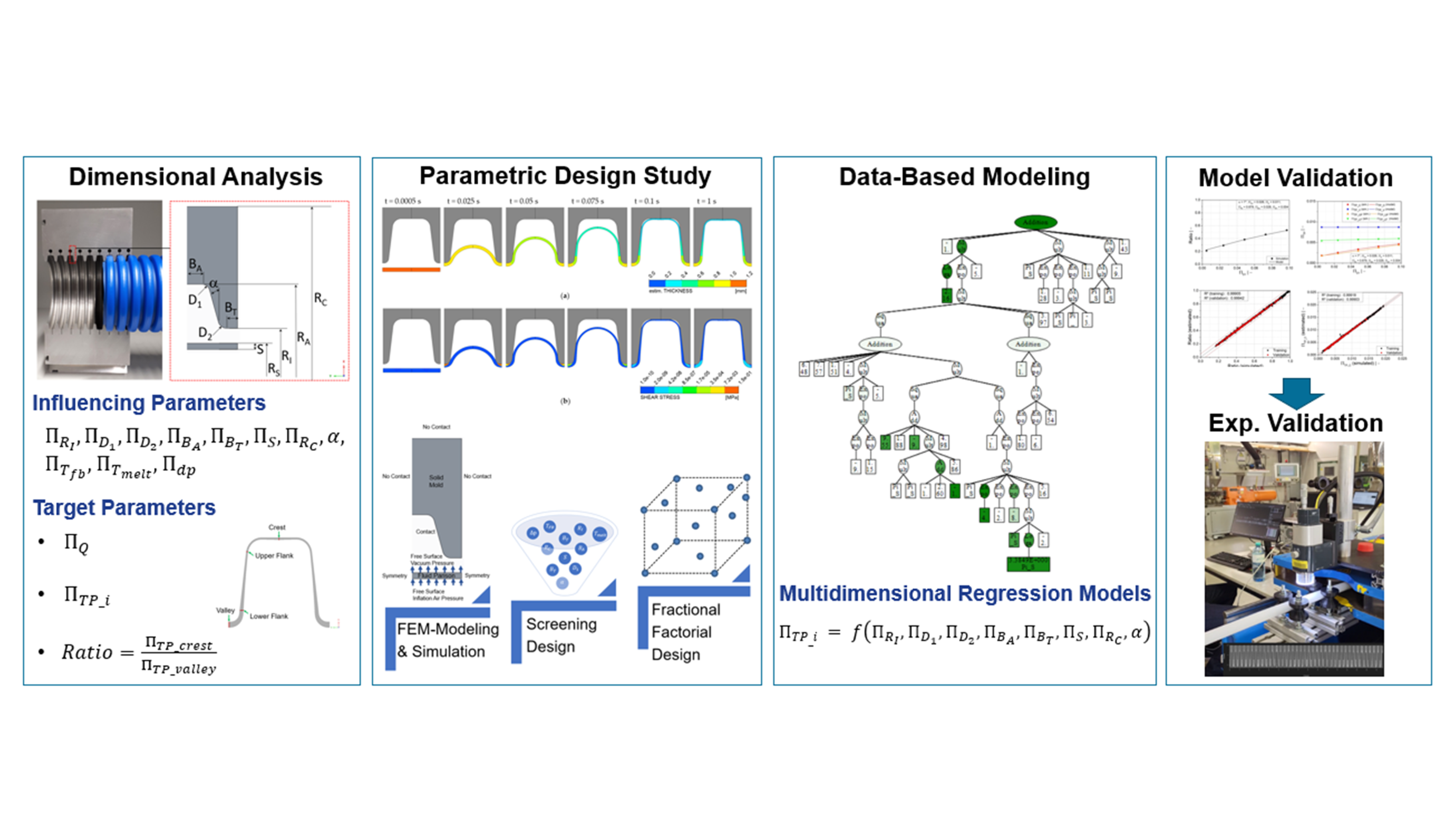
The main objective of this research work is the smart optimization of the production process of corrugated pipes. A variety of modeling methods are used to achieve the project goals. We implemented a hybrid modeling approach combining analytical, numerical and data-based modeling for corrugated pipes. Multi-dimensional mathematical models were developed and implemented using symbolic regression analysis based on genetic programming for predicting the wall thickness distribution as function of the mold geometry and initial parison thickness. These models are later optimized by taking the thermal energy flow parameters into account. Thus, the production process can also be optimized for efficient cooling. Furthermore, to ensure the reliability and performance of the created pipe geometry, a mechanical performance analysis was also performed based on the models to determine the strength of a geometry. These results will help to develop guidelines for energy-efficient manufacturing a lightweight corrugated pipe that has the required mechanical performance with minimum material requirements. In addition, the findings can be used for the effective design and operation of corrugator and for the optimization of corrugated pipes.
Approach
In the progress of this project, a hybrid modeling approach that combines numerical and data-based modeling is implemented. The workflow is structured as follows: first, the mold block geometry with different mold shapes is analyzed. Then, the similarity theory is applied to determine the dimensionless influencing geometry and processing parameters, and then a comprehensive parameter design study is conducted to identify the most critical influencing parameters. The results of numerical simulation are later used as input for data-based modeling so that mathematical models can be developed. Furthermore, a mechanical performance analysis is performed based on the wall thickness models to determine the achievable strength of geometry. In order to gain insight into the physical conditions during the mold process, a selected mold block, equipped with a specifically devised sensor inset, will autonomously collect data for the analysis process.
Expected and Achieved Results
In general, the expected results of this research work relate to the knowledge gained to optimize the manufacturing process and the final product itself, as well as to optimize the corrugator design. Using engineering simulation and data-based modeling to develop mathematical models for the prediction of the wall thickness distribution and the heat flux in the corrugator. Furthermore, guidelines and strategies for manufacturing a lightweight corrugated pipe that has the required mechanical performance with minimum material requirements will be provided.
So far, the initial stage of modeling the entire process of corrugated pipe extrusion has been achieved. The influences of major geometry parameters on the parison inflation process were identified and investigated by applying the theory of similarity, dimensional analysis, and a parametric design study. Correlations between independent and target parameters were established and utilized to estimate the wall thickness and its distribution in corrugated pipes. Multi-dimensional regression models of the wall thickness distribution as a function of mold geometries in extrusion blow molding of corrugated pipes were developed using heuristic approaches and implemented for mold design in the early design phase. The comparison of numerical simulation results and model predictions also confirmed the validity and feasibility of the regression models developed in this work. First comparisons with experimental trials delivered promising results. These results showed that the wall thickness predictions capture the reality as long as the velocity of the extruded parison approximately equals the line speed of the corrugator. For new processes, the proposed method may prove to be a valuable tool for minimizing the number of expensive and time-consuming experiments when evaluating (new) pipe designs and may add value well before the final product is produced. The developed models allow a target variable (of the corrugated pipe geometry) to be predicted without manufacturing and prototyping of a product. In addition, the regression models can cover a wide range of geometry variations as they are dimensionless, and as long as the new geometry is within the chosen dimensionless geometry parameter range. For very small and very large corrugated pipes, there is some risk that the dimensionless parameters fall within the extrapolation range for various reasons.