

E-MANAGER
To reduce CO2 emissions, besides the automotive industry, manufacturing industries are increasingly under pressure to optimize processes and procedures for energy efficiency. These optimizations mainly involve the production processes, where most energy demand occurs. Alternatively, when most of this energy demand can be determined during the product design phase, the product designer can make energy-efficient decisions in the design phase. Most product designers are unaware of their decisions’ significant impact on a product’s energy demand. Therefore, this project develops a workflow and novel method for predicting the energy demand of parts of their machining operation during the design phase. For this purpose, 29 energy consumption models for machining processes are examined, and the data published in the literature are summarized. Four resulting comprehensive process maps are derived, which enable the prediction of a part’s energy consumption due to machining, specifically, the milling operation, based on the geometric features of the part. This was further verified on three machined parts. The workflow and methods developed in this project are some of the first steps to facilitate conscious decisions already in the product design phase. The benefits of the method were demonstrated in a final survey: Both product designers and machine operators showed in this survey that their estimation of the energy consumption of the parts investigated differed by orders of magnitude.
Goals
All state of the art energy consumption models in machining examined are based on machining parameters, which cannot be determined solely based on geometry. The second point to note is that all models are based either on general physical relations or on experimentally determined data, but there is no formal mathematical inductive derivation. Thirdly, some specific models are difficult to generalize or the accuracy of these models is greatly reduced. The question, therefore, arises as to how the extensive data and models in the literature can be used to predict energy consumption during the machining phase. Moreover, the prediction must be done at the product design phase by the use of geometrical features of the designed part and the volume of raw material of the part. The challenge lies, on the one hand, in the fact that in the product design phase, there is not yet any precise information about the subsequent machining and the associated related parameters. On the other hand, a key basis of many models for predicting energy consumption is the process-related material removal rate (MRR), which is also not known precisely in the product design phase but can be estimated between upper and lower borders based on literature and industry experience.
Approach
In the progress of this project, we first investigated how such a prediction of the energy consumption of parts can already be made in the design phase with the help of a workflow and which parameters are necessary for this. It is shown that the workflow is more comprehensive than can be researched in this project. Therefore, the core of this workflow, the method that assigns different geometrical features to energy consumption. In the next step, this method is derived theoretically. In contrast to existing methods from the literature, which are derived inductively from experiments, this project proceeds deductively and derives an analytical connex between energy consumption and part geometry. This correlation is verified in the following step utilizing experiments for machining and validated in the next step through a user study with product designers and machine operators.
Expected and Achieved Results
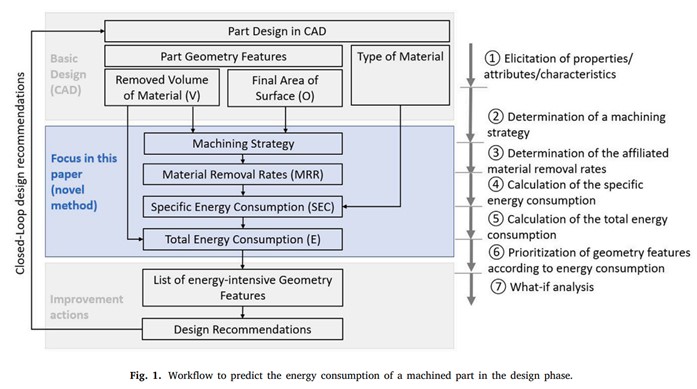
To determine the energy consumption of the parts already in the design phase, data from the corresponding machining process and the part geometry from the CAD software are necessary. The entanglement of these data is the first novelty of this project. From the CAD software, the material, surface and volume properties assigned to the part are read out, as well as the individual geometry features. Based on these properties, a machining strategy is assumed for each geometric feature. With the assumed machining strategy, the metal removal rate, the specific energy consumption and finally the total energy consumption are calculated for each geometric feature. Finally, the geometry features are sorted and prioritized according to the ranking of energy consumption. These can be fed back to the designer as a design recommendation in the form of a closed loop to create awareness and enable the designer to design parts in a more energy efficient way. Furthermore, as part of this workflow, this project investigates how total energy consumption can be derived from an assumed machining strategy, thus developing an analytical method, which is the second and the major novelty of this project. To verify this method we focussed on the machining strategy of fine milling.
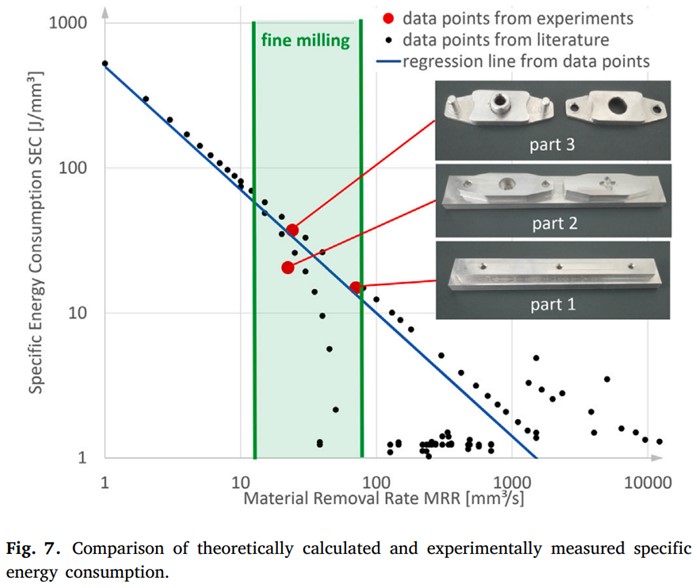
In this project, a workflow for predicting the total machining-related energy consumption of a part during the design phase was developed. Within this workflow, a novel method was derived that links parameters from product design, like the removed volume of material, with data from the literature for machining. Therefore, 628 data points from the literature were elicited and reverse-calculated to create process maps for steel, aluminium, cast iron and nickel. In most of the studies in literature, the parts were machined without lubrication. However, the data points for nickel come from a study that uses a special form of minimum quantity lubrication and therefore they are significantly lower than the others. This method was verified based on 3 experiments. Experiments were performed for 3 aluminium parts and the novel model was applied. All experimentally assessed values of energy consumption were within the upper and lower limits of the developed theoretical model. Hence, it was shown that it is possible to predict the total energy consumption in machining processes based on the part geometry and material type within reasonable margins of error. The benefits of the workflow were confirmed by two surveys: The novel method limits the variance of the estimates of the energy consumption of the parts of part designers and machine operators by more than a power of ten. From the results until now, we can draw the following conclusions:
- First, the specific energy consumption for machining of all investigated material types decreases with higher material removal rates.
- Second, the energy consumption of machining a part can already be estimated in the design phase. In the cases researched in this project, a maximum deviation from the experimentally measured energy consumption of 208% for machining could be determined.
- Third, the maximum deviation of the presented model is, however, smaller than the deviation of the opinion-based estimated energy consumptions of designers and machine operators, which was shown by a study carried out. The deviation in this study was several orders of magnitude higher than that of the model.