

ACTION II
The complexity and demands of assembly tasks in production have been found to increase cognitive load in assembly workers. This leads to physical stress effects induced by work overload. To determine how assembly tasks can be assessed for stress effects, the project conducted a study using wearable sensors to measure heart rate and heart rate variability. The project showed that heart rate and heart rate variability, along with questioning of the assembly workers, is a valid process for stress detection and classification. The project used the machine learning algorithms, Random Forest and K-Nearest-Neighbours, to analyze heart rate and heart rate variability. These algorithms were able to distinguish between assembly task and rest phase, as well as between an easy and hard type of assembly tasks, which is a significant novelty of the project.
Goals
In the state of the art, a wide variety of stress detection studies were conducted. However, these were carried out exclusively under laboratory conditions with highly accurate and expensive measuring equipment which require specialized personnel to use. Furthermore, there are no studies in the literature so far, that assess the stress of workers during assembly operations with commercially available wearable sensors. As a consequence, the research questions of this project emerge as follow:
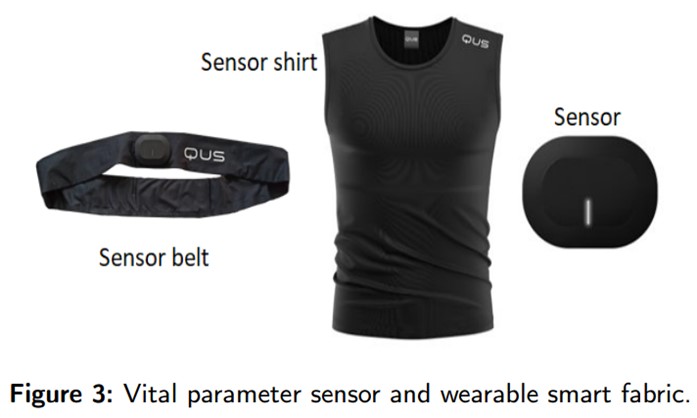
- Are there commercially available sensors which are able to measure physiological stress responses?
- Can machine learning algorithms distinguish between workload (overload) phases and rest phases by evaluating vital parameters of subjects during assembly tasks?
- If this is the case, is it possible for the algorithms to distinguish between the workload of a task based only on the measured stress responses?
- If machine learning algorithms can satisfy the previous research questions: how well do machine learning algorithms perform in recognising and classifying stress?
Approach
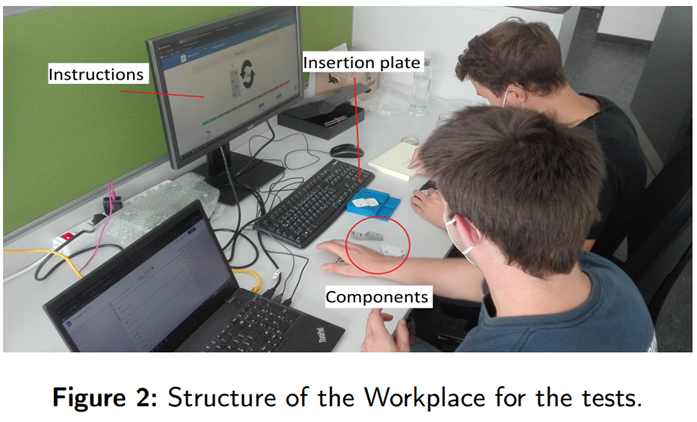
This project investigates how the condition of a subjects measured by means of a commercially available wearable sensor is related to the subjectively perceived stress. Based on two machine learning algorithms, Random Forest algorithm (RF) , K-Nearest-Neighbours algorithm (KNN), it is investigated if and how precisely these algorithms can distinguish between a person put under work overload and a resting phase. For this purpose, a study is conducted in the field of assembly tasks. The assembly tasks during the study must be performed by each subject faster than calculated by the Method Time Measurement (MTM) method, which should induce work overload related stress to the subject. The physiological stress response is measured by the relative changes in of HRV and HR. In addition, a subjective assessment of workload was conducted using the NASA-TLX method. The results are compared afterwards.
Expected and Achieved Results
In this project, a commercially available wearable sensor was used to measure time series of HR and HRV of subjects. Two machine learning algorithms, KNN and RF, were trained to automatically distinguish between the difficulty levels of an assembly task. The KNN was found to have lower overall accuracy compared to the RF. The RF algorithm was found to be more suitable for both stress detection and stress differentiation. The highest achieved labeling accuracy between 75% and 90% was produced by an unbiased RF classifier. The detected stress levels are compliant with the subjective stress perception: Robustness comparison for algorithms trained on all subjects but one and tested on the missing subject with absolute maximum normalisation. The NASA-TLX score is interpreted with an given workload scale: low (0-9), medium (10-29), somewhat high (30-49), high (50-79), and very high (80-100). The global minimum approach reduced the accuracy of both algorithms significantly. One reason for this decrease in accuracy is the resulting form a skew change and decrease of deviation of the distributions resulting form the normalisation and scaling. When the absolute maximum value normalisation is applied the resulting distribution of data has more similarity (standard deviation, skew, quantiles, ect.) to the distribution of the raw data when compared to the minimum value scaling. The minimum value scaling tightens the distribution and therefore reduced the standard deviation of the resulting distribution compared to the raw data distribution. This effect leads to worse performance especially with respect to the KNN algorithm which is highly affected from the distribution of the data.