

ASP2 II
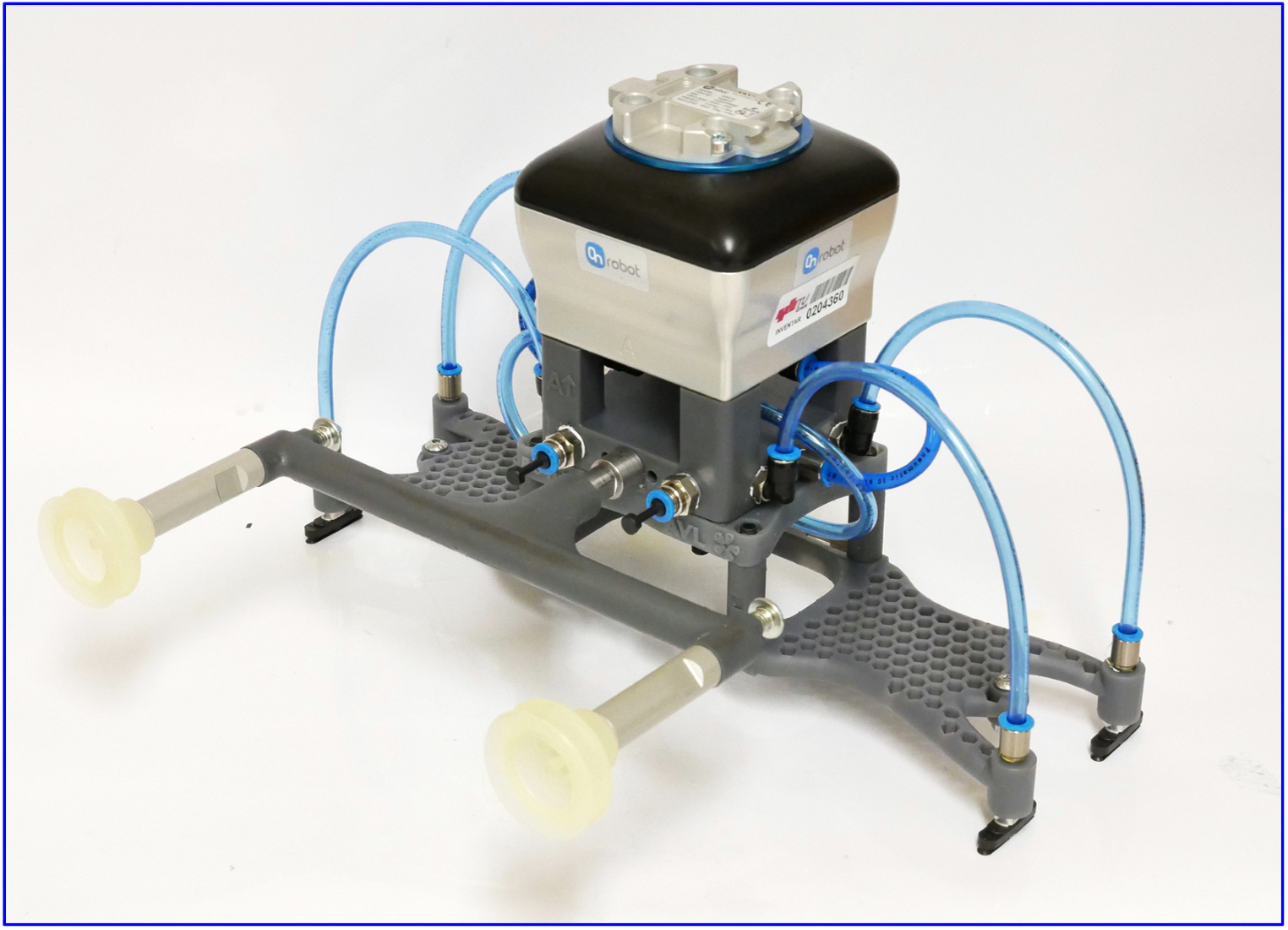
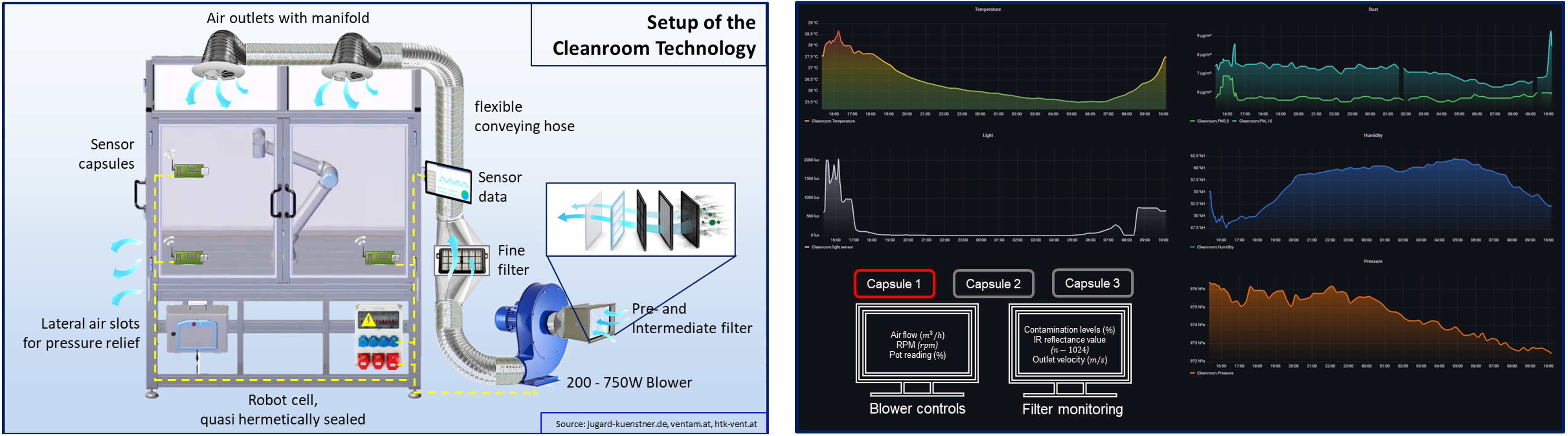
In recent years, research in the field of fuel cells is gaining momentum. Leading automotive industries are investing in e-mobility. In fuel cell research, topics such as fuel cell durability, degradation phenomenon, catalyst performance enhancement, etc., are mainly researched upon. However, one fails to recognize the need for innovations in the area of assembly systems for the stacking process. In this project, a modular approach referencing two topics is addressed. Firstly, the gripping of bipolar plates and the membrane electrode assembly layers for the stacking process. Second, the development of modular cleanroom for the stacking process of the polymer electrolyte membrane fuel cell (PEMFC). A vacuum end-effector (VEE) gripper is innovated, designed, and manufactured using 3D printing methods. It is then tested in real-time at the maximum acceleration of the Cobot. The cycle time of assembly per unit cell achieved was 1.25s; for comparison, manual stacking per unit cell is averaged to approx. 8s. Therefore, huge potential savings in assembly time were denoted. Additionally, the benefit of using a vacuum end-effector gripper mitigates the particulate matter induced via manual handling. This prevents the early degradation of the fuel cell. The assembly technology postulated in this project integrates a complete loop of design, manufacturing, and assembly of the VEE gripping mechanism. With respect to the second topic, the cleanroom is designed and developed to address the fuel cell contamination occurring during the handling and manual assembly of the PEMFC. Four sensory capsules situated in the cabin, where the stacking process takes place, capture the relevant data with respect to the environment. These sensors measure parameters such as temperature, pressure, humidity, dust levels, i.e., particulate matter, etc., and monitor the environment. Additionally, the filter-fan-unit responds to the measured parameters accordingly to deliver clean air to the cabin. Thus, addressing the closed-loop system for the fuel cell stacking process.
Goals
The focus towards the Sustainable Development Goals and Circular Production is addressed by the ASP2 Project. At ASP2, the goal is to develop a resilient adaptive system of the fuel cell stacking process that must be integrated with the existing battery stacking process. Vacuum end-effector (VEE) gripping mechanism is developed for handling of unit cells along with the stacking process. The concept of ISO standard cleanroom for stacking process is also prototyped at the institute. In ASP2, we focus on:
- Development of flexible handling technology for gripping of BPP and MEA layers.
- Analysing the necessity of a clean environment, i.e., cleanroom for the stacking operation.
- Development of a modular cleanroom with ISO standards.
- A GUI (Graphical User Interface) of real-time monitoring of cleanroom which also indicates the control environment of the filtering and high-efficiency blower system.
- Stacking process of the unit cell components, which form the core of each polymer electrolyte membrane fuel cell (PEMFC).
Approach
The challenge was to handle the individual unit cell components robotically since some of them are very sensitive and limp. Until now, the cell plates have been stacked almost exclusively by hand, due to careful handling and maximum precision in positioning is required to guarantee the full power potential of the fuel cell with the longest possible service life. For the automation of stacking, a collaborative robot was used on which a specially developed vacuum end-effector (VEE) made by SLA printing was mounted.
In the aspect of development of cleanroom, the basic approach is to utilize the data generated from the sensory system to enhance the stacking process via the developed user model. Four sensory capsules with 6 sensors in each capsule record the data and displays it on a GUI with real-time monitoring and control. They are: Temp – °C, humidity – %, pressure – Pa, velocity of airflow – m/s, light intensity – lux, and particulate matter – µm are monitored. Through the developed graphical user interface (GUI), airflow – m³/hr is controlled.
Expected and Achieved Results
The runs with the fastest settings had an angular velocity of 180deg·s-1 with an angular acceleration of 500deg·s-2. Since the suction cups were dimensioned accordingly, the holding force was suitable for the test sequences. During the verification of the VEE gripper, the time of a sub-cycle lasted 5s. This sub-cycle included the parallel gripping of the two-unit cell components - BPP and MEA, and two intermediate layers - between the unit cell components (see Figure 6). The cycle time of the stacking process per handling object is therefore 1.25s. For comparison, manual stacking at this assembly station resulted in an average cycle time of approx. 8s, with comparable accuracy. The unit cell components were assembled with high accuracy. In this case, the BPP and the MEA layers could be positioned congruently to each other, with an accuracy of less than 0.2mm. The unit cell stack, i.e., the entire stack, for the Gen0-PEMFC includes 142 BPPs and 142 MEA plates, therefore 284 unit cell components. Assuming that another 284 intermediate layers are placed in each of the shaft magazines of the unit cell components, the total number of handling objects would be 568. Therefore, the stacking of the entire unit cell stack would take 710s or 11.83min without interruptions of material feeding. By further calculation, the cycle time of 1.25s per handling object would mean a theoretical unit cell stack production of 15200 pieces per year. This is achieved by assuming 568 handling objects, an overall equipment efficiency of the system of 80% and a two-shift system of 8 hours each.