
CAVL-SD
Whether manufacturing physical products or delivering virtual services, corporations engage in a variety of sub-processes which are interrelated both within and across different phases of the production development process. In addition to achieving the core functional purpose of each step, each of these sub-processes generates information. This can be information about the product itself as well as information on the process. There are countless examples of information generated during production development. Corporations have already started to collect and store such information, with the expectation that this data might prove useful in the future as a means of generating valuable insights about production, and thus as a means of improving the production process and the generated product. Although this information may already be stored, most of it is not yet integrated into the overall production development process. In addition, such data is usually designed and used in a very specific context (e.g., monitoring the quality of the product during a particular production step) which leads to this data being generated in a wide range of proprietary or open formats (for example, as plain comma-separated-value files) which lack proper or standard facilities for preserving possibly important accompanying metadata about the production development process.
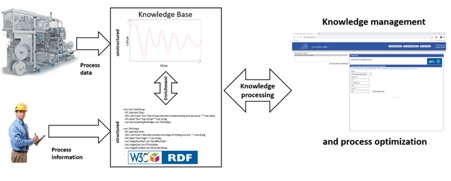
The MFP aims to develop a framework which allows (i) semantic modelling of the overall production development process and its underlying sub-processes, (ii) an interface to the production environment, to facilitate (iii) the active integration of process data into the semantic model, which leads to the potential for (iii) a data-driven optimization of the overall process. This will result in an application framework for cognitive production processes (linking the research with Area 4.2), which enables a process to act based on historical and currently perceived process information. The framework must provide tools and applications which allow creation, management, and adaptation of the models of the underlying sub-processes. Additionally, methods need to be derived which prepare and link process data generated in the various stages of the production process with the semantic model by means of meta-data. Once integrated into the process and linked to process data, the framework will be used to monitor and optimize key performance indicators (KPIs) of the production process. Automated reasoning (cognition) will be implanted to allow optimization of an individual process or of the overall process composition. To validate the ease of integration as well as the benefits of the framework and its underlying cognitive process, it will be tested in the context of dedicated use-case scenarios.
Goals
In order to remain competitive, companies constantly need to individualize and optimize their production development processes. One way of achieving this is by means of active integration and utilization of process data. For this, a foundation of models and tools is required that allow creation and management of data-related models, as well as a way to link such models with whatever process data is available. The goal of this project is to research how semantic technologies can be applied in the context of complex industrial processes. This requires the development of structures that enable easy mapping of the production development process into process-models. In addition, methods need to be established to allow the integration of unstructured data (such as time-series) into these process models. Such structures can be used as a basis for the optimization of individual processes and for the management of interdependent processes. Using such mechanisms allows a company to better understand the impact of individual steps of the product development process on the overall process, and to include this information as a driver of change in the development process. By providing predictions of the impact of potential changes on the production process, flexible and adaptive production processes are enabled.
Approach
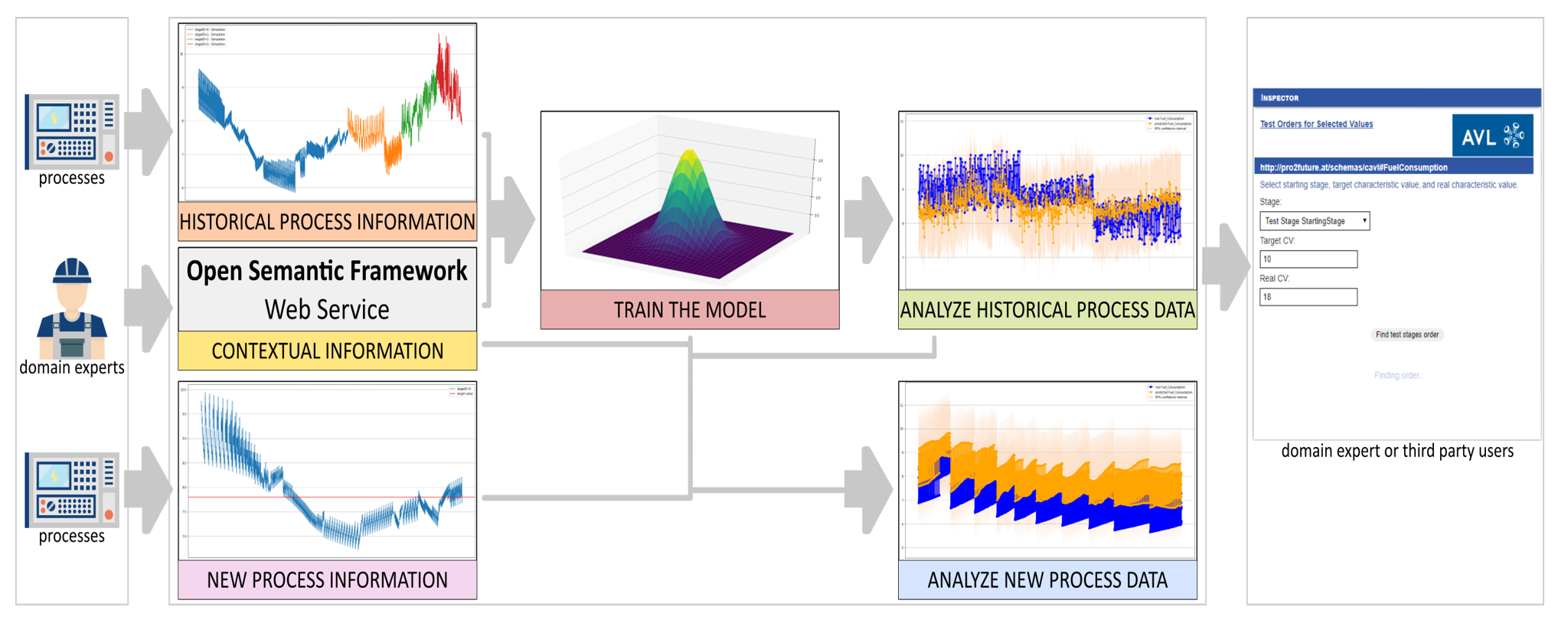
First appropriate information models and interfaces linking the production system to the semantic model framework are established. An information model is established as a group of interlinked resource description framework (RDF) ontologies. Each ontology maintains information relevant to a specific problem. Second, interfaces to the production system are designed and developed by extending the semantic model framework. This includes interfaces to process information which can be enriched with metadata; interfaces allowing the saving, access to, and management of process information; as well as interfaces which allow external applications to access the framework. In a third step prediction models are developed which allow to estimate the quality of processes and allow for their optimization.
Expected and Achieved Results
The product development process framework developed within this project will allow its users to model the overall production development process, while utilizing interfaces into the production environment allowing active integration of process data into the model to facilitate data-driven optimization of the modelled process. So far, the initial framework has been developed, and a simple product development process has been modelled. Based on this framework, we are currently investigating how structured data stored in the form of directed graphs of resources can be linked to unstructured data like time-series data produced during production, as well as how the system can be used to gain information about ongoing production to further assist smart management of the production process. After the concepts for this data integration are derived, the project will focus on the application of cognitive reasoning for process optimization. As the feasibility and benefits of such a semantic framework will be demonstrated and tested in the context of several specific use cases of the company AVL List GmbH, tools which allow the integration of the framework into their product development process will be developed.