
REWAI
The REWAI project aims to enhance sustainability through cognitive decision-making, utilizing explainable AI techniques to augment human intelligence with machine intelligence. For this purpose, it contributes (i) virtual sensor implementation for quality prediction in time series, (i) development of trustworthy Explainable AI techniques which establish trust with users, (iii) establishing the cause-effect relationships within the production parameters. Along with company partner Lenzing, these interfaces will enable human workers to be in control and provide human oversight by creating trust in Human-AI collaboration. The main factors of the environmental impact in global fashion industry are the use of resources (lands, water, chemicals, etc.) and energy, and greenhouse gas emissions. AI-based methods are leveraged to optimize resource efficiency and increase competitiveness of sustainable fibers, reducing the industry's footprint and boosting market pressure on unsustainable synthetics.
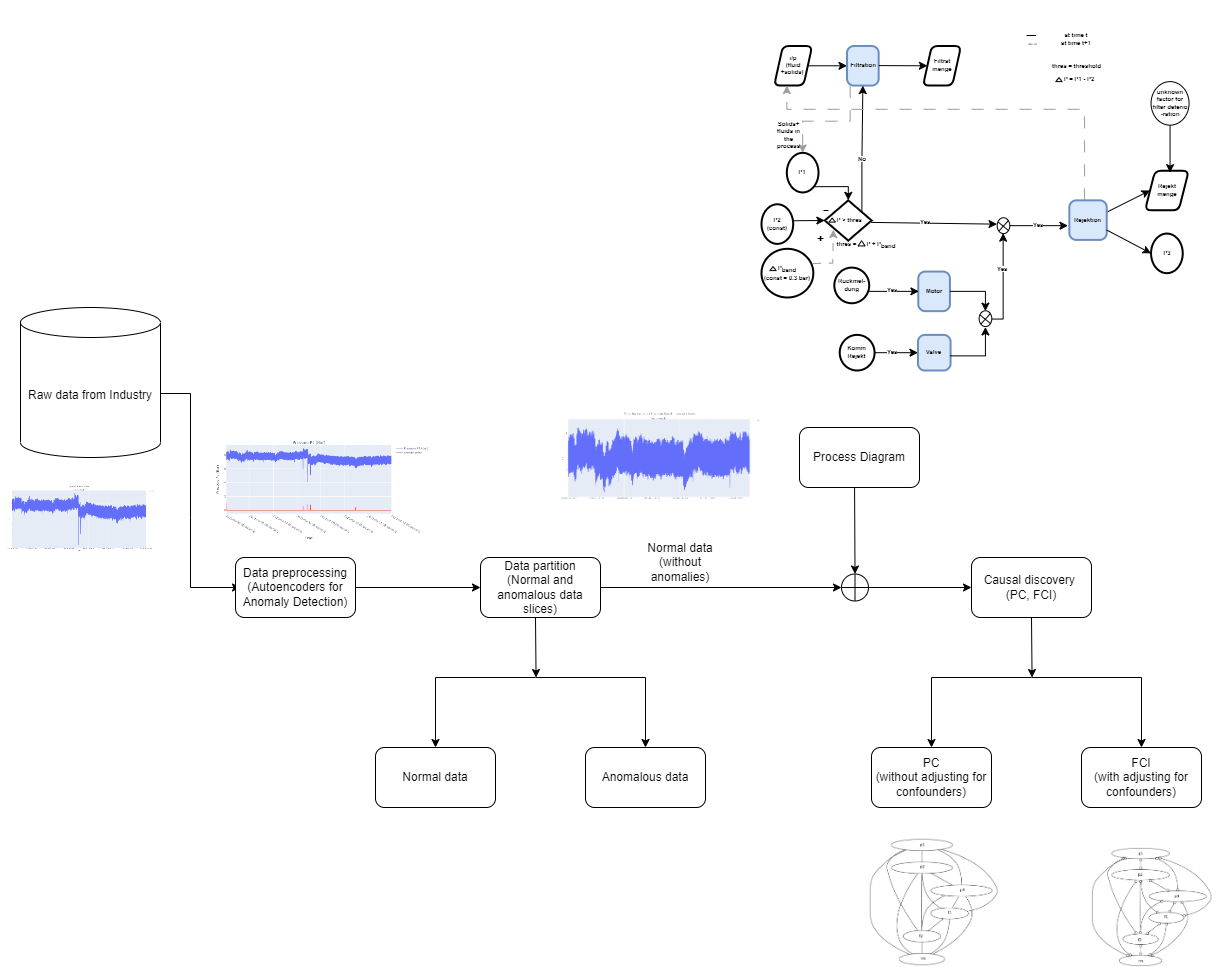
The process incorporates parallel sieves, arranged in dual groups, where each sieve executes filtration and rejection/backwash procedures. Filtration removes impurities from the input fluid (viscose), while rejection/backwash removes the filtered impurities. The outcome is the sought-after high-quality, clean material. The process entails a causal mechanism influencing the material quality. Adjusting parameters impacting output has the potential to elevate the final product's quality. Moreover, this mechanism is valuable for root cause analysis, identifying origins of faulty items, and it enables predictive analysis, anticipating faulty products and suggesting changes to prevent defects in advance. However, there are challenges behind the optimization and adoption of AI in this process, e.g., complex relationships among factors, finding global optima, ensuring stability, high dimensionality. Also, creating accurate and interpretable models is related to the right balance between intricate models and transparent decision pathways since those models often tend to function as “black boxes”.
To overcome these challenges, we use various AI-based techniques with the aspects of data analysis in production process and the real-life application. We implement a trustworthy AI in the production pipeline, fostering human-machine collaboration to enhance human performance by combining human perception with the process power of computers. To prevent low-quality outcomes, we focus on high-frequency data for initial optimization and low-frequency data to establish causal relationships between subsequent stages. This strategy aims to avoid inferior quality products that would require recycling, thereby reducing energy loss, plastic waste, and storage needs. Additionally, we develop techniques where the users can understand the implications of AI with confidence and control over the system by clearly communicating key data and methods.
Goals
REWAI focuses on diminishing the environmental impact of the textile industry with the aim of reducing operating costs and enhancing the competitive edge of unsustainable synthetic fibers. This initiative encompasses two primary objectives: (i) constructing a prediction system upon the already implemented sensor instrumentations to ensure timely intervention and (ii) trustworthy decision-support to the decision-makers throughout the production pipeline to guide human using AI tools. The pursuit of optimized production, minimizing energy loss, and waste necessitates (a) uncovering causality gaps and measurement gaps, (b) embedding energy-efficient explainable AI tools and (c) providing counterfactual-based explanations for what-if analysis to the overall process. We establish root cause analysis that identifies reasons malfunctions or suspicious activities by defining the underlying causal mechanisms. This knowledge allows us to enhance final product quality by addressing direct and indirect factors impacting output parameters. Meanwhile, the explainability in our system will ensure that the operators and end-users can understand the output of ML and predictions so that they can be able to perform human oversight, monitor the outputs continuously and be enabled to re-evaluate the model with ensuring the validated input and output.
Approach
We use diverse AI-based models, including CNN, RNN, LSTM, and the hybrid ML models, Autoencoders. Initially, we train these models individually on each sieve’s data, later, perform combined training on all data for a unified prediction model. This approach aids in model comparison and evaluation of its generalization ability. The pivotal aspect of this is comprehending the operational intricacies of each machine and their interactions in parallel operations, along with discerning the impact of individual and collective machine behavior on sensor values.
We use anomaly detection to tackle component failures and build a causal graph for the process. Causal discovery algorithms identify relationships in normal and anomalous data, comparing causeeffect using metrics to locate anomaly origins. In the field of xAI, counterfactuals provide interpretations to point out which changes would be necessary to accomplish the desired goal.
Expected and Achieved Results
REWAI has two main objectives: (i) implementation of AI-driven quality outcome prediction within the production pipeline, (ii) building a trustworthy for decision-making system with the aspect of “human-inthe-loop”. Our primary focus is on comprehending the factors that lead to low quality production and provide this insight to the users with the context of fairness, explainability, auditability and safety.
We have used Autoencoders to drive an input representation from multi-dimensional time series data, thereby extracting relevant features. Later, we have created univariate and multivariate input-output structures and performed AI models to achieve real-time performance. Our findings show that these models can capture the meaningful features and the patterns by r educing input dimensionality, and they can be used for high-frequency data labelling where the changes and outliers occur at a lower frequency. Parallel to this, we have employed individual models for each sieve and a unified model trained on the entirety of the data to observe prediction models’ sequence prediction performance. The goal of observing the behaviour of the prediction models with several approaches is to draw a framework for the XAI application according to the reasons behind the input-output relation. However, in practical scenarios, it is not always feasible to measure every quality attribute and establish a direct relationship with the final product quality. Hence, conducting causal discovery becomes essential to identify the key factors affecting product quality and optimize
them effectively. Causality analysis serves two main objectives in this context. Firstly, it enables root cause analysis for identification of the reasons behind malfunctions or suspicious activities occurring in the process. Secondly, causality analysis holds the potential to improve final product quality. The knowledge derived from the causal graph can be utilized for predictive analysis for a feasible prediction of when a hole is likely to be created in the sieve, enabling proactive measures to prevent or mitigate potential issues.