
StreamingAI
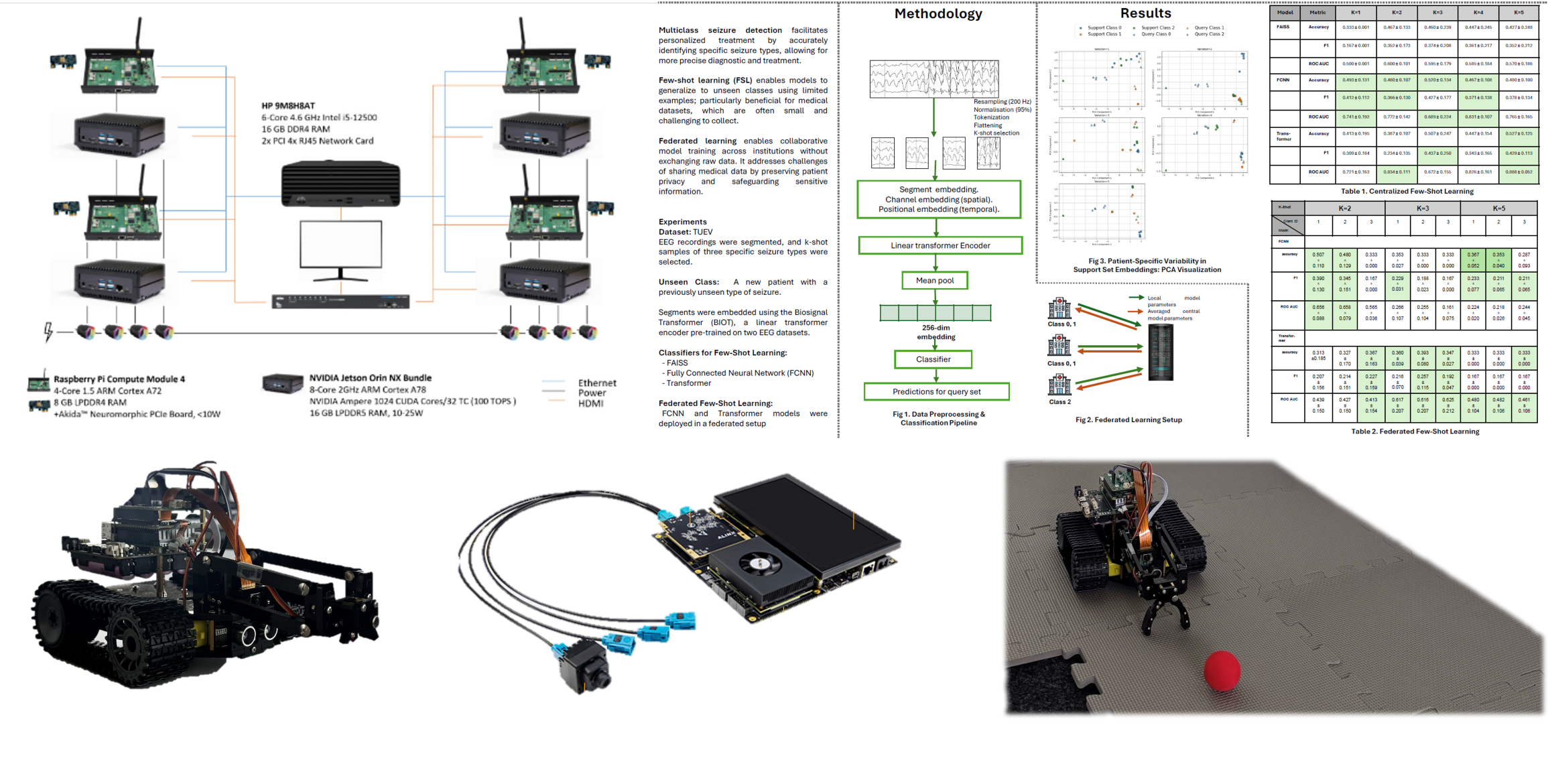
StreamingAI is a basic research project with the aim of raising “perception” in the sense of artificial intelligence in federated ensembles to higher TRLs, as well as training these federated ensembles on the basis of incremental learning methods (reinforcement learning, few-shot learning). Streaming AI researches the perception and recognition of objects and situations in changing systems in a federated manner. The consortium has completed the basic research work by surveying the state of the art, designing initial prototype system architectures and defining possible implementation candidates. A system architecture was selected and implemented as prototype reference architecture, and several proof-of-concept studies on the assumptions and decisions made were calculated. Currently, StreamingAI has a stable federation setup using both (i) a software simulation environment that can emulate arbitrary network topologies and network link parameters, and supports implementation of arbitrary learning tasks, aggregation algorithms, routing approaches, and approximated energy measurements, and (ii) a physical federation testbed using 8 energy-efficient AI devices suitable for embedded applications. By integrating neuromorphic computing units, StreamingAI enables the applicability analysis of this technology for the digital transformation of the industry, especially in the context of systems that require high processing speed and energy efficiency. Additionally, 3 custom-built, self-propelling compute units were created for studies with mobile, collaborating, autonomous devices. The project has further set the task of developing and evaluating the federated systems developed by applying the principles of reinforcement learning and, based on biological learning systems, using only a few training examples (few-shot learning). Following the development of the physical and simulated testbed, the consortium has continued to focus on proof-of-concept studies on federated ML, with the integration of multi-agent reinforcement learning and few-shot learning currently undertaken.
Goals
StreamingAI aims to (i) develop strategies that leverage federated learning to minimize the time, energy, and memory requirements for re-training neural networks, (ii) design and implement frameworks that ensure secure, and trustworthy data exchange in distributed learning processes, (iii) develop and optimize federated learning techniques for embedded devices with limited computational, storage, and communication resources, by pre-processing machine learning models for efficient on-device execution and enabling decentralized, consensus-driven model updates, bypassing the need for centralized orchestration, (iv) advance the technology readiness level (TRL) of spiking neural networks (SNNs) by developing and implementing industrial prototypes, with a focus on enhancing perception capabilities and enabling online learning in real-world applications, (v) develop adaptive learning systems capable of generalizing to new environments with minimal temporal exposure, using zero/few-shot and reinforcement learning methods, while overcoming the limitations of current approaches that struggle with scenarios unrelated to the original data distribution, (vi) accelerate model-free reinforcement learning by leveraging reward decomposition and distribution across state-action pairs, and by integrating advanced techniques such as soft Q learning, reverse reinforcement learning, and adaptive profiling of state-action sequences. The research aims to enable flexible, agent-based learning for acquiring new skills in dynamic environments, address delayed rewards in complex multi-step tasks, and ensure efficient information flow in low signal bandwidth conditions.
Approach
StreamingAI takes an incremental approach to machine learning, in particular the deep learning methods, and proceeds according to the principle of federated, and reinforcement learning. In digital industrial systems, it is generally not possible to assume the existence of large and multifaceted training datasets, which is why the approach of pre-trained models (such as ChatGPT - generative pretrained transformers) is not compatible with the industrial reality. Based on biological learning systems, the project pursues the development of the ability to learn quickly from just a few training examples (few-shot learning) or learning according to the reinforcement principle (reinforcement learning, as in human learning). This requires the development of new approaches that run counter to established ML methods and are not based on data storage for training purposes, but on incremental learning from data streams.
Expected and Achieved Results
The project has currently achieved results in both targeted research domains of federated learning, as well as incremental learning. The comprehensive development of the state of the art led to drafting commercially viable application scenarios currently under implementation and study. The completed development of both the physical and simulated system architecture, as well as the proof-of-concept studies, have demonstrated the feasibility of increasing energy efficiency while maintaining recognition accuracy. The development work on the first prototype resulted in useful findings for the Pro2Future II Hearing. The successful technical development of a federated streaming architecture enables the current work with realistic data. A study on federated few-shot learning in the medical domains has been concluded and is currently being published. A multi-agent reinforcement learning system with mobile, autonomous sensor and compute platforms was developed and is currently used for study of reinforcement learning for path planning. Finally, a simulation environment for federated control of PID controllers in furnace and reactor settings was developed and is now used for study.