

CompEAS-BSW
Embedded systems for vehicles are still implemented in a strictly static way: The individual functions are first implemented and tested separately for each Electronic Control Unit (ECU); their integration in an ECU is then largely manual. However, there is little support for dynamic modifications or partial updates in the field and there are currently no established and standardized mechanisms for ensuring the preservation of correctness during or after a modification. This applies to both the basic and application software and needs to change significantly due to the increasing number and complexity of in-vehicle and cross-vehicle functions.
First, the computing power required for future vehicles (e.g., for AI and machine learning for ADAS and autonomous driving) cannot be increased simply by installing more ECUs. Instead, a wide range of functions must be integrated on as few devices as possible per vehicle to reduce costs, weight, energy consumption, etc. In addition, new hardware functions (e.g., processors with domain-specific functions) to dynamically variable logic (e.g., in FPGAs) are constantly added. In addition, wireless networking of vehicles brings new challenges. While customers want convenient access to new features and flexible customization, security vulnerabilities or software failures need to be addressed in a timely manner to prevent malfunctions and attacks. This relevance is not only about the careful development of a reliable Embedded Automotive System (EAS), but also about its long-term maintenance. The software must be re-integrated during updates and the basic software must be adapted to new hardware. CompEAS-BSW is dedicated to automating the necessary processes by exploring new concepts for model-based software design and the composition of modular software with changing non-functional requirements.
CompEAS-BSW addresses with the dynamic composition and reliability of the entire software stack of embedded systems: The holistic approach ranges from the conception of future basic software (model-based OS design and portability) to module-based software development and partial updates (automatic integration and non-functional requirements). The results of CompEAS-BSW results should help to improve/expand the service and product portfolio of the partners while optimizing internal development processes. The technology transfer through the intensive interaction of all partners is expected to open up new business models, as more flexible and reliable products and services can be offered to customers.
Goals
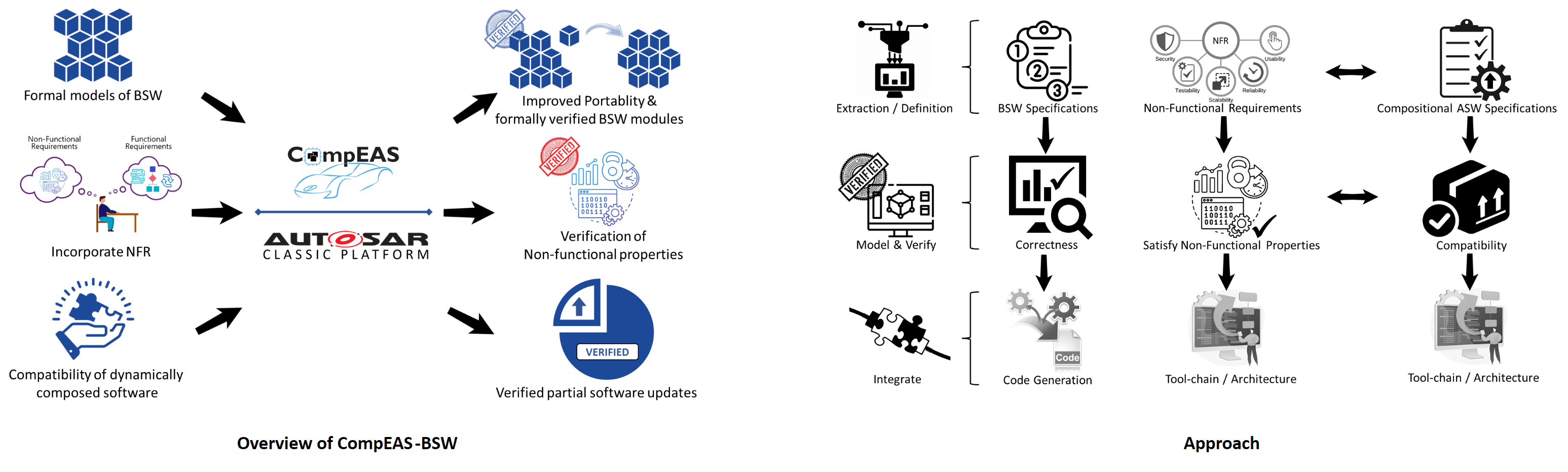
The goal of this project is to investigate reliability aspects and the dynamic composition of software and hardware of complex computer platforms or EAS over the entire system stack. Scientific methods are to be used to (1) derive concrete questions from the current industry practice, (2) develop viable solutions for the systematic realization and long-term maintenance of future EAS, and (3) transfer the knowledge gained to partner companies and established standards.
The project is about the evaluation/development of new technical concepts that are close to general research focusing on the Classic AUTOSAR environment. It focuses on Classic AUTOSAR and thereby on (1) improvements to the low-level Basic Software (BSW) layer (OS, drivers) with respect to portability and verification, (2) support for modeling of non-functional requirements (NFRs) in middleware through automatic AUTOSAR configuration/verification/code generation according to these NFRs, and (3) improvement of integration and verification of compositional application software.
Approach
The approach is to apply formal methods to model and verify embedded operating systems (OS). By analyzing common programming paradigms in embedded OS, we create consistent formalizations for hardware and software models (HW/SW), that ensure compliance with functional and non-functional requirements. Non-functional requirements (NFRs) are integrated into BSW through a "Budget Manager", which enables systematic derivation of target values that satisfy the NFRs. Implement generic NFR managers in operating systems to enable offline analysis and online management of NFRs. Improve system maintainability through runtime software updates and compatibility checks via SWC fingerprinting and algorithms, enhancing both modeling and compositional aspects of EAS.
Expected and Achieved Results
The expected outcomes of CompEAS-BSW project are:
- LongtermBSW: Concepts for model-based development of BSW with the aim of verifying models with respect to the target architectures and porting basic software largely automatically.
- GenericNFR: Concepts for the formal specification of non-functional requirements (NFR) in the sources of Application Software (ASW) with the aim of formalizing these NFRs of the BSW and enabling the BSW to comply with them at runtime.
- CompASW: Concepts for extracting NFRs and generating metadata for individual software components (SWC) of the ASW with the aim of automatically checking them for compatibility ("automatic integration" for partial changes (updates, etc.).
The publication of the project results at scientific conferences and in journals, the technology transfer to the company partner and, if necessary, the publication of concrete implementations of the results in open-source software.