
UNSUDET
This project aims to facilitate a harmonious collaboration between human expertise and AI advancements, acknowledging the growing integration of AI in various aspects of our lives. The focus of this project is to develop a range of methodologies fostering effective cooperation between humans and AI systems. This collaboration seeks to enhance the interaction between humans and machines, particularly in decision-making processes across different application scenarios. The project's goals include exploring various thematic domains, each contributing to the overarching objective of improving the synergy between humans and AI.
One of the key areas of study is the utilization of visual analytics and dashboarding tools in practical settings. The project places a strong emphasis on identifying and addressing challenges that hinder the smooth adoption of these tools. To achieve this, the project employs intelligent strategies that take into account users' existing knowledge of dashboards. Additionally, the project delves into Interaction Provenance, thoroughly investigating how users engage with Visual Analytics tools and devising methods to guide users towards seamless utilization of these tools.
Goals
The goals of the project include research into various topics, all of which contribute to the overarching goal of improving the collaboration relationship between humans and AI:
- Understanding the use of visual analytics and dashboarding tools by users and companies: The use of visual analytics and dashboarding tools has become a central aspect of modern information processing. This initiative takes an in-depth look at how users and businesses use these tools to gain insights from complex data sets. A key focus is on identifying and breaking down barriers that hinder the seamless adoption of visual analytics tools - from technological and organizational obstacles to broader environmental considerations. This effort spans a longer period of time to uncover shifts in adoption and meet the needs of various stakeholders, including data scientists and decision makers.
- Dashboard onboarding strategies: Integrating new users into the world of static or interactive dashboards is a major challenge. This project addresses the development of strategies that build on the user's existing knowledge of how to use dashboards. These strategies are carefully tailored to guide newcomers through the nuances of dashboard interaction and ensure a seamless transition into using these powerful tools.
Embedded analysis of high-dimensional data: Navigating the complexity of high-dimensional data requires innovative approaches. This project presents a comprehensive exploration of interaction provenance - an in-depth analysis of user interactions with visual analytics tools. Using dimension reduction algorithms, the project aims to extract user strategies and enable a hybrid approach that uses both topology and attribute-driven layouts. This allows users to drive the decision-making process, promoting a harmonious collaboration between human intuition and AI-driven insights.
- Uncovering visual patterns for decision-making: The inherent challenge of extracting insights from high-dimensional data is addressed by identifying visual patterns. These patterns are revealed in embedded latent spaces and provide deep insights that support decision-making processes. The project extends its reach by incorporating automated labelling strategies, improving the comprehensibility of visual patterns and reducing cognitive load.
Approach
- Understanding the use of visual analytics and dashboarding tools by users and companies: We conducted a study to understand the effects of transitioning to Microsoft Power BI within one of our industry partner’s settings. Our study included a diverse group of participants spanning various employee roles, backgrounds, skills, and experiences. A total of 19 volunteers from diverse IT and data analysis roles, with full approval from their supervisors, participated in this study. Upon analysis, two participants were excluded due to their notably different and less personalized responses during the individual interviews. Consequently, we focused our analysis on the insights gathered from 17 participant interviews. We divided the interview questions into three parts. In the first part, the interviewers introduced themselves, the research project, and the objective of the interview, clarified the compliance with data protection regulations, and asked for permission to audio record the conversation. The second stage gave the floor to the participants by first addressing general information such as their role at the company and their experiences using Power BI. More in-depth questions focused on the workers’ intrinsic motivations and problems faced when making the transition to Power BI. In the final stage of the interview, the interviewers asked the participant for any other things they wished to share, and they wrapped up the interview.
Expected and Achieved Results
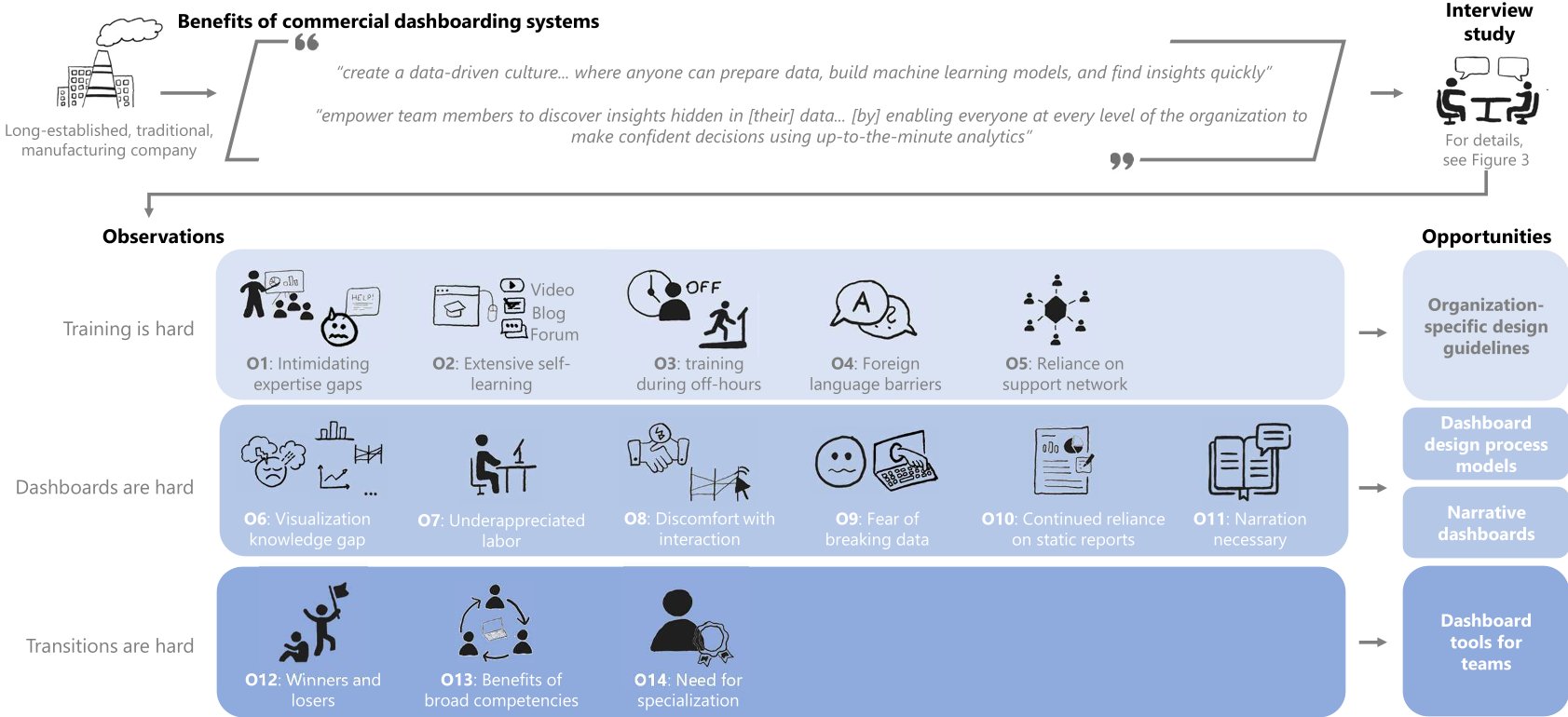
- Understanding the use of visual analytics and dashboarding tools by users and companies: Together with Prof. Miriah Meyer from Linköping University, we submitted a paper to IEEE VIS’23, titled Transitioning to a Commercial Dashboarding System. It was accepted and will be presented at the conference this year. In this paper, we report on the results of an interview study with 17 participants working in a range of roles at a long-established, traditional manufacturing company as they adopted Microsoft Power BI. The results highlight several socio-technical challenges the employees faced, including difficulties in training, using, and creating dashboards, and transitioning to a modern digital company. Based on these results, we propose a number of opportunities for both companies and visualization researchers to improve these difficult transitions, as well as opportunities for rethinking how we design dashboarding systems for real-world use.
- Dashboard onboarding strategies :This is an ongoing work in collaboration with Prof. Niklas Elmqvist, Aarhus University, Denmark. We are working on implementing strategies that leverage the work on storytelling to create impactful onboarding strategies. The project has also resulted in an MSc Thesis titled Dashboard Onboarding from a User's Perspective: Storytelling as a key to creating and improving the onboarding experience. The main goal of this work was to find a well-working programmatic solution for dashboard onboarding, which can help users to understand the dashboard, its visualizations, and its interactions.