

PREMAC
The efficiency and safety of heavy industries depend significantly on crane systems, making the condition of critical components, such as wire ropes, vital for seamless production processes. However, continuous stress, wear, and tear on wire ropes can lead to fatigue and unforeseen failures, resulting in costly downtime and safety hazards. Our ambitious project focuses on developing advanced predictive maintenance approaches for wire ropes in crane systems. Central to our strategy is the timely detection of wire break development, a crucial indicator of wire rope health. We delve into various topics, including sensor data dependencies and pattern recognition techniques, to create a robust Health Indicator (HI) that accurately reflects the wire rope's condition. Additionally, we explore the impact of factors like bending cycles and operating time on wire break development.
The primary aim of this project is to create a predictive model that estimates the remaining service life of wire ropes, enabling proactive maintenance planning and timely replacements. By implementing this model, we anticipate substantial improvements in crane system reliability, significant reduction in downtime, and enhanced worker safety.
To achieve our objectives, we thoroughly investigate sensor data dependencies and leverage pattern recognition techniques to develop an accurate Health Indicator (HI). We also analyze the relationship between wire break development and critical factors such as bending cycles and operating time. By drawing insights from these investigations, we aim to create a robust predictive maintenance model for wire ropes.
Goals
The primary objective of our project is to advance predictive maintenance approaches focusing on crane systems. By developing cutting-edge methodologies and leveraging data-driven techniques, we aim to improve the efficiency and safety of crane operations within logistics environments. A significant aspect of our research involves investigating methods to analyze large and heterogeneous datasets commonly generated in logistics operations. These datasets encompass diverse information, such as sensor data, operational logs, and maintenance records. Our goal is to develop effective data analysis techniques that can extract valuable insights and patterns, crucial for informing predictive maintenance strategies.
Central to our project is the creation of a reliable prediction model capable of estimating the remaining useful life of wire ropes in crane systems accurately. This model will utilize data-driven approaches, including machine learning algorithms and statistical methods, to forecast wire rope health and degradation with high precision.
While focusing on the development of the prediction model for Crane 220 at Kontiglühe 2 during the initial phase, we envision a transferable model that can be adapted for other cranes, contingent on the availability of relevant data. This transferability will enable wider adoption and scalability across various crane systems, contributing to industry-wide improvements in predictive maintenance practices.
Moreover, we strive to develop approaches that provide optimized recommendations for crane operation and maintenance intensity. These data-driven insights will empower crane operators and maintenance teams to make informed decisions, leading to reduced downtime, minimized maintenance costs, and enhanced overall operational efficiency.
Approach
Our approach to developing advanced predictive maintenance methodologies for wire ropes in crane systems combines the fusion of crane logistics and sensor data, change-point detection techniques, outlier removal based on domain knowledge, and the creation of a Health Index (HI) framework. Leveraging the power of deep learning and integrating domain knowledge, we aim to achieve improved accuracy and interpretability in our predictive model.
Applying change-point detection techniques, we extract cyclic data patterns from the integrated dataset. This help identifying periods of significant change in the wire rope's condition, aiding in detecting anomalies or potential degradation events. Leveraging domain expertise, we identify and remove outliers from the data. By filtering out irrelevant or noisy data points, we ensure the accuracy and reliability of subsequent analyses and predictions.
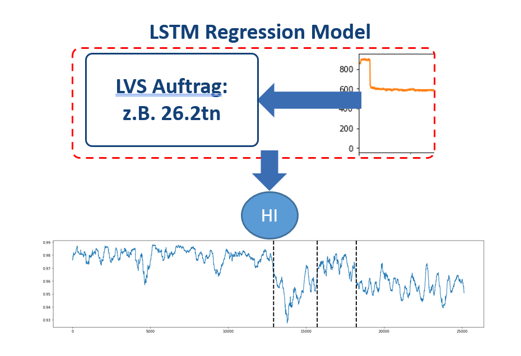
We aim to develop a novel technique for estimating the Health Index (HI) of the wire rope, leveraging Long Short-Term Memory (LSTM) deep learning architectures. LSTM models excel at capturing temporal patterns in time series data, enabling us to map these patterns to crane logistics data and wire rope degradation trends. To enhance the accuracy and interpretability of the HI, we integrate domain knowledge into the model development process. This incorporation of expertise from crane engineers and maintenance personnel provides valuable context and constraints for the predictive model.
As part of our HI framework, we implement a physics-based approach that considers wire rope efficiency. By combining data-driven techniques with fundamental physics principles, we can achieve more accurate predictions of the wire rope's condition.
To assess the effectiveness of the constructed Health Index, we evaluate it against real wire rope condition data over an extended period of more than six months, encompassing approximately 25,000 operational cycles. This rigorous evaluation demonstrates the HI's robustness and its ability to capture wire rope degradation trends effectively.
In addition to evaluating the HI's accuracy, we employ a novel causal inference-based approach to enhance its robustness and interpretability. This approach helps us identify causal relationships between various factors and the wire rope's health, providing valuable insights for maintenance planning.
Expected and Achieved Results
- Health Index estimation: The approach involves the development of a novel technique for estimating the Health Index (HI) of wire ropes in an overhead crane using LSTM Deep Learning architectures. This technique leverages the strengths of LSTM in capturing temporal patterns from time series data. To create the HI estimation model, we map the temporal patterns extracted from the time series data of the wire rope's condition to relevant logistics data. This mapping allows us to correlate the operational history of the crane with the wire rope's degradation trends. By capturing degradation trends, the LSTM model learns to identify patterns and changes in the wire rope's condition over time.
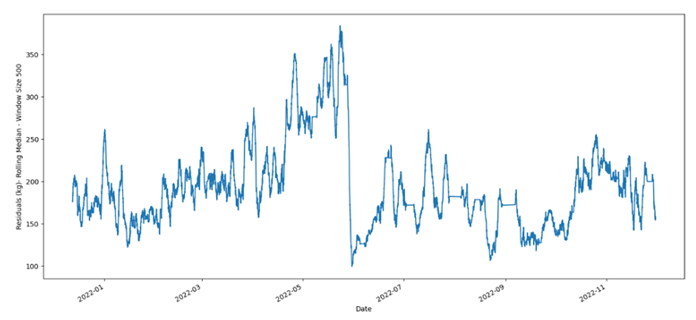
- Efficiency estimation (rope efficiency): The idea behind the efficiency estimation methods is, that the efficiency of the rope increases over a rope's life, and that this can be seen, among other things, by measuring the torque. To achieve this, a regression model is trained for a subset of the data at the beginning of the rope's life using the average torque measurements of cycles, with the avalanche weight as the target value. The model is subsequently applied to all other data and compared to the LVS weight. Residuals between estimated avalanche weight and actual value can indicate a deteriorating rope condition over a rope life.
- Causal Effect: The causal effect refers to the impact that a particular intervention has on an outcome variable. This effect is often measured by comparing the outcomes of two groups: one group that receives the intervention and another group that does not. The difference in outcomes between the two groups is then attributed to the intervention. The outcome variable is the dependent variable that is measured. It is the variable that is affected by the intervention variable and is used to evaluate the effectiveness of the intervention. The method is used to calculate the causal effect (Average treatment effect, ATE) of raising and lowering on weight sensor measurement. Differences in causal effect over time should indicate decreased rope efficiency.