

Fischer4You2
Fischer4You2 aims to assess recreational alpine skiers to find their skill level of skiing, therefore providing them with an appropriate range of alpine skiing equipment and skill recommendations. The primary motivation of this study is that alpine skiing equipment recommendations not only must be based on the general profile of skiers but also their skill level of skiing. Through this project, we will try to build a data-driven model that can evaluate skiers' skills in driving different alpine skiing techniques. Thus, Fischer4You II needs to research the interdisciplinary fields of sports science, computer science, biomechanics, and kinesiology. Further, the ultimate goal of Fischer4You II is to go beyond alpine skiing activity recognition and performance analysis and offer product and coaching recommendations based on skiers' profiles to improve their skiing experience and safety.
Austrian Skiing Association defines alpine skiing techniques as follows: Glide, Schuss, Wedging, Snowplow, Drift, Parallel Short Swing, Parallel Long Swing, Carving Long Swing, and Carving Short Swing. These techniques differ in speed, turn rate, etc. Moreover, they must be adapted depending on the skiing piste condition, which makes it hard for novice skiers to ski comfortably while performing different styles and controlling their speed at each turn. Therefore, inexperienced users are often unable to maintain their pace and body angle to make a smooth curve at turns and, as a result, lose control which causes severe injuries and accidents with other skiers. In addition, there is a direct relationship between the skiing behavior at turns, created curves, turn radius, and appropriate skiing equipment. The problem is that skiers often choose the wrong equipment, which does not fit their skiing profile. As a result, they will have a bad experience at alpine skiing and may endanger others as they cannot fully control their skis. To avoid such problems, there should be an easy-to-use system that can evaluate skiers and offer them the right skis and bindings based on their expertise. Therefore, there is a need to have an easy-to-use system that can evaluate skiers and offer them the right skis and bindings based on their expertise to prevent such problems.
Goals
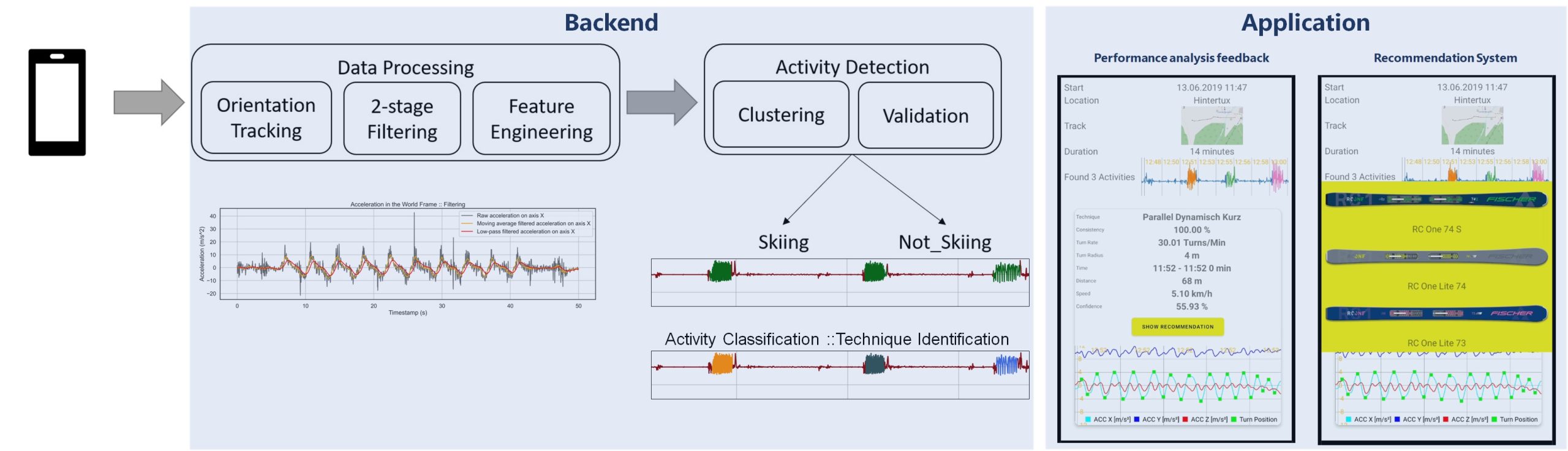
Fischer4You2 aims to recommend appropriate alpine skiing equipment based on the skill level of alpine skiers and make them aware of their expertise and level of consistency in performing different alpine skiing techniques. During the Fischer4You project, we will implement a pipeline that collects skiers' data via body-worn sensors embedded into their smartphones, processes the recorded signals to detect their skiing activities, classifies those activities into alpine skiing techniques, monitor user behavior while performing different skiing styles such as speed control and consistency and stability at each turn and acceleration/deceleration after/before each turn, and scores them to provide a level of expertise. This pipeline processes the accelerometer, gyroscope, magnetometer, and GPS signals and detects alpine skiing patterns and insights to build a skill assessment model. The model recognizes the skier’s skill from the generated patterns during skiing using machine learning algorithms, creates a skier performance profile, and assists them with feedback in the form of product and skis recommendations and technique guides.
Ultimately, this system provides users with their skiing profile, supports them to access their own driving quality and choose a proper product, and improves their skiing skills. Further, the goal is that this system runs on a central server and its assessment can be triggered by just using data coming from a mobile phone, which is also used for informing users about their skill level and an appropriate product recommendation.
Approach
The Fischer4You2's approach is to build a model based on state-of-the-art methods in sports activity detection, performance and motion analysis, activity identification/classification, and skill level recognition relying on machine learning algorithms. The Fischer4You II pipeline will gather data using IMU and GPS sensors embedded in the smartphone, preprocess recorded signals, detects and analyze alpine skiing activities, and creates a skier profile based on generated patterns. Finally, it will score skiers through a data-driven model that compares each skier with expert users' behavior and their consistency in reproducing similar patterns at consecutive turns. Subsequently, recognized skill levels fused with other general information sources, e.g., demographic information, form an input to the recommendation system to get both ski product and coaching recommendations.
Expected and Achieved Results
The main goal of the Fischer4You II is to develop a smartphone application to be used by every recreational alpine skier with any level of skiing skill. This recognition pipeline consists of the following components: (i) a sensor fusion module used to create viable sensor ensembles opportunistically as a basis for motion analysis and activity recognition, (ii) performance analysis and activity recognition models to know what each skier does and how well he is performing each technique, (iii) a data-driven model based on expert users profile to be used as a reference for skill assessment (iv) a recommendation module, able to offer the most appropriate equipment to each user, and (v) a feedback trigger module, which will formulate a ski recommendation and potentially also areas of improvements, e.g., like recommending seldom driving techniques. This framework is developed as a distributed application, with a sensing and actuating component, e.g., an application on a smartphone, and a reasoning component, e.g., implemented as a machine learning server component for recognition. For demonstration purposes, the produced application on a smartphone along with the skill assessment framework and recommendation system provides state-of-the-art user assistance to form a standalone, visual support- and guidance system for a targeted personas study and a bigger audience of skiers in the long run.