

ZEWAS
The Perfect Welding division of Fronius International offers welding devices and services to customers on five continents. Data analytics and data-driven solutions are one key aspect to excel in the welding market. In this project, maintenance welding and condition data is analyzed to detect the performed maintenance events and actions. The main objective of this project is the detection of maintenance actions based on the telemetry data collected by the welding machines. The automatic identification of maintenance events will increase the quality and amount of useful maintenance data, helping to overcome the challenge of incomplete maintenance logs posted in many data analytics applications so far. ZEWAS investigated two different approaches for maintenance event detection, one focused on template matching and one based on changepoint detection. The template matching is based on a window-based similarity search using a reference maintenance event. The distance approach used to estimate the similarity is a correlation-based approach. The second approach is based on Pruned Exact Linear Time (PELT) as a change point detection method combined with additional post filtering steps based on a mean ratio and distribution threshold analysis. As a result, we found that these approaches could help to identify maintenance events. The results of both approaches must be validated against maintenance logs. To increase the number of documented events, we analyzed data already logged by the machines, such as changes of component serial numbers, gaps in the otherwise automatically logged condition data, and compared them with the provided maintenance logs. While each of these data sources are potentially not complete, their unification helps us to identify the real maintenance events. The proposed framework based on PELT and extended by post-filtering identified different candidate events of which 75% of candidate events are validated by the maintenance logs. Moreover, the proposed framework showed a drop in the FP (False positive rate) rate of 20% when evaluating for a specific machine.

Goals
ZEWAS aims to detect maintenance events from sensor data, with a focus on changes in the wire core. The wire core is replaced when issues like wire jams occur due to wear. This complex maintenance activity takes minutes, and normal operations see rare occurrences, weeks, or months apart. Predicting wire core changes is crucial for proactive scheduling. However, finding partners with comprehensive logs for evaluation has been difficult. The objective is to detect wire core maintenance actions from welding and condition data, even with incomplete logs. Automating maintenance logs would relieve shop floor workers from manual recording burdens. In highly optimized manufacturing lines, automatic log generation is valuable, as workers lack time for manual record-keeping. Evaluating the framework requires more documented maintenance actions affecting the wire core. Domain experts suggest considering wire core and wire feed as a single component to increase documented events, though this may introduce higher variability. Nevertheless, this approach helps evaluate the system with available data.
Approach
This section presents the results of how various Machine Learning methods were applied to detect maintenance actions, e.g., the correlation-based annotation for template matching and PELT as change point detection approach. The goal of this project is to test the hypothesis that maintenance actions can be detected from condition monitoring data. Multiple sensors are integrated in each welding device to continuously monitor the components of the welding system. Various measurements such as components temperature and motor currents are collected. In addition to this automatically collected data there are also logs of maintenance actions manually documented by shop floor workers and engineers. Depending on the Fronius customer, these logs proved to be less than complete since the additional effort of meticulously keeping maintenance logs is not feasible in many shop floor environments. This led to the need for new solutions to automatically identify events in the condition data that indicate maintenance actions.
Expected and Achieved Results
Correlation-based annotation
Initially, we used the correlation-based annotation approach for maintenance event detection. This approach consisted of a simple two steps methodology. Firstly, select the relevant maintenance event that is already documented in maintenance logs as a template. Secondly, the pattern of the selected maintenance event is searched in the remaining data. To do this, the data is split up in overlapping windows of a predefined size. Any windows that have a sufficiently high similarity to the template are listed as potential candidate maintenance events. One crucial aspect concerning this approach is tuning the hyperparameters. In this case, we used GridSearch to select the relevant parameters. Moreover, this approach is univariate; therefore, the statistical features are explored and considered as input features for this model separately. One crucial advantage of this approach is the simplicity, that helps to understand and interpret results.
This approach is applied in a particular machine and only the documented maintenance logs are considered in this case. As a results 229 candidate events are identified using the mean of motor current as input feature. The main advantages of this approach are that it can identify a lot of potential candidate events and can identify already documented maintenance actions as shown in the example in Figure 1.
Change Point Detection (CPD) and post-filtering
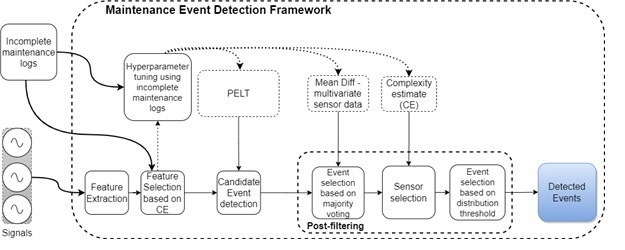
The proposed framework based on the PELT (Pruned Exact Linear Time) as its central change point detection (CPD) approach is depicted in Figure 2. The framework’s aim is to detect real maintenance events with a high sensitivity and low FP rate. In this setup, small subsets of maintenance data together with the completed condition monitoring and welding data are the input data to the framework and the outcome is the list of potential candidate maintenance evets. The framework consists of two core components, namely PELT used to detect initial potential maintenance events and a heuristic post-filtering approach aiming to reduce the FP rate in the potential maintenance events. The post-filtering methods are motivated by the fact that the most informative sensors concerning maintenance events show larger variability and higher absolute values before the performed maintenance event due to worn-out wire feed components. This can be seen in the more significant peaks and valleys of the wire feed motor current before the maintenance event.
The proposed framework had a noticeable impact on reducing the FP rate and showed promising results in detecting maintenance events, particularly with effective post-filtering, but further advancements are needed to handle complex signal changes and improve generalizability across different machines.
To examine the generative nature of our framework, we conducted evaluations using the Microsoft Azure Predictive Maintenance dataset, which is a comprehensive dataset containing sensor data, error logs, and maintenance records. This evaluation aimed to assess the framework's capability to accurately detect maintenance events by utilizing the complete and diverse information available in the dataset. The evaluation demonstrated that the framework outperformed cases with no or only one post-filtering, resulting in improved accuracy and reduced false positive rates without significant impact on sensitivity. These promising results are beneficial for applications requiring low false positive rates to gain trust and acceptance in manufacturing environments.