

A2PS
This MFP investigates models, architectures, techniques, and algorithms for increasing the flexibility and adaptability of cyber-physical production systems, specifically here adaptive assembly process systems (A2PS).
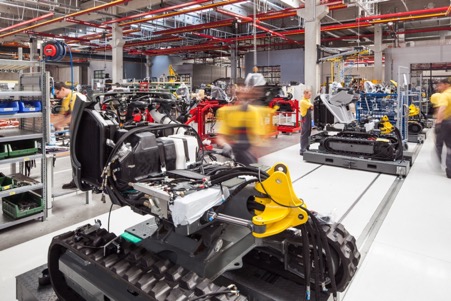
A primary concern in assembly production systems is increasing the flexibility and adaptability as companies move towards producing highly customizable products in small lot sizes at the costs of mass production. A2PS exhibits tight dependencies between work steps, their duration, input, required machines/tools/skills, product variants, product mix, and production cells/stations. Any disturbance such as missing work input, delays, or degraded resources will cascade and grow, potentially bringing production to a standstill when left unmitigated. Hence self-adaptation is a key concept to managing such complexity.
The desired flexibility often limits the applicability for full automation. On the one hand cognitive capabilities required for adaptation to unforeseen situations can (so far) only be achieved by human operators. On the other hand, programming and configuring all the necessary automation steps for each and every product variant (e.g., gripping positions and movement for robots) takes an excessive amount of time and needs to be updated often. From an economic point of view, human workers are more efficient for such tasks. Self-adaptation approaches in A2PS have to explicitly account for humans participating in the adaptation loop: not only as part of the adaptation control logic but also as the entities subject to adaptation.
In assembly lines, workers are learning and optimizing their activities from experience or from their peers. Regularly, mitigation actions become necessary to overcome micro-deviations locally. Experienced workers help out novices (e.g. an expert jumps in where ever s/he notices delays about to happen, workers reorder their tasks while they wait for a late input part to arrive). Such local optimizations by human workers are a natural way of self-adaptation at the lowest, local level. Such behavior prevents basic deviations to grow but cannot guarantee that deviations won’t cascade.
At the same time, these deviations make monitoring more difficult, as even with perfect observations available, these would not match the expected behavior. The challenge, hence, becomes obtaining an accurate picture of the current production that is robust to the above micro-deviations while remaining able to detect ‘’serious`` deviations early. Specifically, in this project we address the challenge of obtaining a reliable view on the assembly progress through modeling of prescribed assembly processes, monitoring heuristics that are robust to incomplete observations, followed by deviation detection algorithms that highlight impact of deviations.
Goals
The overall applied research-centric goal is investigating a novel approach for supporting of networks and flexible shop floors with dedicated focus on assembly processes. Concrete goals focus on (i) modeling of human-intensive assembly processes and (ii) monitoring of human-intensive assembly processes. The former aspires to obtain a model of the organizational units carrying out the assembly work (i.e., assembly stations and human workers) flexibly integrated with the assembly process steps, assembly part structures, and required tools. The requirement is to go beyond rigid, control-flow driven processes as these limit the workers’ flexibility to react to unforeseen circumstances. At the same time the goal is to allow constraints among work tasks to allow reasoning upon the assembly progress in the presence of incomplete and deviating observations. A key element in modeling and monitoring assembly work is the high amount of variability within the assembly products which needs dedicated modelling support. The later concrete goal addresses the need to establish an accurate view of the assembly line without complete, fine-grained observations.
The industry partner specific goal for Wacker Neuson and Fabasoft are obtaining a live/continuous picture of the assembly progress, respectively show case how assembly processes, product orders, and assembly progress can be managed in the cloud.
Approach
The approach is based on “Design Thinking”. Stage1 Empathize: Interviews and workshops with company partners showed the current complexity of monitoring progress on the assembly floor and involved intra-organizational logistics. Stage 2 Definition: Based on this, specific objectives of monitoring were defined and use cases were developed in which target attainment was to be measured (e.g., detecting deviations and notifying logistics department). Stage 3 Ideate: Based on a study of the state of the art and research, several architectural solutions have been identified. Stage 4 Prototype: Simple / advanced prototypes focused on the basics and iterative enhanced prototypes allow fast implementation of ideas. A first simulation of assembly processes was realized. Stage 5 test: Scientists and engineers at the industrial partner evaluate the prototype and thereby generate feedback for the previous 4 stages. The whole process is highly iterative and non-linear, feedback from each stage to previous ones is not only possible but explicitly desired.
Expected and Achieved Results
This project has two main expected results: (i) a framework for assembly process modeling, and (ii) a framework for assembly line monitoring and deviation detection. Along the lines of the former expected result, an extensible meta-model provides the basis for modeling actors (humans, stations, assembly line layout), processes (work steps and dependencies among steps), parts (the physically input of an assembly step), and resources (such as tools). A key aspect is modeling dependencies of assembly steps that are specific to a particular product feature. A first model version including cloud-based editor has been achieved. The second main expected result consists of an assembly-floor sensor integration with a cloud-based assembly tracking tool, heuristics that are able to infer from incomplete and indirect (privacy-respecting) data to the overall assembly progress (within specified boundaries), a deviation detection mechanism, and algorithm for inferring the impact of deviations in one part of the assembly process onto upcoming assembly steps as well as on subsequent process instances. A set of heuristics have been implemented that apply constraints among work steps and stations to infer additional progress information. Detecting deviations in a timely manner is of uttermost importance. One potential application of the deviation analysis and impact estimation is notifying logistic about (upcoming) changes such as delays or steps reordering. This allows to deliver the right parts at the right time to the right station even in the presence of assembly deviations. The deviation analysis can also serve as input for supporting the redesign of the assembly line by highlighting which products in their particular feature configuration and assembly production sequence were prone to deviations, thus identifying loci of improvement, ultimately making the production sequence more resilient to deviations. To attain this goal, a weekly/daily assembly dashboard has been implemented in the Fabasoft cloud updating the progress of stations and processes in a near-real-time manner and summarizing the detected deviations in different categories.