
HumanAI
Work environments, particularly within the industrial sector, are undergoing swift and dynamic technological transformations. Employees are increasingly confronted with new challenges, notably the integration of highly efficient, semi-autonomous machinery that necessitates seamless human collaboration. Presently, computer-driven methodologies and AI-based systems (centered around human interaction) in the realms of industrial research and machine advancement have been harnessed to enhance productivity and adaptability. Regrettably, the well-being of workers often takes a back seat, occasionally even being completely disregarded.
The core objective of this endeavor is to reconceptualize this paradigm and embark on an extensive research initiative aimed at exploring how the next generation of AI-based systems can significantly enhance occupational safety and prevent the occurrence of accidents.
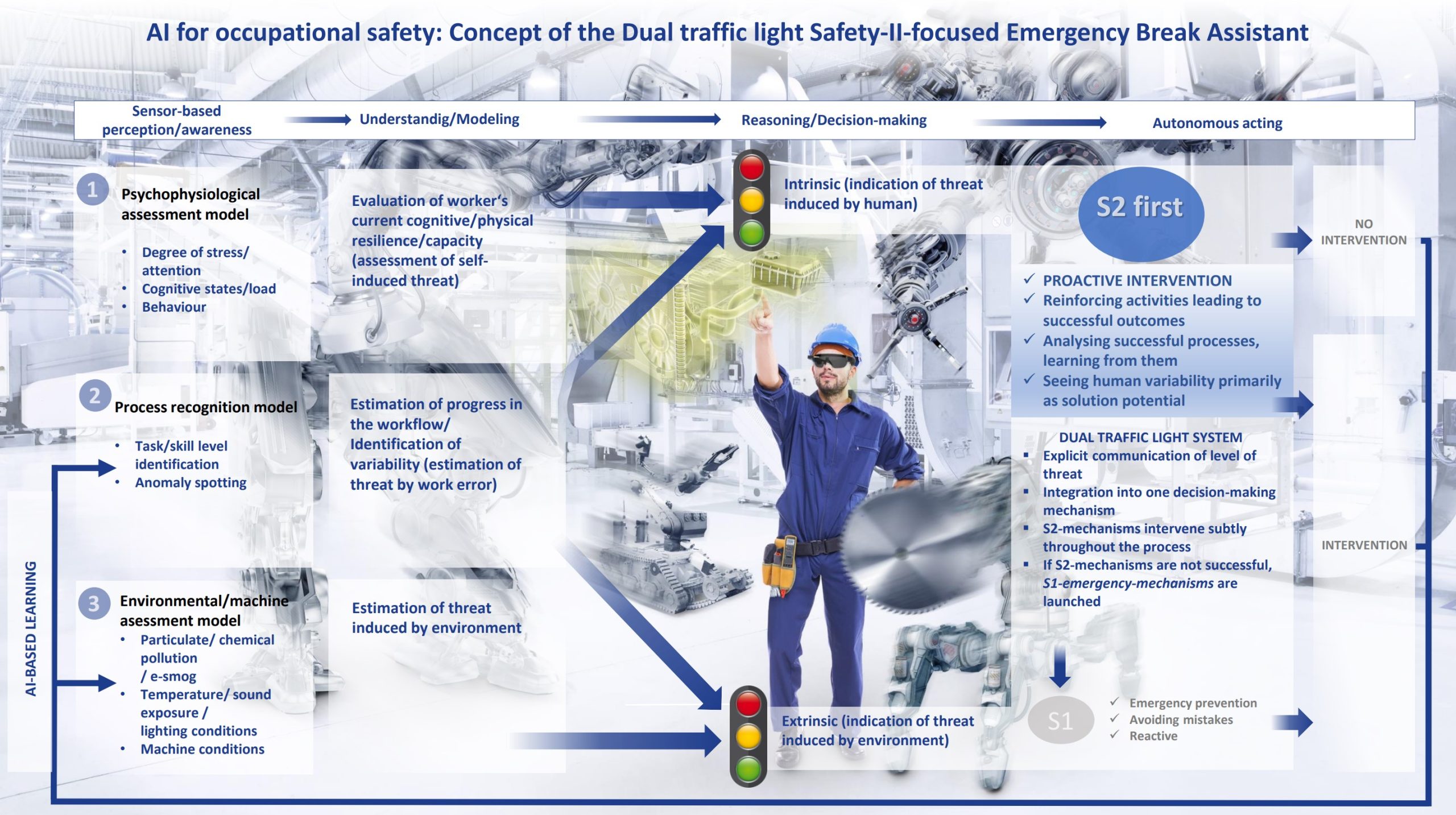
As part of this initial design study, preceding the main project, we are shaping a conceptual and technical framework for an AI cognitive system that prioritizes human safety at work and prevents accidents. This system is named the "Safety-II Emergency Break Assistant." It brings together three interconnected models: firstly, it evaluates the worker's state; secondly, it tracks the progress of the tasks; and thirdly, it analyses the working environment.
The system intelligently assesses potential risks, encompassing both those originating from human errors (intrinsic threats) and those arising from the environment or machine malfunctions (extrinsic threats). Subsequently, it employs appropriate guidance and support measures to facilitate a smooth collaboration between human operators and machines. This includes the ability to provide support and guidance to workers without disrupting their essential duties but is also able to shut down the system by means of an emergency brake if necessary.
The system is designed to continuously learn and improve its accuracy over time. This iterative process ensures that it offers practical and effective assistance while maintaining its trustworthiness. The underlying conceptual framework, combined with a systematic exploration of various sensor data collection and presentation devices aimed at enhancing occupational safety, are documented and described in a position paper, which will serve as the foundation for subsequent research.
Goals
This project initiates a broader study into how AI-powered, human-centered systems can enhance occupational safety and accident prevention, particularly in industrial settings. Our project partners' data highlights that most accidents occur in the domain of manufacturing. Therefore, we are envisioning AI solutions which address existing threats to worker safety but also additional challenges that are brought into the domain by means of constantly increasing automation.
Our primary goal is to firmly establish the concept of “HumanAI for occupational safety” in the domain of industrial research. Proposing a solution, we envisioned a comprehensive and technical framework of a holistic, multisensory, and multimodal interconnected mechanism that gathers data from workers and their environment and provides feedback not just for enhancing productivity, but mostly, safety. Our system aims to seamlessly assist workers as needed, without disrupting their workflow, and only intervenes in real-time if it detects potential dangers. The goal is to recognize workflows that lead to dangerous outcomes before accidents occur. Especially experienced workers may circumvent safety measures seen as unnecessary. Thus, we intend to design the system in such a way workers will not feel compelled to bypass the mechanisms, a common issue in real-world situations.
After anchoring the topic in the research field, we intend to use the framework as a base for the follow up project, where the concepts discussed are planned to be materialized as demonstrators.
Approach
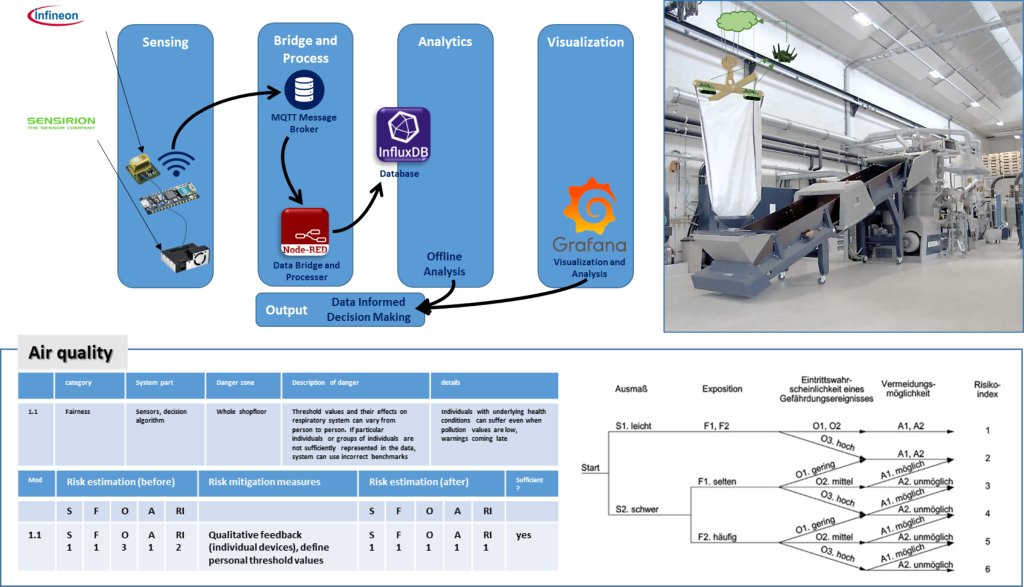
The sensory framework consists of three models, which analyze the threats initiating from those areas: (i) psychophysiological analysis, (ii) workflow recognition, and (iii) environment and machine assessment. Mobile and stationary sensors, unobtrusively deployed in the infrastructure and on the workers bodies, collect the necessary data. Model 1 monitors health and wellbeing, the attention state and stress levels. Model 2 monitors the workflow. Model 3 evaluates the environment and the machines. A dual traffic light system informs the workers of danger levels adding to the system’s transparency. An emergency brake engages only in cases of acute danger, otherwise, the system is serving with assistance. Notably, the system learns from past workflows to enhance precision.
Expected and Achieved Results
Cognitive assistance systems are most useful when based upon adequate sensors, actuators, and data processing devices. Therefore, one of the results of our work was a broad literature exploration and description of these components. We assessed their suitability for worker safety and practicality in real-world scenarios. An eye-opening takeaway was a critical underrepresentation of work safety aspects in general, as well as a lack of potential applicability of the devices for worker safety at that time, revealing a critical gap that spurred our subsequent project. Therefore, with the conceptualization of the technical framework we created an outline of the mechanism we would like to build, which we were able to use for further research and exchange with future company partners. Our emphasis here was on designing a system that does not only regard separate aspects and immediately shuts down whenever a “wrong” work step happened but can see the “whole” picture. The hypothesis behind was that dangerous situations might not arise when one aspect goes wrong, it is rather a combination of factors that might lead to unlucky outcomes. Also, there is not only one way of doing things right, but many ways that can lead to successful outcomes – considering human creativity instead of trying to eliminate it was one of our motivations. Another focus of research has been the mechanisms’ practicality and efficiency, later also trust, making it potentially useful in real-world settings. The results have been summarized and published in form of a position paper (Addressing worker safety and accident prevention with AI, Huber et al.) and presented at a conference (IoT 2023).