
RTEL
RTEL is an innovative Rail Track Error Learning AI system where in collaboration with System 7, we will analyze railroad maintenance signals prior to and after the tamping work, embed machine learning algorithms in track bed analysis, and assess the tamping work quality. Such a system will spot anomalies in the rail track prior to tamping using signal processing and provide findings on the fly to the machine operator, e.g., suspected dirty ballast. Additionally, after tamping work, the system evaluates maintenance jobs and recommends maintenance actions such as ballast replacement due to low quality.
The railway is a highly energy-efficient and environmentally friendly mode of transportation, emitting considerably fewer greenhouse gases per passenger kilometer compared to planes and cars. Therefore, it's crucial to have a high-quality maintenance system in place to maintain railway infrastructure in good condition and ensure service continuity. The most recognized rail track maintenance job is tamping the ballast, which is also necessary for the newly built tracks. Our Company partner, System7, not only does build such a machine but also offers maintenance work. The maintenance task using ballast tampers takes several hours for every kilometer of the railroad. Although the maintenance of railways using ballast tampers is well established, the tamping result is not easy to evaluate. Tamping work is the most important and expensive part of the maintenance process. Therefore, it's essential to have high-quality tamping work to fix errors and reduce costs. However, current tamping quality evaluation methods are limited. To bridge this gap, we're examining track geometry and tamping data to research all informative signals. We'll feed these signals, collected before, during, and after tamping, into machine learning models to formulate the tamping work behavior. In collaboration with System 7, our focus is on tamping result evaluation. To develop a tamping assessment system, we're going to study tamping data and investigate several machine learning models to find the best one for assessing tamping work quality.
Goals
The goal of the RTEL is to spot anomalies in railway tracks, provide online information to the operator, assess the tamping work in dealing with track errors, and recommend actions. RTEL aims to study signals before tamping and while tamping from System 7 machines sensors, i.e., the hydraulic unit, and will develop the anomaly detection mechanisms to predict and generate suggestions for further correction in a railroad. Additionally, knowing failures in the track infrastructure helps with assessing maintenance work and formulating machine behavior in addressing rail track failures.
Approach
The approach in the RTEL project is to build an AI system upon existing data collection architectures from the System 7 tamping machines. This system consists of an anomaly detection model that spots the position of the error on the railroad using signal processing, a deep Autoencoder which can learn tamping data, compress, and reconstruct them, and a deep learning model that can model tamping machine behavior and predict after tamping signals. Therefore, RTEL will find failures, locate and plot them, predict how they will be addressed, and evaluate the tamping work. This system can support decision makers to take appropriate maintenance actions or adjust the maintenance plan ranging from, e.g., not scheduling maintenance for several months or immediate replacement of ballast bed.
Expected and Achieved Results
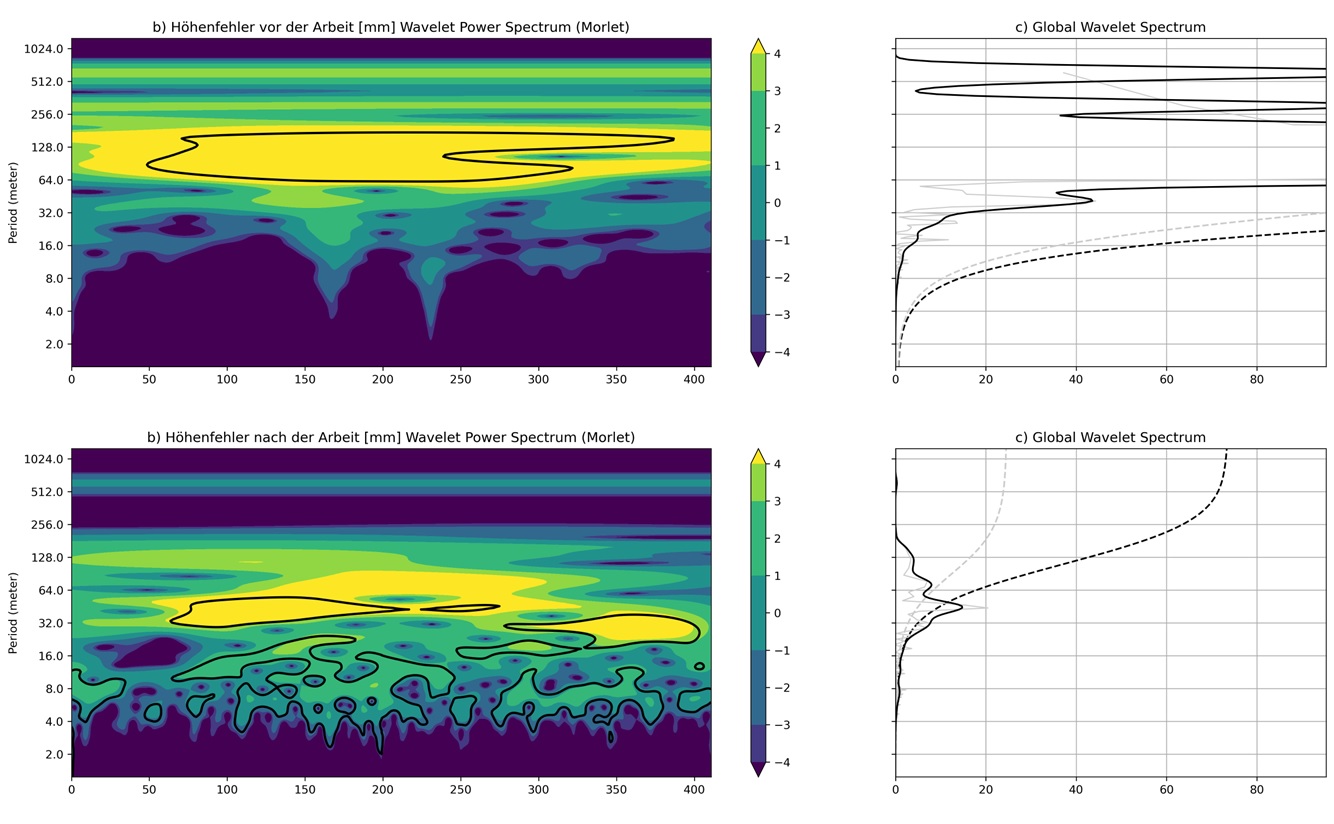
In the scope of the RTEL project, we expect to have a pipeline implemented that can detect anomalies and assess how well tamping work fixes these failures. Therefore, we must develop two main models upon data from tamping machine sensors. The first model is anomaly detection, and the second is machine behavior. We employed wavelet transform to study recorded data in the frequency domain. The output of wavelet analysis spots failures on the track before tamping and helps to identify the source of error. Then, wavelets will be fed into a deep model to learn the machine behavior in tamping. So far, we have implemented the wavelet transform report, where it is possible to compare signals before and after tamping in the frequency domain and see changes due to tamping work. System 7 has already embedded this analysis in its reporting platform. As for the data analysis, company partner System7 expects to identify the source of the error and its position based on the dominant frequencies and to be provided with scientific visualization results indicating underlying problems.
Moreover, by formulating the machine behavior, System 7 will predict the expected result of the tamping work and can evaluate the maintenance jobs. To train such a model, raw signals before and after tamping and their wavelet transformations will be fed into a deep-learning model. As a part of this model, we have already developed an Autoencoder to compress and reconstruct the prior-to-tamping signals and their related frequency bands. Such a model will facilitate the comparison between signals in their latent space. We have trained such an Autoencoder model to reconstruct tamping signals.